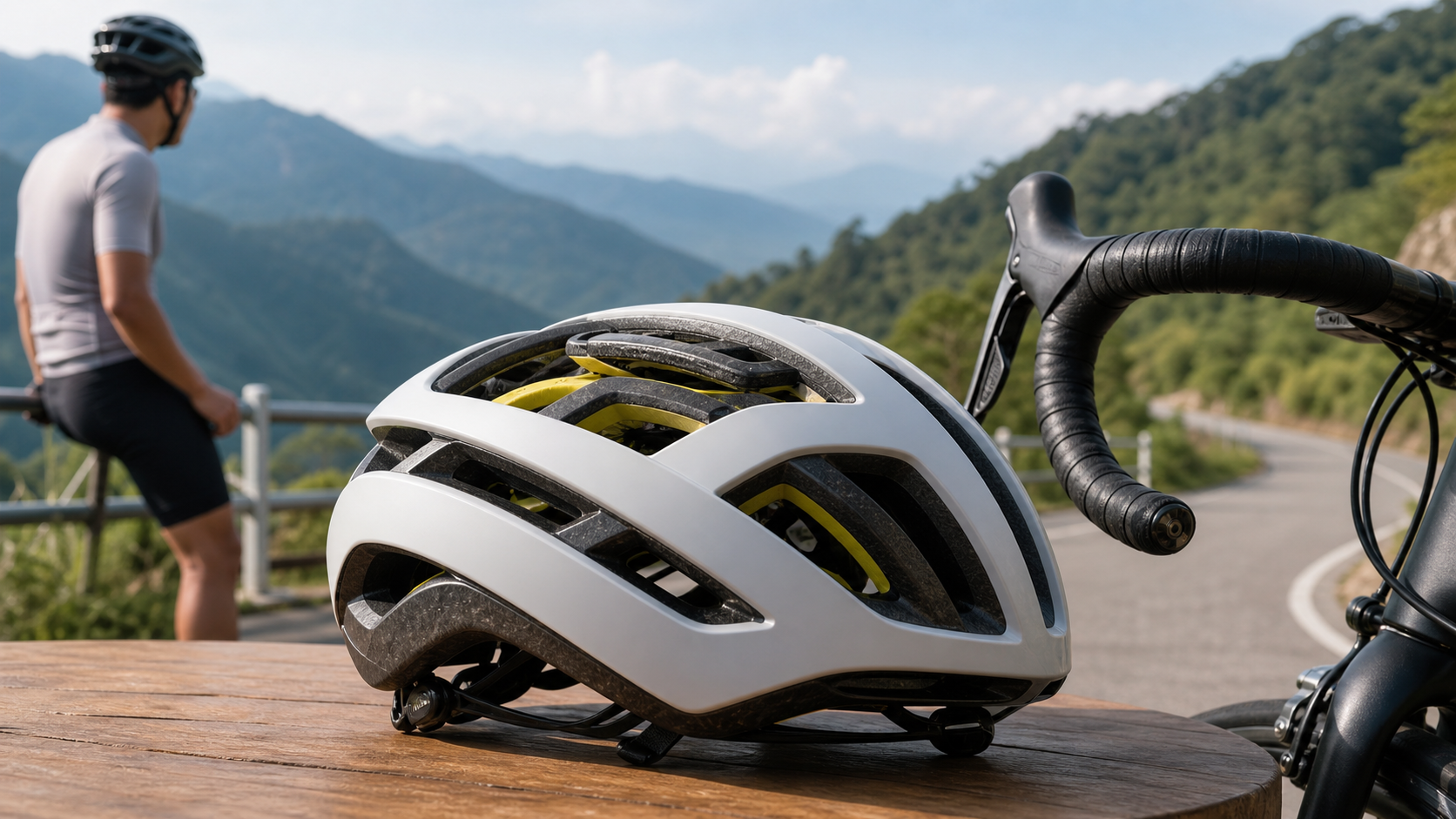
Cycling Helmet Buying Guide: Key Considerations for MIPS Technology, Ventilation Design, and Weight
A helmet is the one piece of gear a cyclist should never skimp on. But “not skimping” doesn’t mean buying the most expensive one—it means buying the “most suitable” one: properly safety-certified, matching your head shape, and capable of effectively protecting your head in your riding environment. This article systematically breaks down every aspect of helmet selection, from safety technology to ventilation design.
Safety Certifications: Standards You Should Know in Taiwan
When purchasing a helmet in Taiwan, the following certifications are basic requirements:
| Certification Standard | Origin | Testing Focus | Market Prevalence |
|---|---|---|---|
| CE EN 1078 | EU | Impact absorption, strap strength | Most common |
| CPSC | USA | Similar to EN 1078, more impact angles | Common |
| SGS / CNS | Taiwan | Complies with Taiwan Consumer Product Safety Act | Essential for local brands |
| MIPS Certification | Sweden | Rotational impact protection (add-on technology) | Mid-to-high-end models |
Every helmet should carry at least one international certification (EN 1078 or CPSC). Riding on Taiwanese roads with an uncertified helmet is not only illegal but also offers absolutely no guarantee of safety.
MIPS Technology: Invisible Protection Against Rotational Impacts
MIPS (Multi-directional Impact Protection System) is a major innovation in helmet design in recent years. Traditional helmet designs are optimized primarily for “vertical impacts,” but in real-world crashes, the head most often sustains “angled impacts,” which generate rotational acceleration of the head—the primary cause of concussions and brain injuries.
How MIPS works:
- A low-friction sliding layer is added between the helmet liner and the outer shell
- On angled impact, the inner and outer layers are allowed to slide relative to each other by approximately 10–15mm
- It can absorb roughly 10–40% of rotational impact energy
Is MIPS worth the extra cost? Most helmet safety testing organizations (such as the Virginia Tech STAR rating) show that helmets equipped with MIPS generally score higher in rotational impact tests. Taiwan’s mountain roads are steep with many curves, so the likelihood of angled impacts in a crash is not low. If your budget allows, a MIPS version deserves priority consideration.
Ventilation Design: A Key Consideration for Taiwan’s Climate
Summer temperatures in Taiwan can reach 35–38°C, and combined with the strenuous exertion of mountain climbs, a helmet’s ventilation design directly affects riding comfort and safety (overheating impairs judgment).
The trade-off between vent count and safety:
More vents mean better airflow and faster heat dissipation, but the helmet’s overall structural rigidity is relatively reduced, and the risk of edge cracking at low-speed impacts is slightly higher. Modern top-tier helmets (such as the Giro Aether and POC Ventral) achieve both high airflow and high safety through precision-engineered ventilation channel designs.
Recommendations for Taiwan riding conditions:
- Summer flat roads and climbs: choose open-style helmets with 20 or more vents
- Winter in northern mountain areas (foggy conditions): consider models with mounting slots for anti-fog visors
- Riding in the rain: some helmets feature front-edge designs that channel water away, reducing rain from flowing into the eyes
Weight: The Marginal Benefits of Lightweight Design
Race-grade carbon fiber helmets can weigh under 200g, while ordinary commuter helmets may exceed 350g. Does the head bearing this 150g difference over long periods cause neck fatigue?
The reality: For most non-racing cyclists, the difference between 220g and 280g is barely noticeable within rides of up to 3 hours. What truly affects neck fatigue is the helmet’s center-of-gravity balance and head-shape fit, not the raw weight number alone.
Practical weight recommendations:
- Leisure / daily riding: 280g or less is sufficient
- Long-distance / climbing training: noticeable benefits start below 240g
- Racing use: below 220g, paired with an aero-designed full-shell helmet
Head Shape Fit: The Most Overlooked Key Factor
The prerequisite for helmet safety is “correct wearing.” When purchasing a helmet, be sure to try it on and verify the following three points:
- Horizontal position: The helmet should sit level on top of your head, with the front edge about two finger-widths (3–4cm) above your eyebrows
- Strap adjustment: After tightening the chin strap, opening your mouth should pull the helmet slightly downward—this is an indicator of proper fastening
- Shake test: After fastening, shake your head front-to-back and side-to-side; the helmet should not shift significantly
Brand and head shape matching: European and American brands (Giro, Bell, Specialized) typically suit oval head shapes; Asian brands (OGK Kabuto, MET) offer better fit for round head shapes.
Practical Buying Checklist
Under NT$3,000: Confirm EN 1078 or CPSC certification and sufficient vent count. Briko and MET entry-level models are good choices.
NT$3,000–8,000: In this price range, you can find mid-range helmets with MIPS. The Giro Foray MIPS and Bell Formula are well-regarded options.
Above NT$8,000: Top-tier ventilation design + MIPS + lightweight construction all in one, such as the Giro Aether MIPS and POC Ventral Air MIPS.
Conclusion
A helmet is not a buy-once-and-forget piece of gear—even without a crash, the EPS foam material degrades over time, so it’s recommended to replace your helmet every three to five years. After any crash, regardless of whether the exterior looks intact, the helmet should be replaced immediately, as the interior has already absorbed one impact’s energy. Taiwan’s riding environment is complex, and a certified helmet with MIPS protection and good ventilation is the most worthwhile safety investment you can make.
Related Reading
- Comprehensive Cycling Helmet Review: The Balance of Aero, Ventilation, and Lightweight
- Cycling Helmet Buying Guide: MIPS Technology and Safety Certification Explained
- Choosing a Safe Road Bike Helmet: MIPS, WG11 and Other Safety Certifications Explained
- Cycling Helmet Aerodynamics: The Design Trade-off Between Ventilation and Low Wind Resistance
Vision Metron RS 37碳幅條輪組 (非SL)官網沒有的 低調開箱 / 這重量太銷魂了 / 公路車 / CT Yeh
6 個月前
再快都跟的上!? 單車跟隨攝影機之王 HOVERAir X1 PROMAX 全面實測 / 唯一!8K畫質&自行車專用模式和跟蹤信標&前後避障 / DJI Neo 可參考/ 公路車 / CT Yeh
1 年前
多到選擇障礙... 換個單車把帶想一個小時 / BTP / 編織&軟木特有材質超吸睛! / 公路車 / CT Yeh
1 年前
入門車錶王者 iGPSPORT BSC100S 一千元的售價! 超大螢幕、連續兩趟北高的續航、藝術般的APP! Bryton Garmin 兩王地位撼動? | 公路車 | CT Yeh
3 年前
Nepest NOVA 碳條輪組:輕量、空力、舒適一次滿足!/ 公路車 / CT Yeh
7 個月前
鉅齒紋輪組!? ControlTech MEG-T50 EVO 碳纖維幅條輪組/ 功率對比實驗 / 公路車 / CT Yeh
2 年前
再一組! 全碳幅條 碟煞/無內胎輪組 開箱! 到底好騎嗎? UNAAS X40 | 公路車 | CT Yeh
4 年前
車錶新黑馬? / 超狂續航 / 超好用錶冠 / 無敵準定位 / Dash圖表合成!?/ COROS DURA 評測!/ 公路車 / CT Yeh
2 年前