Second-Hand Bike Buying Guide: How to Spot Carbon Fiber Cracks and Component Wear
In Taiwan’s second-hand bike market (PTT, Facebook groups, Shopee), a carbon fiber road bike originally priced at NT$150,000 may sell for NT$30,000–40,000. For those on a budget who still want a quality ride, this is a tempting opportunity. But the risks of buying used are real—especially the invisible damage to carbon fiber frames, which could lead to a sudden frame failure during a high-speed descent, causing a serious accident.
The Right Mindset Before Buying a Used Bike
No used bike is “perfect”—every bike shows signs of wear to varying degrees. The key is distinguishing between “normal wear” and “safety hazards.” The checklist below is ordered by importance. Print it out or take a screenshot before viewing a bike, and go through each item one by one.
1. Identifying Damage on Carbon Fiber Frames
Carbon fiber damage is the hardest to assess and the most dangerous item in a used-bike purchase.
Visual Inspection (basic, but not sufficient):
| Inspection Area | Signs of Damage | Risk Level |
|---|---|---|
| Top tube / down tube joints | Paint cracks, white stress lines | High |
| Bottom bracket (BB shell) area | Paint crazing, creaking noises | High |
| Chainstays | Impact marks, dents | High |
| Fork crown | Transverse cracks (most common damage point from a crash) | Extremely High |
| Seat tube opening | Longitudinal cracks (caused by over-tightening) | Medium–High |
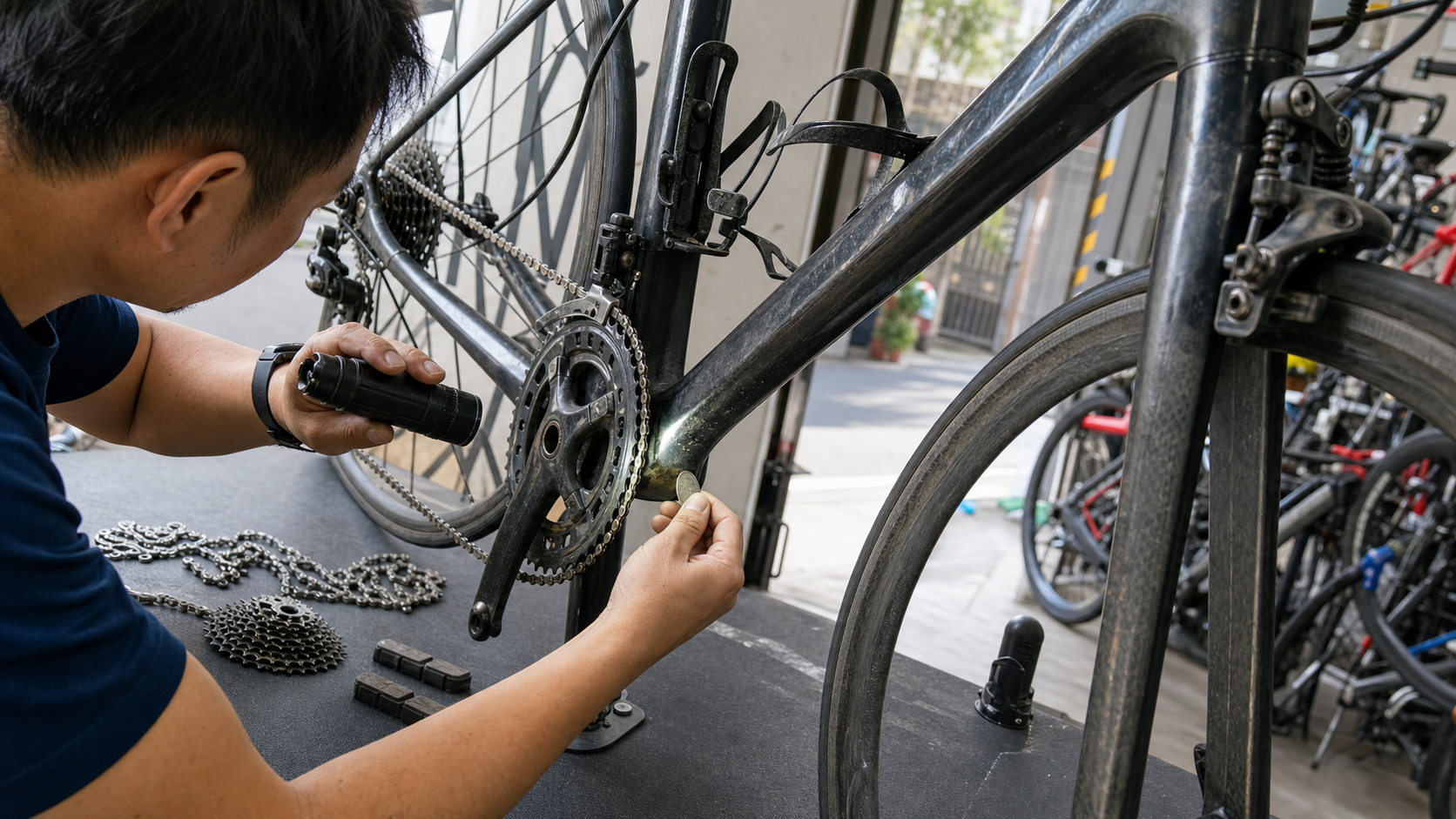
Tap Test (with a coin or key): Lightly tap various parts of the frame with a coin. A healthy carbon frame produces a crisp “tok-tok” sound; a dull “thud” indicates possible delamination damage in that area. This test is simple and effective, but requires some experience to interpret.
The Importance of White Streaks: After an impact, broken internal carbon fibers appear as white, translucent streaks due to light refraction—easiest to spot on dark-colored frames. If you see any white streaks, walk away from the purchase immediately, or ask the seller to have the frame ultrasonically tested at a professional workshop.
Special Attention to the Fork: The fork is the highest-risk component on a used bike, because it takes the brunt of a crash and internal damage is nearly impossible to detect visually. For a used carbon bike, it’s recommended to replace the fork with a new carbon one (around NT$3,000–8,000 on the market) or opt for an aluminum fork instead to ensure safety.
2. Checking Aluminum Frames
Damage on aluminum frames is much easier to spot visually than on carbon:
- Weld joints: Check for cracks or obvious chips in the weld beads, especially at the bottom bracket and chainstay welds
- Dents and bends: Visually inspect the straight sections of the frame from the front and side to check for obvious bending
- Corrosion: Taiwan’s humid climate means you should check moisture-prone areas (bottom of the head tube, inside the bottom bracket) for rust
3. Drivetrain Wear Inspection
Chain wear: Use a chain wear indicator tool (around NT$200–400) to measure chain stretch:
- Below 0.5%: Good, keep riding
- 0.5–0.75%: Moderate wear, consider replacing
- Above 0.75%: Severe wear—when replacing the chain, the cassette must also be replaced
If the chain is severely worn, a new chain may “skip” on the old cassette, because the old sprocket teeth have already worn to match the stretched chain’s shape.
Cassette tooth profile: Check the most-used sprockets (usually the middle ones). If the teeth look like “shark fins” (worn at an angle on one side), they need replacing. Prices range from NT$1,500–5,000 depending on the number of teeth.
Front and rear derailleurs: Lightly press the derailleurs to check spring tension—weak tension means the spring has fatigued and needs replacing. Also check the derailleur bodies for cracked plastic parts (common after a crash).
4. Brake System Inspection
Rim Brakes:
- Check whether the wear indicator line on the brake pads is still visible
- Check that the brake arms are symmetrical (equal gap on both sides)
- Check brake cables for rust or fraying
Disc Brakes:
- Rotor thickness: measure with a caliper—new rotors are about 2.0mm; replace if worn below 1.5mm
- Rotor trueness: lightly press the rotor with your finger to check for obvious warping (a bent rotor causes a rubbing sound)
- Brake fluid: check hydraulic hoses for leaks and the lever feel for sponginess (indicating the system needs bleeding)
5. Wheelset and Tire Inspection
Spoke tension: Lightly pluck the spokes with your finger—tension should be roughly even on the same side. If some spokes are noticeably loose, the rim is under uneven stress and may be at risk of collapse.
Rim trueness: Spin the wheel or place it on a flat surface—if the rim wobbles more than 3–4mm, it needs truing.
Tire wear: Check the tread wear indicators in the center of the tire (most brands have them). If the wear line has disappeared, replace the tire immediately—old tires are far more prone to flats.
6. The Necessity of a Full Test Ride
No matter how thorough your static inspection, nothing beats a complete test ride. During the ride, pay attention to:
- Smooth shifting: Run through every gear combination to confirm there’s no chain skipping or missed shifts
- Brake feel: Confirm the brake engagement point feels right with no sponginess
- Frame creaks: Listen for any “creaking” sounds while pedaling (could indicate a loose BB or carbon friction noise)
- Head tube/stem play: With the bike stationary, hold the brake levers and rock the handlebars to check for headset looseness
Estimating a Fair Price for a Used Bike
General formula (for reference only):
- Under one year, pristine condition: 60–70% of original price
- Two to three years, normal riding: 40–50% of original price
- Four years or more, or needing parts replacement: 20–35% of original price
Negotiation tip: List all parts that need replacing with their estimated costs and deduct them from your offer—this is the most reasonable bargaining strategy.
Conclusion
The used market carries risk, but also opportunity. Systematically working through every inspection step above, searching for owner reviews of the same model in Taiwan cycling groups, and insisting on inspecting the frame carefully in outdoor or well-lit conditions—these habits will dramatically reduce your chances of getting a lemon. If you have any doubts about the frame’s condition, spending NT$500–1,000 for a full inspection at a professional bike shop is far cheaper than the cost of repairs—or injuries—down the road.
Related Reading
2025 自行車錶排行榜 兩萬車友大數據 / Garmin Bryton 排名會大洗牌嗎? / 全新的碼表前身分析 /公路車 / CT Yeh
1 年前
Canyon 公路車斷把手 五年老車特規還能修嗎? 維修保養全記錄 feat. 501單車監理站 | 公路車 | CT Yeh
4 年前
碟煞公路車 銑面器 !? 原來銑完差這麼多! 降低蹭碟機率! | TIME 公路車 保養小記錄 | CT Yeh
3 年前
再一組! 全碳幅條 碟煞/無內胎輪組 開箱! 到底好騎嗎? UNAAS X40 | 公路車 | CT Yeh
4 年前
多到選擇障礙... 換個單車把帶想一個小時 / BTP / 編織&軟木特有材質超吸睛! / 公路車 / CT Yeh
1 年前
2022 前十五大自行車錶 !? 兩萬名車友大數據統計 | 你的上榜了嗎? | 菁英車友都用哪些錶? | Bryton Garmin 誰能拔得頭籌?| 車錶推薦 | 公路車 CT Yeh
4 年前
高雄綠園道鐵路自行車道 / 外地人能輕鬆駕馭 還是整路崩潰? / 2025 全線開通 春節實地探索一次!(附GPS連結)/ 公路車 / CT Yeh
1 年前
單車 一日北高 ( 雙城 ) 肥宅雙人瘋狂行 紀錄片 REACTO
10 年前