Swimming and Lumbar Spine Health: Analyzing the Causes of Butterfly-Related Lower Back Pain and Complete Core-Strengthening Countermeasures
Swimming and Lumbar Spine Health: Analyzing the Causes of Butterfly-Related Lower Back Pain and Complete Core-Strengthening Countermeasures
Introduction
Among the four competitive swimming strokes, butterfly is the most visually striking — the body undulates in a graceful, dolphin-like wave. Behind this beautiful movement, however, lies enormous stress on the lumbar spine. Studies show that roughly 20–38% of swimmers have experienced lower back pain, and butterfly is the most frequently cited culprit.
Even freestyle and backstroke swimmers can develop lower back discomfort after long-distance swimming if their core muscles are insufficiently trained. This article explores the relationship between swimming and lumbar spine health, and offers concrete, actionable improvement strategies.
The Anatomical Basis of the Lumbar Spine
The lumbar spine (L1–L5) bears the greatest load of any section of the spine, and normally has a forward curve (lumbar lordosis). Intervertebral discs sit between adjacent vertebrae, acting as cushions.
The core muscles — including the multifidus, transverse abdominis, internal and external obliques, and erector spinae — act as a natural “back brace” for the lumbar spine, maintaining a neutral spinal position during dynamic movement and preventing excessive flexion or extension.
Biomechanical Causes of Butterfly-Related Lower Back Pain
Repetitive Lumbar Hyperextension
The undulating motion of butterfly requires the lumbar spine to repeatedly cycle through:
- Head clearing the water → lumbar hyperextension
- After the pull → lumbar flexion
At roughly 50 arm-pull cycles per minute, a single 200-meter butterfly set (about 4 minutes) subjects the lumbar spine to more than 200 repeated flexion-extension stresses. If the core muscles lack the strength to control this range of motion, the posterior wall of the intervertebral discs bears excessive pressure.
Tight Hip Flexors
Modern swimmers who sit for long periods — especially students and office workers — often have overly tight iliopsoas (hip flexor) muscles. When initiating the butterfly kick, tight hip flexors force the lumbar spine to compensate with excessive lordosis, increasing lumbar stress.
Uneven Kick Power Distribution
The butterfly kick should originate primarily from the hips, but many beginners rely too heavily on knee-driven kicking. This concentrates the undulating motion in the lower back rather than distributing it across the whole spine, subjecting the lumbar region to greater localized shear force.
| Type of Lower Back Pain | Possible Cause | Common Symptoms |
|---|---|---|
| Central lower back pain | Increased disc pressure | Dull ache after prolonged swimming, worsens when bending forward |
| Pain on both sides of the lower back | Erector spinae fatigue or muscle strain | Immediate pain, improves with rest |
| Radiating pain (sciatica) | Disc herniation compressing a nerve | Pain extending to the buttocks or legs; requires medical attention |
| Tenderness over the spinous processes | Irritation of the lumbar facet joints | Worsens with extension movements |
Self-Assessment: Is Your Core Strong Enough?
Try the following simple tests to assess your core stability:
1. Plank Test
- Hold a standard plank and time how long you can maintain it before your pelvis begins to sag
- Reference standard: adults should be able to hold for 60+ seconds; swimmers are recommended to aim for 90+ seconds
2. Prone Superman
- Lie face down and simultaneously lift the opposite arm and leg, holding for 10 seconds
- If discomfort appears immediately in the lower back, this indicates significant weakness in the erector spinae and multifidus
3. Standing Lumbar Lordosis Assessment
- Stand with your back against a wall; the gap behind your lower back should fit one flat hand but not more than a closed fist
- An excessive gap indicates excessive lumbar lordosis and possibly tight hip flexors
Core-Strengthening Training Program (For Swimmers)
Perform the following program 3 times per week, either after swimming training or as a standalone session.
Phase 1: Activating the Deep Core (Weeks 1–2)
- Diaphragmatic breathing: Lying on your back, inhale through the nose to expand the abdomen, then exhale while gently contracting the abdomen (without holding your breath), 10 reps × 3 sets
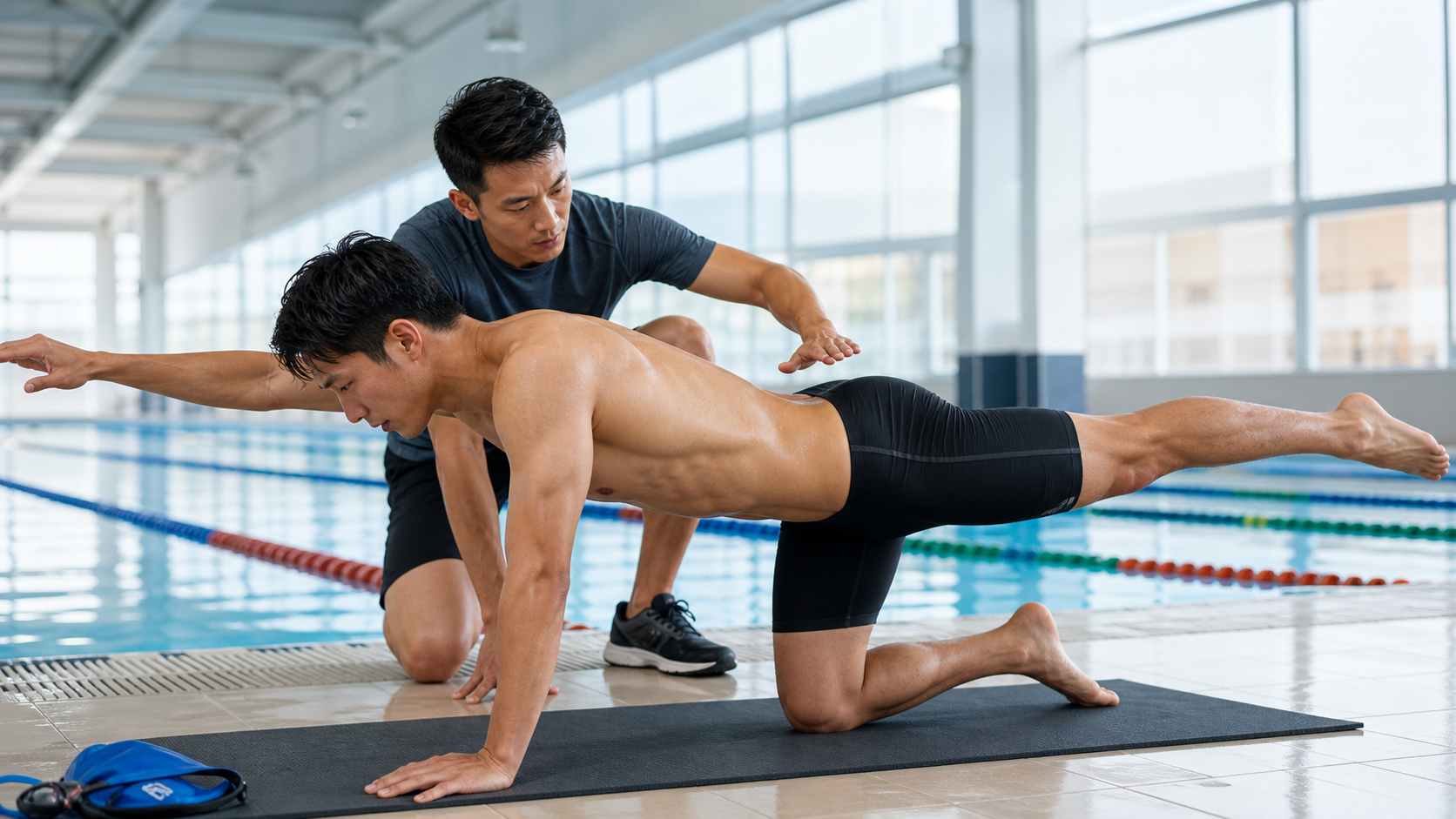
- Transverse abdominis activation: On hands and knees, slowly lift one leg to parallel with the ground while maintaining a neutral spine, 10 reps/side × 3 sets
- Glute bridge: Lying on your back with knees bent, lift the hips until the thighs and torso form a straight line, hold for 2 seconds, 15 reps × 3 sets
Phase 2: Dynamic Stability Strengthening (Weeks 3–4)
- Dead bug: Lying on your back, extend the arm and opposite leg simultaneously while keeping the lower back flat on the ground throughout, 10 reps/side × 3 sets
- Bird dog: On hands and knees, extend the opposite arm and leg simultaneously and hold for 3 seconds, 10 reps/side × 3 sets
- Side plank: Lie on your side and support your body on your forearm and the side of your foot, holding for 30 seconds/side × 3 sets
Phase 3: Functional Integration (From Week 5)
- RDL (Romanian deadlift, single-leg): Standing on one leg, maintain a neutral spine as the torso hinges forward, training the integration of glute strength and lumbar stability
- Pallof press: Using a resistance band, press the handle straight out with both hands while resisting rotational force, strengthening anti-rotational core stability
Improving Hip Flexor Flexibility
- Low-lunge hip flexor stretch: With the back knee on the ground and the front foot planted, push the pelvis forward and hold for 30 seconds/side × 3 sets
- Lizard pose stretch: With the front foot planted and the back leg fully extended, gradually deepen the stretch and hold for 45 seconds/side
- Perform daily after swimming to help redistribute the force generation of the butterfly kick
Key Points for Correcting Butterfly Technique
- Initiate the kick from the hips: Imagine the spine as a single rod during the kick — the motion should travel from head to toe like a dolphin, rather than bending only at the lower back
- Control how high the head clears the water: The head should only rise enough for the mouth to breathe; rising too high forces greater lumbar extension
- Reduce kick amplitude: Beginners often kick with excessive amplitude; it is recommended to keep the kick within shoulder width
Practical Recommendations
- Switch to freestyle or backstroke during periods of lower back pain: Both strokes place less repetitive extension stress on the lumbar spine
- Thoroughly mobilize the lumbar spine before swimming: Perform cat-cow stretches and pelvic circles, 10 reps each
- If lower back pain persists beyond 2 weeks without improvement: Seek diagnosis from a rehabilitation medicine or orthopedic physician to rule out disc herniation
- Control training volume: Beginner butterfly swimmers should keep butterfly distance to no more than 20% of total training volume
- Use a kickboard for assistance: When practicing butterfly kick, using a kickboard allows you to strengthen kick technique specifically without adding extra load to the lumbar spine
Conclusion
Lumbar spine health is the long-term foundation for enjoying swimming. The beauty of butterfly comes from coordinated integration of the whole body, not from the lumbar spine fighting alone. Through systematic core-strengthening training, improved hip flexor flexibility, and fine-tuned technique corrections, most swimmers can significantly reduce or even eliminate swimming-related lower back pain. Remember: a strong core doesn’t just help you swim farther — it also lets you age gracefully in the water.
Related Reading
- Swimming-Related Lower Back Pain: Lower Back Stress from the Butterfly Wave Motion and Countermeasures
- Lumbar Stress in Swimming: Lower Back Protection Strategies for Butterfly and Backstroke
- Swimming-Related Lower Back Pain: Identifying Excessive Arching Posture and a Core Training Prescription
- Breaststroke and Butterfly Lower Back Protection: How to Avoid Back Injury from Undulating Strokes
一日北高/長距離團騎 常見問題補充篇 / 組團或跟團的眉角 / 壯車友容易被瘦車友慢性拉爆 / 原來屁股痛可能是這個原因...? / 風場配速法 / 公路車 / CT Yeh
2 年前
[教學] Premiere 影片 手震 修正 教學 防抖 單眼 影像 GoPro 穩定 Video Stabilization
8 年前
一日北高常見問題大集合 | 攻略 | 路線 | 訓練 | 補給 | 自行車 單車 | 一日雙城 | 雙塔 | TWB北高360 | 屁股痛
6 年前
西進武嶺 自製新版AI配速表產生器 x 賽前攻略 抱佛腳! 沒有功率計也可以產生配速表嗎?有什麼其他眉角賽前要注意的呢? | 西進武嶺 / 東進武嶺 KOM 攻略 | 公路車 | CT Yeh
4 年前
抖肩舞 台灣x日本交流版 (台灣 vs 前橋) 赤城山登山賽 coincidance
8 年前
Nepest NOVA 碳條輪組:輕量、空力、舒適一次滿足!/ 公路車 / CT Yeh
7 個月前
Never Stop 西進武嶺 前後雙機 完整全程錄影 訓練台 實境
8 年前
西進武嶺 免費訓練分析服務 Intervals | 練不夠還是練過頭?你哪一種類型選手?AI模型告訴你! | 備戰神器 | 公路車 訓練 | CT Yeh
4 年前