The Complete Guide to Children's Swimming Milestones: Skill Development and Safety Instruction from Ages 3 to 12
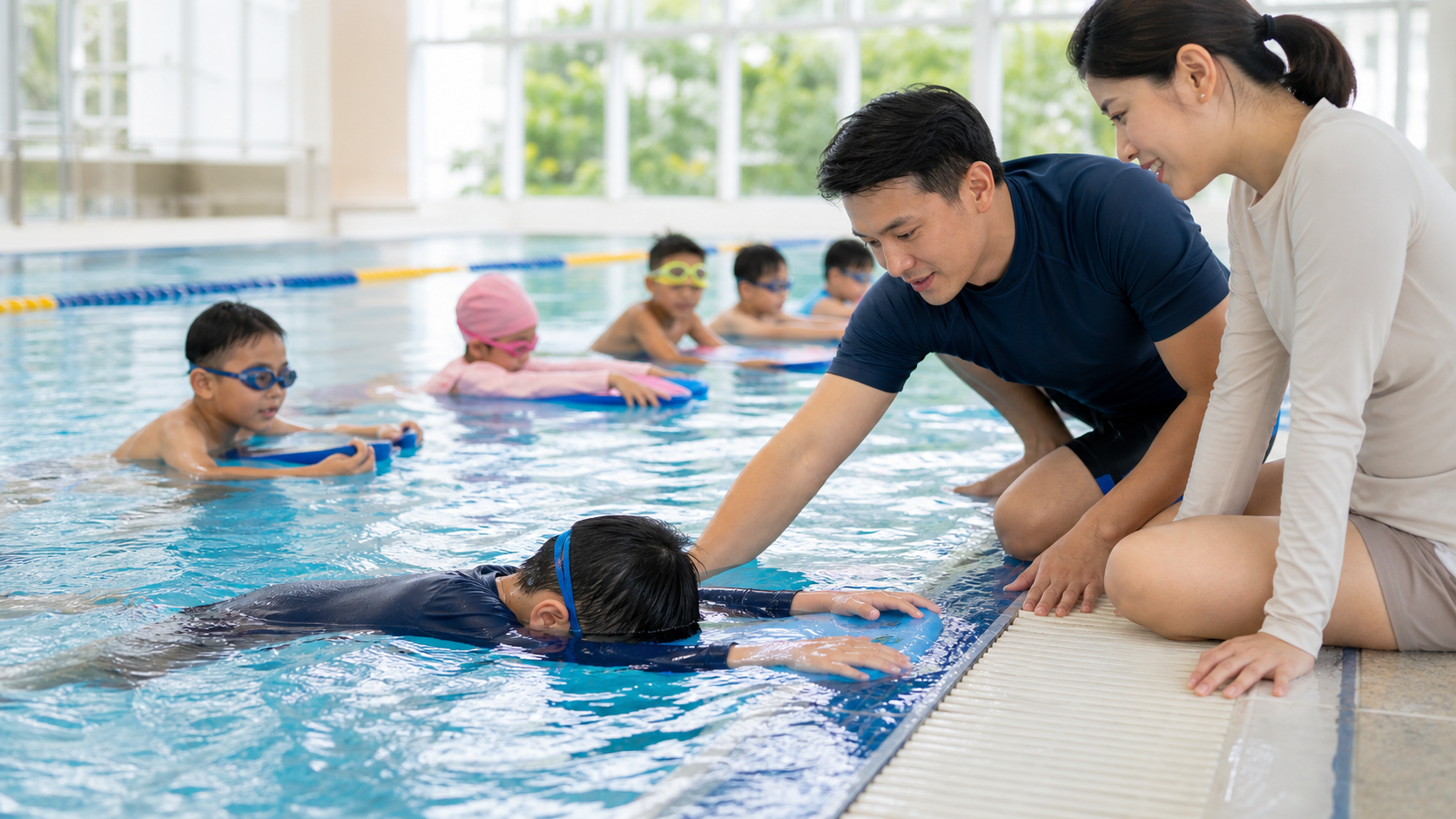
The Complete Guide to Children’s Swimming Milestones: Skill Development and Safety Instruction from Ages 3 to 12
Introduction
Children and teenagers make up a significant proportion of drowning deaths in Taiwan each year, which is why swimming is a fundamental life-safety skill. But the benefits of swimming for children go far beyond safety—it is a whole-body activity that promotes neurological development, builds physical coordination, and cultivates confidence and resilience.
Even so, “What is the best age to start learning to swim?” and “What standard should each age reach?” remain common questions for parents. Based on theories of child motor development and swim-teaching research, this article provides clear milestone guidance for each stage from ages 3 to 12.
The Foundation of Children’s Swim Learning: Readiness Assessment
Before starting formal swim lessons, the following indicators can help assess a child’s readiness:
- Cognitive understanding: Able to understand and follow simple 2–3 step instructions
- Emotional regulation: Relatively stable in unfamiliar environments, without immediately breaking down upon contact with water
- Physical coordination: Able to run, jump, and balance on one foot for a few seconds
- Toilet training: Basic toilet training completed (a pool hygiene requirement)
Most children have this basic readiness by ages 3–4.
Swimming Milestones by Age Group
Ages 3–4: Water-Sense Exploration Stage
Developmental characteristics:
- Growing self-awareness, which may bring on fear of water
- Gross motor coordination is still developing
- Short attention span (lessons capped at 30 minutes each)
Milestone goals:
- Able to float in the water with assistance (face-down or face-up)
- Able to submerge the face in water and blow bubbles (the most important early skill)
- Able to hold the pool edge and walk or jump in shallow water
- Beginning to grasp the rhythm concept of “big-mouth breathing”
Teaching notes:
- Parent-and-child classes work best, with a parent in the water providing a sense of security
- Playful teaching: “blow away the monster in the water” → practicing exhaling
- Never force a child’s head under water—this can cause lasting fear of water
Ages 5–6: Emerging Technique Stage
Developmental characteristics:
- Fine motor coordination is improving rapidly
- Able to accept more explicit technical instruction
- Beginning to independently complete sequences of movements in water
Milestone goals:
| Skill | Standard description | Tips if struggling |
|---|---|---|
| Face-down float | Float face-down for 5 seconds without holding the edge | Practice floating with a kickboard first |
| Kicking | Kick forward 10 meters while holding a kickboard | Practice kicking while lying at the pool edge |
| Breathing basics | Rhythm of exhaling with face in water → lifting head to inhale | Practice repeatedly while standing in shallow water |
| Turning in water | Able to roll from face-down to face-up in the water | Practice paired with storytelling scenarios |
| Jumping in from the pool edge | Stand at the pool edge and jump into shallow water (with an adult present) | Practice sliding into the water from a seated position first |
Ages 7–8: Technique Integration Stage
Developmental characteristics:
- Nervous system development greatly improves motor coordination
- Able to coordinate arm and leg movements together with breathing
- Beginning to have the stamina and attention span for longer lessons (45–60 minutes)
Milestone goals:
- Able to swim freestyle 25 meters independently (including breathing)
- Able to swim backstroke 25 meters independently
- Foundational breaststroke kick established
- Able to jump into deep water and swim back to the pool edge
- Learning self-rescue floating after jumping into water (treading water for 30 seconds)
Technical focus:
- Freestyle breathing: emphasizing “rotating the head to breathe” rather than “lifting the head to breathe” can greatly improve movement efficiency
- Arm pull: the concept of an S-shaped entry path can be introduced starting at this age
Ages 9–10: Technique Refinement Stage
Developmental characteristics:
- Logical thinking ability strengthens, enabling understanding of technical principles
- Emerging competitive awareness, suitable for introducing timing and goal-setting
- Stamina and muscular coordination approaching adolescent levels
Milestone goals:
- Able to complete 25 meters in all four strokes (butterfly can be at a basic level)
- Freestyle 50-meter time target: under 60 seconds for boys, under 65 seconds for girls (a reference standard, not a strict rule)
- Learning pool turn technique (freestyle flip turn)
- Water self-rescue: able to stay afloat in deep water for 2 minutes
Ages 11–12: Systematic Training Stage
Developmental characteristics:
- The stage before puberty is a “golden window” for technical learning
- Able to understand and accept structured training plans
- Can assess interest and potential for competitive swimming
Milestone goals:
- Complete and efficient technique in all four strokes
- Able to complete a 200-meter individual medley (50 meters of each stroke)
- Master turn techniques for each stroke
- Concept of swim training planning: understanding the differences between aerobic base training, technique sets, and speed sets
A Guide for Parents: Do the Right Things, Avoid the Wrong Ones
What you should do:
- After swim class, ask your child “what was the most fun part today,” rather than “what technique did you learn”
- Praise effort and process, not just results: “You kept practicing your breathing today, I could see you working hard”
- Make sure your child stays hydrated (swimming still causes dehydration) and has a snack after class
- Help your child build a regular habit of drying their ears after class
What you should not do:
- Shout instructions from the poolside, interfering with the coach’s teaching
- Compare your child’s progress with classmates
- Put pressure on a child for slow progress
- Force a child who is afraid of water into contact with water—discuss a gradual strategy with the coach instead
Frequently Asked Questions
Q: My child is still very afraid of water at age 4. Is this normal?
A: Completely normal. Fear of water is very common among children and can usually be overcome through a gradual “desensitization” process. The key is to never force it, and instead let the child approach the water at their own pace.
Q: What is the best age to learn butterfly stroke?
A: It’s recommended to wait until after ages 8–9 to start learning butterfly, by which point the shoulders and core muscles have sufficient strength. Forcing butterfly too early can easily cause shoulder injury.
Q: How long does it take to learn to swim?
A: Defining “learning to swim” as being able to swim 25 meters independently, most children aged 6–7 can reach this standard after 30–40 lessons of systematic instruction. However, individual differences are large, so there’s no need to worry.
Practical Recommendations
- Choose a certified swim instructor: Confirm the instructor holds certification from the Sports Administration or a related body
- Control class size: No more than 4 children per class for ages 3–6, no more than 6–8 for ages 7 and up
- Appropriate water temperature: Children’s pool water temperature should be around 29–32°C; water that is too cold will make children tense and shorten the effective lesson time
- Keep a swimming log: Record each milestone your child achieves, so they can see their own progress over time
Conclusion
For a child, swimming is not just a sports skill—it’s a gift that benefits them for a lifetime. Every child who overcomes fear in the water is building courage to face challenges; every extra meter covered in the water is a small victory of self-improvement. As a parent, your most important role isn’t to push, but to support—letting your child know that no matter how slowly or quickly they swim, you are proud of them.
Related Reading
- The Complete Guide to Kids Learning to Swim: Stage-by-Stage Lesson Plans for Ages 6, 8, and 12
- The Best Age for Children to Learn Swimming: The Science Behind Skill Development at Each Stage
- The Best Age and Course Selection for Children’s Swimming: The State of Swim Education in Taiwan
- Designing a Children’s Swimming Curriculum: Balancing Technical Learning and Fitness Building for Ages 6–12
滑雪新手們慘摔學習全紀錄(請開字幕),滑雪好好玩 | Snowboard + Ski | 岩原 スキー場 | 滑雪APP使用 | GoPro Max
6 年前
西進武嶺 免費訓練分析服務 Intervals | 練不夠還是練過頭?你哪一種類型選手?AI模型告訴你! | 備戰神器 | 公路車 訓練 | CT Yeh
4 年前
一日北高常見問題大集合 | 攻略 | 路線 | 訓練 | 補給 | 自行車 單車 | 一日雙城 | 雙塔 | TWB北高360 | 屁股痛
6 年前
Live) 備戰2019彰化經典百K 賽前攻略 (已完賽請看新影片
7 年前
FTL 與 SYB 車隊專訪 西進武嶺 實用攻略分享! 2小時 如何練?!你不知道的眉角!新手準備武嶺必看 EP1 | 實力派女車友 | 精華版 | 公路車 | CTYeh
4 年前
2023桃園團體繞圈賽 / 海鷗繞圈賽 | 全程空拍數據版 | 公路車 | CT Yeh
2 年前
教學) 如何做出專業 慢動作 影片 Slow Motion 120fps GoPro 7 ActionCam AX700 A99II
7 年前
CT 喇低賽) 武嶺牽車 才是王道 西進牽車四小時內秘訣 攝手位置 如何判斷 防抽筋小秘訣
7 年前