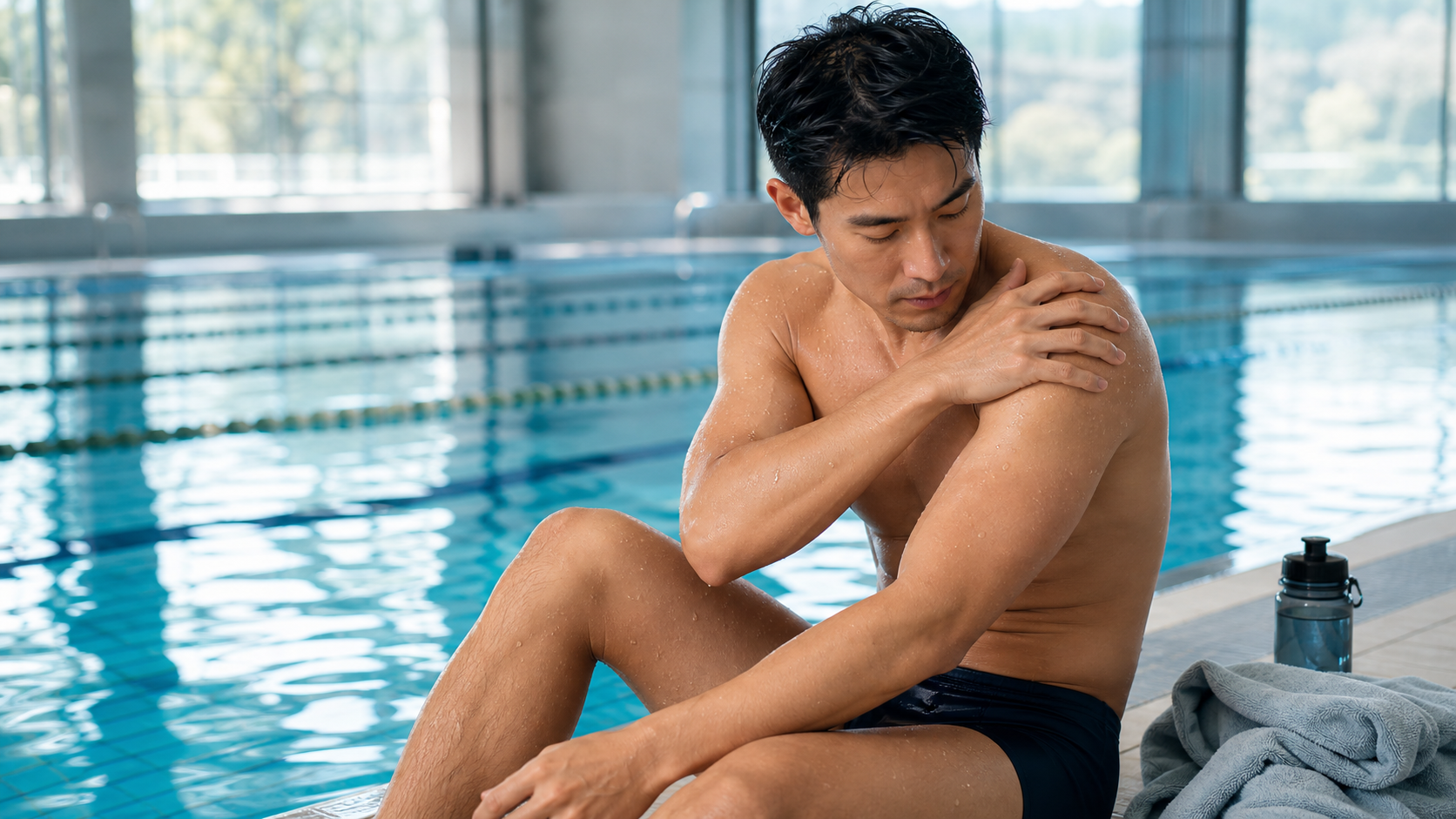
Managing Post-Swim Muscle Soreness: A Complete Swimming-Specific Guide to DOMS
Introduction
Many swimmers discover the hard way, the morning after their first serious swim session, that they can barely lift their arms, their shoulders hurt at the slightest touch, and their core muscles are staging a full protest. This is Delayed Onset Muscle Soreness (DOMS) — a type of muscle discomfort that peaks 24 to 72 hours after intense or unfamiliar exercise.
Swimming-induced DOMS has its own specific character. Because water resistance is distributed evenly and comes from multiple directions, the muscle groups affected — and the way to manage the soreness — differ from land-based sports like running.
What Causes Swimming DOMS: The Micro-Trauma Theory
The primary cause of DOMS is micro-trauma to muscle fibers generated during eccentric contraction. In swimming, the following movements are especially likely to trigger DOMS:
| Movement | Main Muscles Involved | Common Pain Locations |
|---|---|---|
| Freestyle pull (eccentric control) | Latissimus dorsi, posterior deltoid | Back of the armpit, upper back |
| High-elbow catch (eccentric control) | Rotator cuff, biceps | Front of the shoulder |
| Kicking (direction changes) | Quadriceps, hamstrings | Front and back of the thigh |
| Core stabilization for horizontal body position | Transverse abdominis, multifidus | Both sides of the lower back |
| Breaststroke kick (external rotation) | Gluteus medius, hip adductors | Groin, hip |
The main differences between swimming DOMS and running DOMS are:
- No gravitational impact: Kicking works the muscles but involves no ground-strike impact, so lower-body DOMS is usually milder than after running
- Upper body soreness is more pronounced: The eccentric loading that pulling motions place on the upper body is rarely experienced in daily life, so beginners or swimmers returning after a break often feel the most soreness in their arms and shoulders
- Core DOMS is underestimated: Core muscle fatigue after long-distance swims is often overlooked, but it can contribute to lower back discomfort
The DOMS Timeline and Natural Recovery
Understanding the DOMS timeline helps with planning your training schedule:
- 0–6 hours: Mild muscle fatigue, usually not very noticeable
- 24–48 hours: Soreness peaks, most noticeable when the muscle is pressed
- 48–72 hours: The most uncomfortable period for most people
- 72–96 hours: Soreness begins to naturally subside
- 5–7 days: Full recovery (assuming no other injury)
Important note: DOMS is a normal adaptive response and does not mean you have overtrained. However, if soreness persists beyond 7 days or is accompanied by localized redness, swelling, or heat, see a doctor to rule out a muscle tear or other injury.
Immediate Recovery Strategies (Right After Swimming)
Cool-Down Swim
The most effective immediate recovery method.
- Add 5–10 minutes of very easy swimming at the end of every session
- Intensity: should feel “very easy,” bringing your heart rate down to within 20–30% of your resting heart rate
- Stroke choice: backstroke or whichever stroke feels most comfortable
- Purpose: promotes blood circulation to help clear metabolic waste and reduce muscle tightness
Post-Swim Static Stretching
After swimming, take advantage of your muscles still being warm to stretch:
Key stretches (hold each for 30 seconds x 2 sets):
- Latissimus dorsi: overhead arm reach with a side bend
- Chest: doorway stretch or a backward chest-opening stretch
- Front of thigh (quadriceps): standing heel-to-glute stretch
- Back of thigh (hamstrings): standing forward fold
- Calves: standing lunge (Achilles tendon stretch)
- Neck: slow side bends and rotations
Recovery-Phase Strategies (12–48 Hours After Swimming)
Active Recovery
Research shows that low-intensity aerobic activity speeds up DOMS recovery better than complete rest.
Recommended options:
- An easy 20–30 minute walk or jog
- 20 minutes on a stationary bike (light resistance)
- Yoga or Pilates (non-intense)
- A light 500–800m swim if soreness isn’t severe (easy swimming during a DOMS period is safe and can actually aid recovery)
Contrast Water Therapy
A recovery tool widely used by professional swimmers and triathletes:
| Method | Temperature | Duration | Notes |
|---|---|---|---|
| Cold water immersion | 10–15°C | 1–2 minutes | Constricts blood vessels, reduces inflammation |
| Hot water immersion | 38–40°C | 1–2 minutes | Dilates blood vessels, promotes blood flow |
| Number of cycles | — | 3–5 cycles | End with cold water |
At home in Taiwan, you can use a bathtub or shower to alternate hot and cold water instead of full immersion — slightly less effective, but still helpful.
Caution: People with heart conditions, pregnant women, and those with unstable blood pressure should avoid extreme-temperature contrast water therapy.
Nutrition Strategy: Accelerating Recovery from the Inside Out
Protein
- Consume 20–30 grams of protein within 30 minutes of finishing your swim to kick-start muscle repair
- Good sources: eggs (about 7g each), unsweetened soy milk (about 8g per 250mL), chicken breast (about 30g per 100g)
Anti-Inflammatory Foods
- Curcumin (turmeric/curry): Multiple studies show it can reduce the severity of DOMS
- Omega-3 fatty acids (fish, walnuts): Help suppress the inflammatory response
- Dark berries (blueberries, cranberries): Anthocyanins provide antioxidant effects
Hydration
- Swimming still causes dehydration (swimmers often don’t notice they’re thirsty)
- After swimming, replace roughly 500–750mL of water per kilogram of body weight lost
- Adding a small amount of electrolytes (such as coconut water or an electrolyte drink) can improve muscle recovery
Preventing Excessive DOMS in Your Training Plan
- Progressive overload: Increase weekly training volume by no more than 10% at a time, giving muscles time to adapt
- Recovery after high-intensity training: Allow 24–48 hours of recovery after interval sessions or long-distance training
- Introduce new movements carefully: When learning a new stroke (especially butterfly), start with short distances and low intensity
- Sleep: 7–9 hours of quality sleep per night is the cheapest and most effective recovery tool available
Practical Tips
- You can still swim easily during DOMS: As long as the intensity is low enough, swimming won’t worsen DOMS — it can actually help recovery
- Avoid relying on painkillers as a training aid: NSAIDs (such as ibuprofen) may interfere with the muscle adaptation process
- Foam rolling: Slowly rolling over sore muscle groups can help promote blood circulation (avoid rolling directly over bony areas)
- Distinguishing DOMS from injury: DOMS is a symmetric, diffuse soreness across an entire muscle, not a sharp, localized pain at a single point; if it’s the latter, seek medical evaluation
Conclusion
Post-swim muscle soreness is a sign that your body is getting stronger — not something to fear. Learning to work with DOMS and building an effective recovery routine is an important skill for any advancing swimmer. Proper recovery not only gets you back in the pool faster, it also ensures every training session builds on an even stronger foundation, helping you sustain a long and continually improving swimming career.
Related Reading
[教學] Premiere 影片 手震 修正 教學 防抖 單眼 影像 GoPro 穩定 Video Stabilization
8 年前
一日北高/長距離團騎 常見問題補充篇 / 組團或跟團的眉角 / 壯車友容易被瘦車友慢性拉爆 / 原來屁股痛可能是這個原因...? / 風場配速法 / 公路車 / CT Yeh
2 年前
一起升級!海鷗盃LSD團練...JJSC Zone2招待 騎到手抖 / 公路車 / CT Yeh
1 天前
一日北高常見問題大集合 | 攻略 | 路線 | 訓練 | 補給 | 自行車 單車 | 一日雙城 | 雙塔 | TWB北高360 | 屁股痛
6 年前
西進武嶺 免費訓練分析服務 Intervals | 練不夠還是練過頭?你哪一種類型選手?AI模型告訴你! | 備戰神器 | 公路車 訓練 | CT Yeh
4 年前
教學) 如何做出專業 慢動作 影片 Slow Motion 120fps GoPro 7 ActionCam AX700 A99II
7 年前
#KOM 夏季登山王之路 比賽實況 #東進武嶺
7 年前
DJI Osmo Action 5 Pro 首發最強!單車運動攝影機! 一顆電池錄完KOM 西進武嶺? / 超狂夜拍效果 / 4奈米AI晶片/ 一鍵數據合成 / 公路車 / CT Yeh
1 年前