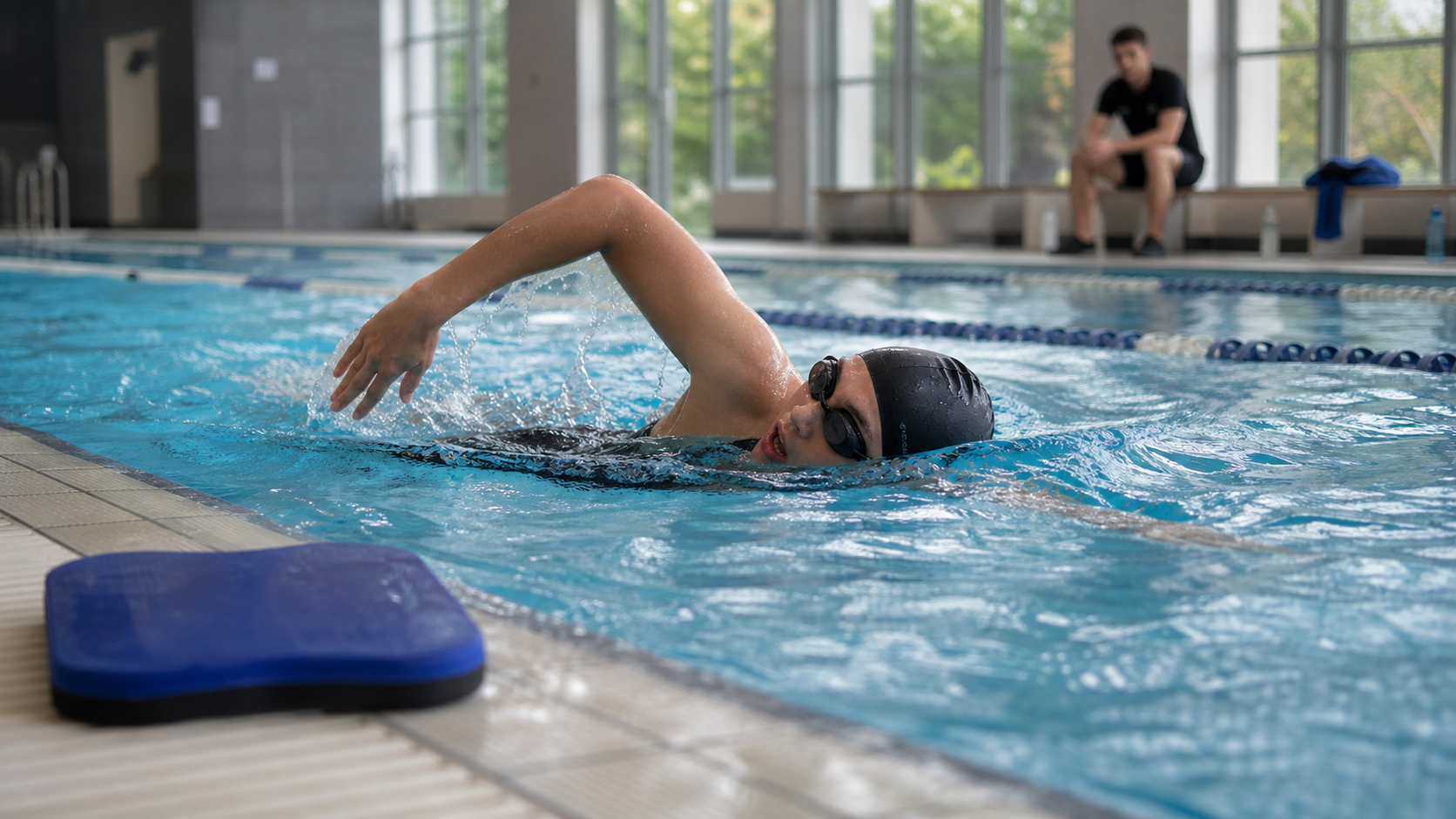
Starting with the First Pool Length
On the first day you step into the pool, many people’s goal is simple: swim one lap without choking on water. This seemingly modest goal actually encompasses three major challenges: breathing control, buoyancy management, and muscle coordination. The core philosophy of the 12-week plan is “accumulating successful experiences,” allowing the body to gradually build swimming motor memory and cardiovascular adaptation in a low-pressure environment.
This plan is suitable for complete beginners or those who can move in the water but cannot swim more than 50 meters continuously. Train 3 times per week, 45–60 minutes per session, focusing primarily on freestyle, supplemented with appropriate kicking drills.
12-Week Training Periodization Overview
| Week | Primary Goal | Longest Single Distance | Weekly Volume |
|---|---|---|---|
| 1–2 | Build water feel and breathing rhythm | 50m (2×25m) | 200–400m |
| 3–4 | Stabilize continuous 50m swim | 100m (2×50m) | 500–700m |
| 5–6 | Progress to continuous 200m | 200m | 800–1000m |
| 7–8 | Build 300m endurance | 300m | 1200–1500m |
| 9–10 | Break through the 500m barrier | 500m | 1500–2000m |
| 11–12 | Achieve the 1000m goal | 1000m | 2000–2500m |
Weeks 1–4: Building the Foundation
Breathing is the top priority. The most common problem for beginners is holding their breath while swimming, which leads to exhaustion before reaching 50 meters. The correct approach is to exhale slowly and continuously in the water (through nose or mouth), and only inhale when turning the head, breathing once every 3–4 arm strokes.
- Before each practice, spend 5 minutes in the shallow end doing “hold-and-exhale drills”: submerge your face and exhale slowly until empty, then lift your head
- Use a kickboard for 25m kicking drills, focusing on relaxing the ankles and avoiding excessive knee bending
- Accumulate distance using a “swim 25m → rest 30 seconds” interval format, without chasing continuous swimming
- Spend the final 10 minutes of each session stretching, with emphasis on the shoulders, hip flexors, and hamstrings
In weeks 3–4, begin attempting to swim 50m without stopping. If you need to grab the wall mid-way, don’t put psychological pressure on yourself—this is a completely normal part of the learning process.
Weeks 5–8: Building Continuous Swimming Ability
The key at this stage is “slow down to sustain distance.” Many beginners accumulate lactate because they swim too fast; in reality, simply reducing speed by 20% can potentially double your endurance.
A simple way to gauge appropriate pace: If you can “deliberately” pay attention to your stroke technique while swimming, that’s the right speed; if you’re only focused on survival, you’re going too fast.
- In week 5, introduce the “goldfish workout”: 50m × 4 sets with 45 seconds rest between sets, noticing how your stroke count changes each set
- In week 6, attempt 100m without stopping, using a “fast 30 seconds, slow 30 seconds” pacing method
- In weeks 7–8, use a timer and swim 300m at the slowest pace you can maintain
- It’s recommended to schedule 1 technique session per week, using a pull buoy to focus on upper-body stroke mechanics
Weeks 9–12: Sprinting Toward the Kilometer Goal
By week 9, most people can swim 300–400m continuously without stopping. The training focus for the final 4 weeks is “getting used to the monotony of long distances” and “finding your own rhythm.”
Practical tips:
- Break the 1000m into 4×250m or 2×500m segments, giving yourself 60 seconds of rest between each, then gradually shorten the rest time
- Record your 100m split times each session and observe whether the second half slows down noticeably (a signal that endurance needs improvement)
- Before swimming 1000m continuously, it’s recommended to complete the same distance in a “non-continuous” format first to confirm you have enough energy
- Set the 3rd training session of week 12 as “Challenge Day”: attempt 1000m continuously, focusing on completion rather than speed
Conclusion
12 weeks sounds long, but for swimming—a sport that demands extremely high muscle coordination—this is only the beginning. The moment you complete 1000m continuously, you’ll realize this is not just a victory of physical stamina, but a milestone of your body learning to “relax in the water.” From here, you now have the foundation to enter intermediate training, and more interesting workouts are waiting for you.
Related Reading
- Swimming Beginner’s 12-Week Progressive Plan: From 25 Meters to Swimming 1000m Continuously
- Swimming Beginner’s 8-Week Introductory Training Plan: From 25m to 1000m Continuous Swimming
- Swimming Beginner 12-Week Plan: Progressive Workout from 25m Non-Stop to 1500m Continuous Swimming
- Swimming 4-Week Beginner Plan: The First Step for Complete Novices
西進武嶺 免費訓練分析服務 Intervals | 練不夠還是練過頭?你哪一種類型選手?AI模型告訴你! | 備戰神器 | 公路車 訓練 | CT Yeh
4 年前
live) 超越北高 之一日北高12小時 策略
7 年前
一日北高常見問題大集合 | 攻略 | 路線 | 訓練 | 補給 | 自行車 單車 | 一日雙城 | 雙塔 | TWB北高360 | 屁股痛
6 年前
半日 小台灣 極限單車路線挑戰實錄
7 年前
FTL 與 SYB 車隊專訪 西進武嶺 實用攻略分享! 2小時 如何練?!你不知道的眉角!新手準備武嶺必看 EP1 | 實力派女車友 | 精華版 | 公路車 | CTYeh
4 年前
一日北高前的高裝檢 | 北高 360 | 挑戰11小時的裝備 | 一日雙塔 | 補給
6 年前
實景訓練台) 彰化經典百K 高強度喵團 90分鐘 跟著一起練功 2019 Indoor workout Changhua Classic 100 Taiwan
7 年前
Live) 備戰2019彰化經典百K 賽前攻略 (已完賽請看新影片
7 年前