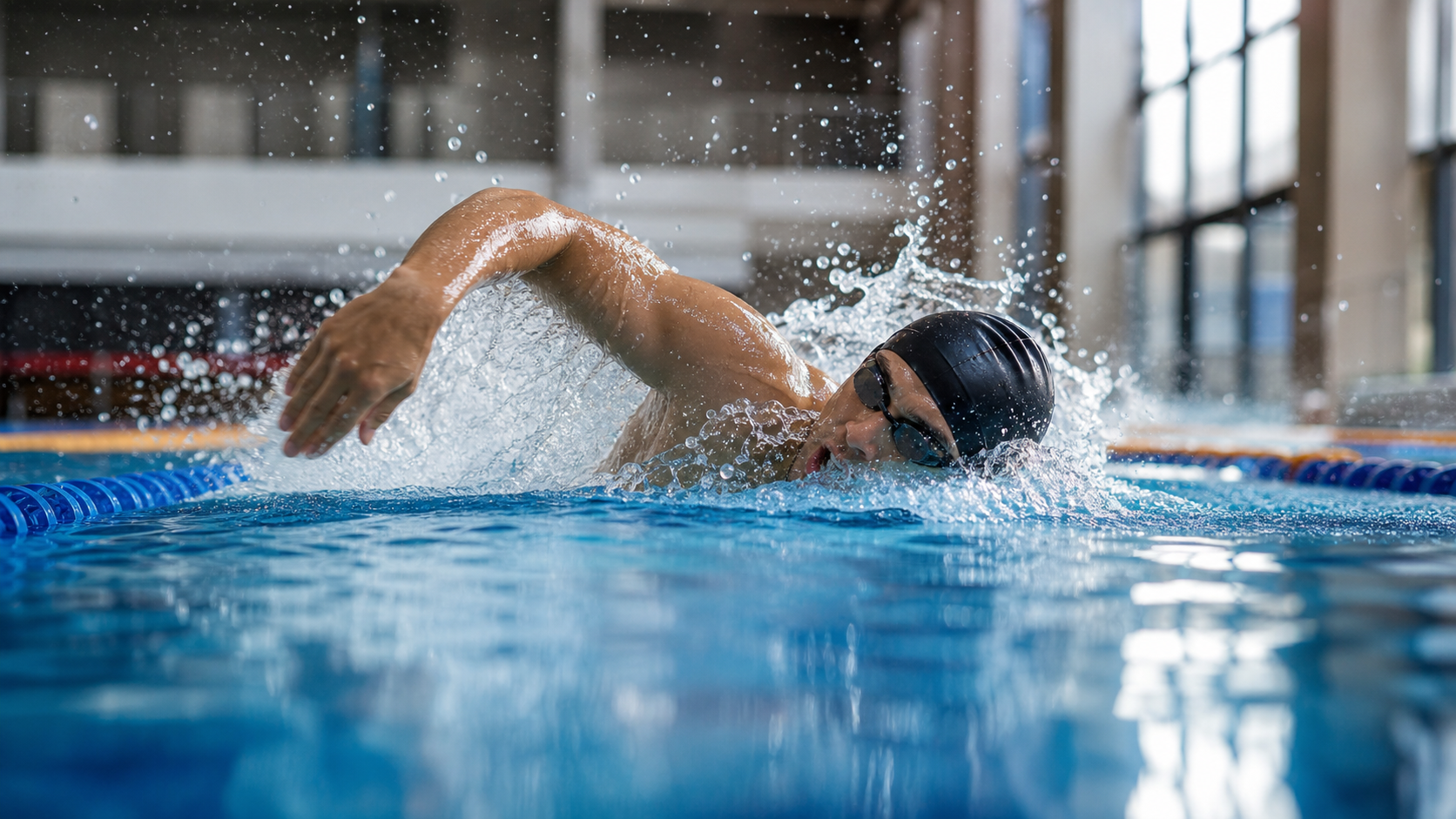
Why Train Sprints?
Many swimmers’ training plans contain no speed work at all. They think, “I’m not a sprinter, why would I train sprints?” This mindset is actually wrong. Speed training holds value for swimmers of all levels because the neuromuscular efficiency it develops can improve performance across all distances.
When you practice swimming at maximum speed, your body is forced to recruit more fast-twitch muscle fibers and improve neuromuscular coordination patterns. This change allows you to “swim faster at the same effort level” during low-to-moderate intensity swimming.
The Physiological Basis of Sprint Training
| Energy System | Activation Time | Duration | Role in Sprint Swimming |
|---|---|---|---|
| Phosphocreatine (ATP-PC) | Immediate | 6–10 seconds | Start acceleration |
| Anaerobic Glycolysis | 5–10 seconds | 30–90 seconds | Primary energy source for 50m sprints |
| Aerobic Oxidation | Increases after 60 seconds | Unlimited | Recovery between sets |
A 50m sprint lasts approximately 30–60 seconds (depending on individual speed) and primarily depletes phosphocreatine and anaerobic glycolysis energy. Adequate rest between sets (2–3 minutes) allows phosphocreatine to recover to 80–90%, ensuring maximum output on every set.
10×50m Sprint Workout Design
Basic Version (Suitable for Intermediate Swimmers)
Warm-up:
400m easy swim
4×25m gradual acceleration (from 50% to 90%)
200m easy swim

Main set:
10 × 50m all-out sprint
Rest between sets: 2 minutes 30 seconds (full recovery)

Cool-down:
400m easy swim (active lactate clearance)

Total: approximately 2000m
Advanced Version (With Speed Variation)
Warm-up: 600m

Main set:
4 × 50m @ 90% (warm-up sprints)
Rest between sets: 2 minutes

6 × 50m @ 100% all-out
Rest between sets: 3 minutes

Cool-down: 600m
Technical Points: How to Sprint Correctly
Push-off and First 15m (Acceleration Phase):
- Push off the wall with sufficient force, maximizing glide distance
- The first 3 stroke cycles after entry should be powerful and strong
- No breathing during this phase; maintain a streamlined body position
15–35m (Speed Maintenance Phase):
- Increase stroke rate rather than stroke length
- Maintain high-elbow catch (maximize surface area for the pull)
- Breathe every 2–3 stroke cycles, without over-breathing
35–50m (Finish Phase):
- Absolutely no slowing down; stay mentally focused
- The final 5m can be swum without breathing for a direct sprint finish
- Record your time upon touching the wall
How to Evaluate Sprint Training Results
Track the following data to monitor progress:
- Fastest single set time: The improvement margin of your best performance
- Average difference between first 5 sets and last 5 sets: A gap of <3 seconds indicates balanced conditioning; >5 seconds indicates insufficient speed endurance
- Time difference between Set 1 and Set 10: The degree of fatigue decline after a full workout
Recommended recording format:
Date: ____
Set:   1   2   3   4   5   6   7   8   9   10
Time:  __  __  __  __  __  __  __  __  __  __
Fastest: __  Slowest: __  Average: __
Position of Sprint Training in the Periodization Plan
- Frequency: At most 1–2 sessions per week; the remaining time should be dedicated to aerobic recovery
- Timing: Schedule during the “speed week” of the periodized plan; not suitable during fatigue phases or within 1 week before competition
- Seasonality: It is recommended to add sprint training only after establishing an aerobic base (8–12 weeks)
Four-Week Sprint Introduction Plan:
| Week | Sprint Workout | Special Notes |
|---|---|---|
| Week 1 | 6×50m @ 90% | Build stroke feel; no all-out effort |
| Week 2 | 8×50m @ 95% | Begin timing and recording |
| Week 3 | 10×50m @ 100% | Full workout |
| Week 4 | Recovery week, reduce volume by 50% | Let the body absorb and adapt |
Practical Advice
- Warm up thoroughly before sprint training; sprinting all-out with cold muscles is the most common cause of shoulder strain
- Do not schedule long-distance training after sprint sessions; let the day focus solely on speed work
- Sometimes “feeling very tired but times are fast” is a good sign, meaning technical efficiency is maintained even under fatigue
- The drag difference between goggles and swim caps is noticeable during sprints; use your regular equipment during official training sessions
Conclusion
Sprint training is the “catalyst” on the swimming improvement curve. It does not replace aerobic training; rather, it ignites speed potential on top of a solid aerobic foundation. With one 10×50m sprint session per week, after 3 months you will be surprised to find that not only have your short distances gotten faster, but your easy pace for longer distances has improved as well.
Related Reading
- Swim Speed Training: Short-Distance Sprint Workout Design Principles
- Swim Maximum Speed Training: Neuromuscular Activation with 10–25m All-Out Sprints
- Swim Speed Development Plan: Periodization Design for Short-Distance Sprint Sets
- Competitive Speed Training for Swimmers: Maximum-Speed Swimming and Nervous System Activation
西進武嶺 免費訓練分析服務 Intervals | 練不夠還是練過頭?你哪一種類型選手?AI模型告訴你! | 備戰神器 | 公路車 訓練 | CT Yeh
4 年前
Live) 備戰2019彰化經典百K 賽前攻略 (已完賽請看新影片
7 年前
西進武嶺 自製新版AI配速表產生器 x 賽前攻略 抱佛腳! 沒有功率計也可以產生配速表嗎?有什麼其他眉角賽前要注意的呢? | 西進武嶺 / 東進武嶺 KOM 攻略 | 公路車 | CT Yeh
4 年前
戰略) Zwift Race 如何咬在第一集團 如何評估自己要開多少推力 (請開1.5倍速看)
7 年前
#公路車 #西進武嶺 配速配瓦實驗 坡度分析 四小時內攻略 建大盃 NeverStop #西進武嶺攻略
6 年前
FTL 與 SYB 車隊專訪 西進武嶺 實用攻略分享! 2小時 如何練?!你不知道的眉角!新手準備武嶺必看 EP1 | 實力派女車友 | 精華版 | 公路車 | CTYeh
4 年前
教學) 如何做出專業 慢動作 影片 Slow Motion 120fps GoPro 7 ActionCam AX700 A99II
7 年前
實景訓練台) 彰化經典百K 高強度喵團 90分鐘 跟著一起練功 2019 Indoor workout Changhua Classic 100 Taiwan
7 年前