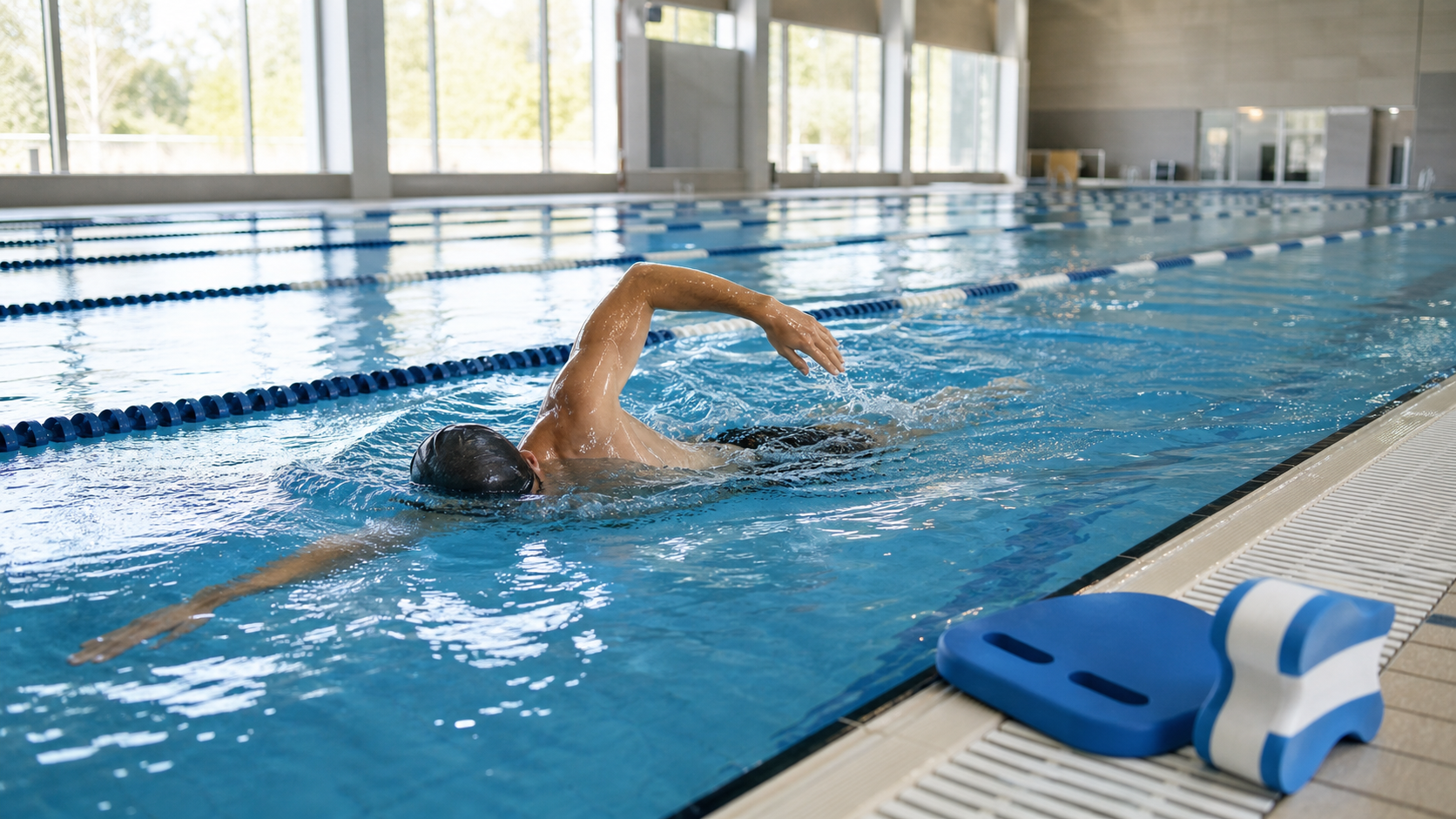
Why Do You Need a Dedicated Technique Session?
Imagine this: every day you practice a flawed stroke, and the more you swim, the more deeply that flaw becomes ingrained. This is exactly the situation for many amateur swimmers. They have training volume and enthusiasm, but without continuous technical improvement, their progress stalls.
The purpose of a Technique Session is not to build cardiorespiratory fitness, but to rebuild movement patterns at low intensity. This type of training only needs to reach Zone 1–Zone 2 intensity, giving the brain enough resources to process the signals of motor correction instead of being overwhelmed by fatigue.
Six Core Swim Technique Drills
1. Catch-Up Drill
Keep the lead hand extended until the trailing hand reaches a position parallel to it before switching. This forces you to prolong the glide after hand entry, improving stroke rhythm.
Best for correcting: too-short strokes, rushing the hand switch, asymmetric body roll
2. Fist Drill
Swim with closed fists (not open palms). With reduced hand surface area, the forearm instinctively increases its role in the catch, training the “big paddle” feel of the forearm.
Best for correcting: pulling with the palm only, insufficient forearm catch angle
3. Side Kick
Lie on your side, extend the lower arm, place the upper arm at your side, and propel forward using only ankle kicks. Switch sides every 12 kicks.
Best for correcting: insufficient body roll, poor core stability
4. Single-Arm Swimming
Keep one arm behind your back or extended forward while pulling with only the other arm. This lets you clearly feel the flaws in a one-sided pull.
Best for correcting: left-right asymmetry, off-center hand entry
5. High-Elbow Catch
Deliberately keep your elbow higher than your wrist during the pull. You can use paddles to enhance feedback.
Best for correcting: dropped elbow, low pulling efficiency
6. Timed Kick Set
Propel using only leg kicks (holding a kickboard), and record your 25m time. Compare the speed difference with and without arm pulling to quantify your kick contribution.
Best for correcting: stiff ankles, kick frequency too low or too high
A Standard Technique Session Workout
Warm-up (300m total)
  100m easy freestyle, feel out today's condition
  2×100m gradually building pace (50%→70%)

Drill Main Set (900m total)
  4×25m Catch-Up Drill, 20 sec rest between reps
  4×25m Fist Drill, 20 sec rest between reps
  4×25m Side Kick, 30 sec rest between reps
  4×25m Single-Arm Swimming (2 each side)
  4×25m High-Elbow Catch, 20 sec rest between reps

Technique Integration (400m total)
  4×100m normal swim: focus on one just-practiced technical cue per 100m
  Rest between reps: 30 sec

Cool-down (200m)
  200m easy swim or backstroke

Total: 1800m (entire session at Zone 1–Zone 2)
Design Principles for Technique Sessions
Principle 1: Technique sessions should not leave you breathless
Your heart rate should stay in Zone 1–Zone 2 throughout the technique session. If you feel out of breath, you’re going too fast. This is not an aerobic training session — it’s a neuromuscular learning session.
Principle 2: Integrate immediately after each drill
After finishing the Catch-Up Drill, immediately swim 2×50m normal freestyle while carrying the feel you just learned. This “drill → integrate” cycle is the fastest way to make technical progress.
Principle 3: Fix only one thing at a time
Each technique session should focus on at most 2 key points. Don’t try to correct everything at once — the brain’s capacity for motor learning is limited, and spreading attention too thin is counterproductive.
Principle 4: Record your observations
Immediately after the technique session, write down: “What did I feel today? Where did I improve? What should I keep practicing next week?”
Scheduling the Technique Session into Your Weekly Plan
| Day | Session Type | Primary Goal |
|---|---|---|
| Monday | Aerobic long swim | Cardiorespiratory endurance |
| Wednesday | Technique Session | Movement pattern rebuild |
| Friday | Intensity session (CSS/Sprint) | Speed endurance |
| Saturday (optional) | Long recovery swim | Base building |
The technique session is best scheduled in the middle of the week, after you’ve recovered from Monday’s fatigue, and while you still have energy in reserve before Friday’s high-intensity session.
Practical Tips
- In the early stages, it’s recommended to film yourself (have someone film you from the side in the water, or use a waterproof action camera) to objectively identify technical flaws
- Choose paddles sized to fit your palm — oversized paddles put excessive strain on the shoulders
- Technical drills are more effective at slower speeds — try to keep your 25m drill pace 20–30% slower than your usual pace
- If you’re especially fatigued that week, you can do just the warm-up and drill portions, skipping the intensity integration segment
Conclusion
A once-a-week technique session may look like “just an easy 2000m swim,” but its long-term impact on movement patterns far exceeds the same distance of aerobic training. Swimming is one of the few sports where “technical improvement equals speed improvement.” Every minute invested in technique will keep paying you back in every swim you do from now on.
Related Reading
- Technical Sets in Swim Training: Designing Technique-Oriented Workouts
- Swim Technique Workout: Adding a 10-Minute Technical Drill to Every Session
- Optimal Proportion and Design of Technique Drill Sets in a Swim Program
- Technique Week for Swimming: The Training Wisdom of Reducing Volume to Improve Quality
西進武嶺 免費訓練分析服務 Intervals | 練不夠還是練過頭?你哪一種類型選手?AI模型告訴你! | 備戰神器 | 公路車 訓練 | CT Yeh
4 年前
FTL 與 SYB 車隊專訪 西進武嶺 實用攻略分享! 2小時 如何練?!你不知道的眉角!新手準備武嶺必看 EP1 | 實力派女車友 | 精華版 | 公路車 | CTYeh
4 年前
西進武嶺 自製新版AI配速表產生器 x 賽前攻略 抱佛腳! 沒有功率計也可以產生配速表嗎?有什麼其他眉角賽前要注意的呢? | 西進武嶺 / 東進武嶺 KOM 攻略 | 公路車 | CT Yeh
4 年前
一個測試有沒有認真練車的方法😂 #公路車
10 個月前
單車AI教練!全新 ChatGPT4o 幫你分析訓練成果!排武嶺課表,分析騎車姿勢! 太神了! / 公路車 / CT Yeh / feat. 緯緯
2 年前
碟煞公路車 銑面器 !? 原來銑完差這麼多! 降低蹭碟機率! | TIME 公路車 保養小記錄 | CT Yeh
3 年前
[教學] Premiere 影片 手震 修正 教學 防抖 單眼 影像 GoPro 穩定 Video Stabilization
8 年前
CT 喇低賽) 武嶺牽車 才是王道 西進牽車四小時內秘訣 攝手位置 如何判斷 防抽筋小秘訣
7 年前