Cycling and the Environment: The Contribution of Electric-Assist Bicycles (E-bikes) to Urban Carbon Reduction
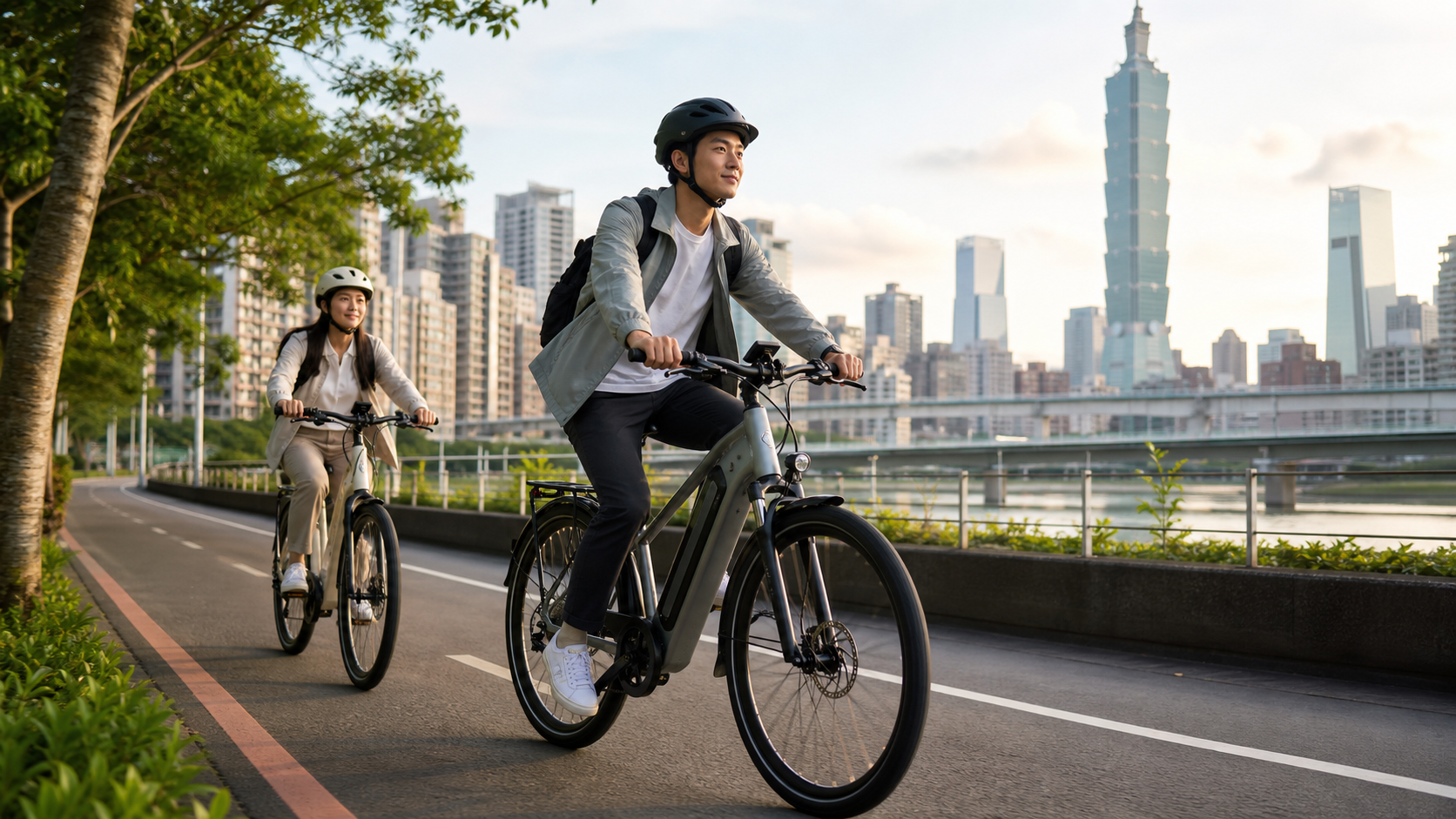
Cycling and the Environment: The Contribution of Electric-Assist Bicycles (e-bikes) to Urban Carbon Reduction
On Taiwan’s city streets, a mode of transport somewhere between a bicycle and a scooter is becoming increasingly common—the electric-assist bicycle, commonly known as the e-bike. Unlike electric scooters, the motor on an e-bike only provides assistance while you pedal, making riding less strenuous while retaining the physical activity of cycling. This design is changing many people’s perception of “I can commute by bike.”
Definition of e-bikes and Taiwan regulations
In Taiwan, according to the Road Traffic Management and Penalty Act, an electric-assist bicycle is defined as: primarily driven by human pedaling, with the electric assist system automatically cutting off at 25 km/h, and a motor power not exceeding 250W. E-bikes meeting these conditions do not require a license plate or compulsory insurance, and have the same road rights as regular bicycles.
Electric vehicles exceeding the above specifications must be registered and licensed by law, falling under the management scope of light electric scooters.
Why do e-bikes help reduce carbon emissions?
The carbon-reduction effect of e-bikes lies in their ability to effectively replace trips that would otherwise be made by cars or scooters. Research shows that the main reasons most people don’t commute on regular bicycles are:
- Taiwan’s hilly terrain—slopes deter the average person
- Commuting distances over 5–8 km demand too much physical exertion, leaving riders drenched in sweat upon arrival
- Taiwan’s hot and humid climate makes regular cycling unsuitable for formal attire
The electric assist of e-bikes precisely addresses these three barriers. When someone who originally drove to work switches to an e-bike, the carbon reduction is direct and quantifiable.
Carbon emission comparison of various transport modes
| Transport Mode | CO₂ Emissions (g/person-km) | Notes |
|---|---|---|
| Gasoline car (single occupant) | Approx. 120–180 | Depends on engine displacement |
| Scooter | Approx. 60–80 | Four-stroke scooter |
| Electric scooter (Taiwan grid) | Approx. 30–40 | Calculated based on Taiwan’s electricity carbon coefficient |
| E-bike (Taiwan grid) | Approx. 5–10 | Extremely low motor electricity consumption |
| Regular bicycle | Near 0 | Counting only human caloric expenditure |
| MRT/Bus | Approx. 15–25 | Depends on load factor |
From the numbers, e-bike carbon emissions are far lower than those of cars and scooters, and because the motor power is small (below 250W), even though Taiwan’s electricity grid is not yet fully decarbonized, e-bike emissions remain extremely low.
Practical applications of e-bikes in Taiwan’s cities
Taipei: The last mile for hillside communities
Many residential areas in Taipei are located in hilly zones (such as Neihu, Muzha, and Beitou), where getting home from a bus stop or MRT station often requires climbing slopes. E-bikes allow these residents to handle inclines with ease, replacing taxis or private car use with electric assistance.
Taichung: Extending mileage beyond YouBike
Taichung’s city streets are wide, making e-bikes highly practical as a commuting tool. For office workers with commutes of 10–20 km, regular bicycles fall short, and e-bikes fill the gap where public bike-sharing coverage is insufficient.
Kaohsiung: Accelerated commuting on flat terrain
Kaohsiung’s terrain is flat, so e-bikes there don’t need to overcome slopes but rather provide a more relaxed cruising speed, allowing riders to maintain a comfortable pace over longer distances without arriving at their destination drenched in sweat.
Environmental concerns of e-bikes: The battery issue
E-bike batteries typically last 500–1000 full charge cycles, with a service life of about 3–7 years. The recycling and disposal of batteries after their lifespan is an unavoidable issue in the environmental case for e-bikes.
Currently, Taiwan’s recycling mechanisms for electric bicycle batteries are not yet well-established. Some brands offer recycling services, but the market as a whole still lacks a unified battery recycling system. This is an area where policy needs to catch up more quickly.
Practical advice for purchasing an e-bike
- Confirm compliance with Taiwan regulations: Before purchasing, verify that the motor power is ≤250W and the maximum assist speed is ≤25 km/h to legally ride on bicycle lanes
- Choose brands with comprehensive service: E-bike battery and motor repairs require specialized expertise; confirm that reliable maintenance services are available locally
- Test ride first: The pedaling feel of e-bikes varies significantly by brand and system (Shimano Steps, Bosch, etc.), so decide after a test ride
- Consider battery capacity: If your commute is longer, choose a battery with larger capacity (400Wh or above) for greater range on a single charge
Conclusion
The e-bike is not a tool for the lazy; it is a bridge that brings more people into the cycling lifestyle. When someone who originally drove starts commuting by e-bike, the city streets have one less car and gain a measure of quiet and cleanliness. On Taiwan’s path toward net-zero emissions, the e-bike is an accessible, immediately effective personal choice.
Related Reading
- Electric-Assist Bicycles (E-bikes): Who Are They Suitable For?
- Taiwan Market Trends for Electric-Assist Bicycles (E-Bikes)
- Cycling and the Environment: Calculating the Carbon Emission Benefits of Choosing a Commuter Bicycle Over Cars and Scooters
- The Complete Guide to Electric Bicycle Commuting: A Smart Choice to Say Goodbye to Traffic Jams and Sweat
靠單車減肥35公斤 心得分享與整理
7 年前
高雄綠園道鐵路自行車道 / 外地人能輕鬆駕馭 還是整路崩潰? / 2025 全線開通 春節實地探索一次!(附GPS連結)/ 公路車 / CT Yeh
1 年前
#公路車 #Fitting 靠人工智慧APP 幫你調整單車
6 年前
單車 一日北高 ( 雙城 ) 肥宅雙人瘋狂行 紀錄片 REACTO
10 年前
全台首發!邁金P715踏板功率計!市場價格撼動者再出招 / 功率對比實測 / FAVERO ASSIOMA 可參考! / 公路車 / CT Yeh
1 年前
2023自行車展!與環台賽選手一同表演賽 / 全自動AI Fitting?/ TIME新車發表/神秘充電桌等 精華分享 VLOG | CT Yeh | 公路車
3 年前
3D 列印車褲墊 / 舒適改善? / 無痕 x 分區壓縮 / ATK & Decider系列 / JE22黑科技 / #公路車 #CTYEH
11 個月前
太平山單車員工旅遊 | 這樣玩CP值最高!| 公路車
5 年前