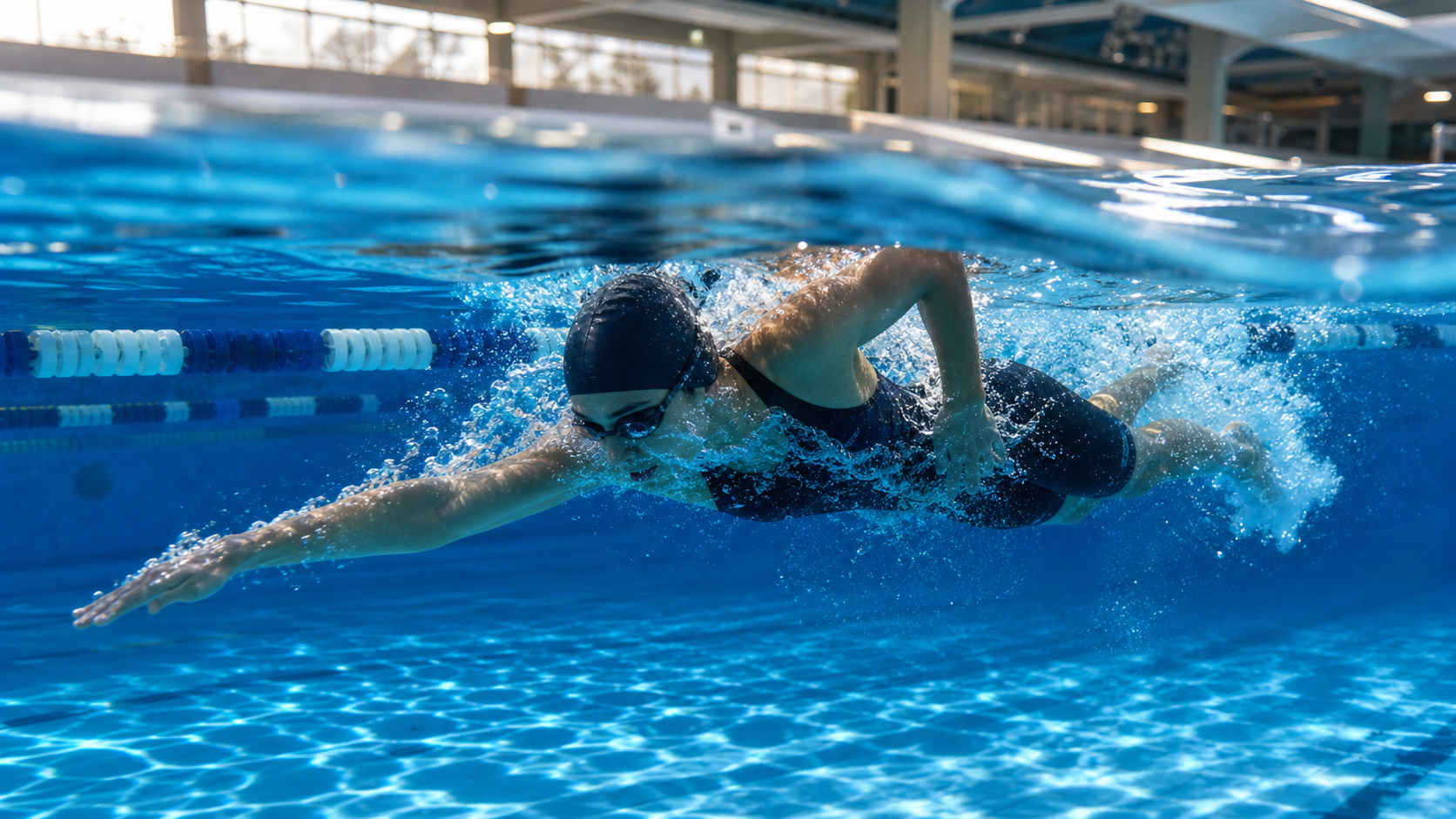
Freestyle Kick Rhythm: 2-beat, 4-beat, 6-beat
Freestyle kick frequency has long been a topic of debate. Sun Yang used a relaxed near-2-beat rhythm in the 1500 meters, while Caeleb Dressel kicked furiously with a 6-beat in the 50 meters. Kicking more isn’t always better—it needs to match your stroke, distance, and energy systems.
1. Defining the Three Kick Rhythms
Kick counts are calculated per “one full stroke cycle (one pull with each arm)”:
| Rhythm | Kicks per Cycle | Primary Function |
|---|---|---|
| 2-beat | 2 kicks (1 per side) | Maintain balance and body rotation |
| 4-beat | 4 kicks | Compromise option, rarely used |
| 6-beat | 6 kicks (3 per side) | Provide propulsion |
2. Energy Expenditure Comparison
Kicking is the most energy-intensive movement in swimming because the leg muscles are large, yet their propulsive efficiency in water is relatively low. Research shows:
- 6-beat kicking increases oxygen consumption by 30–40% compared to 2-beat
- But 6-beat propulsion only increases by about 10–15%
- Therefore, the “energy efficiency” of 6-beat is far lower than that of 2-beat
3. Recommended Kick Rhythm by Distance
| Event | Main Rhythm | Final Sprint |
|---|---|---|
| 50m FR | 6-beat throughout | — |
| 100m FR | 6-beat | Increase intensity |
| 200m FR | Mixed 4–6-beat | 6-beat |
| 400m FR | 2–4-beat | 6-beat (final 50m) |
| 800m FR | 2-beat | 4–6-beat (final 100m) |
| 1500m FR | 2-beat | 6-beat (final 100m) |
4. The Essence of 2-Beat Kicking
2-beat isn’t “not kicking”—it’s “precise kicking”:
- Each kick is timed with the catch of the opposite arm
- Its primary function is to maintain body position and rotation rhythm
- The kick motion is larger and deeper, similar to the force distribution of a breaststroke leg drive
Example: As your right hand catches, your left leg kicks downward; as your body rotates to the left, your right leg kicks downward.
5. Technical Details of 6-Beat Kicking
- Kick amplitude: up-and-down range of about 30–40 cm
- Kick origin: power generated from the hips, knees only slightly bent (15–20 degrees)
- High ankle flexibility required: dorsiflexion range should reach 70 degrees or more
- Toes pointed slightly inward: avoid a “duck-footed” position that creates drag
6. Ankle Mobility Test
Good kicking requires good ankle mobility:
- Sit with legs extended and feet hanging naturally
- Measure the angle between the shin and the top of the foot
- If the angle is less than 165 degrees (unable to approach a straight line), mobility is insufficient
- Improvement methods: perform ankle stretches and kneeling stretches daily
7. Recommended Training Ratios
Sprint Specialization (50–100m):
- 50% full-stroke swimming
- 30% kick training (including with kickboard)
- 20% pull training (with pull buoy)
Middle Distance (200–400m):
- 60% full-stroke swimming
- 20% kicking
- 20% pulling
Long Distance (800m and above):
- 70% full-stroke swimming
- 15% kicking
- 15% pulling
8. Quantitative Benchmarks
- 50m kickboard kick time: Elite men under 35 seconds, women under 40 seconds
- 50m no-board kick (arms at sides): Elite men under 40 seconds
- Full-stroke vs. kick-only time difference: Should be within 8 seconds for 50m
Conclusion
Finding your own kick rhythm requires experimentation. It’s recommended to use a heart rate monitor to record the relationship between heart rate and pace at different rhythms, and find the optimal balance between energy efficiency and speed.
Related Reading
- Complete Guide to Freestyle Kick Rhythm: The Logic Behind Choosing 2-Beat, 4-Beat, and 6-Beat
- Freestyle Kick Rhythm 2-beat, 4-beat, 6-beat: Which Should Triathletes Choose?
- Freestyle Kick Rhythm: What Distances and Body Types Suit 2-Beat, 4-Beat, and 6-Beat
- Freestyle Stroke Rhythm: Suitable Scenarios and Training Strategies for 2-Beat, 4-Beat, and 6-Beat Kicking
西進武嶺 免費訓練分析服務 Intervals | 練不夠還是練過頭?你哪一種類型選手?AI模型告訴你! | 備戰神器 | 公路車 訓練 | CT Yeh
4 年前
Live) 備戰2019彰化經典百K 賽前攻略 (已完賽請看新影片
7 年前
CT 喇低賽) 武嶺牽車 才是王道 西進牽車四小時內秘訣 攝手位置 如何判斷 防抽筋小秘訣
7 年前
實景訓練台) 彰化經典百K 高強度喵團 90分鐘 跟著一起練功 2019 Indoor workout Changhua Classic 100 Taiwan
7 年前
白沙屯媽祖進香在家走!UREVO 坡度自調走步機 / 可連接訓練遊戲APP MyWhoosh / 邊看直播邊走起來 / CT Yeh
11 個月前
武嶺配速表最佳使用方式 #bike
1 年前
團練) 4K NEKO 雙崎部落 間歇 狂拉 爽飛天 19/05/11
7 年前
單車AI教練!全新 ChatGPT4o 幫你分析訓練成果!排武嶺課表,分析騎車姿勢! 太神了! / 公路車 / CT Yeh / feat. 緯緯
2 年前