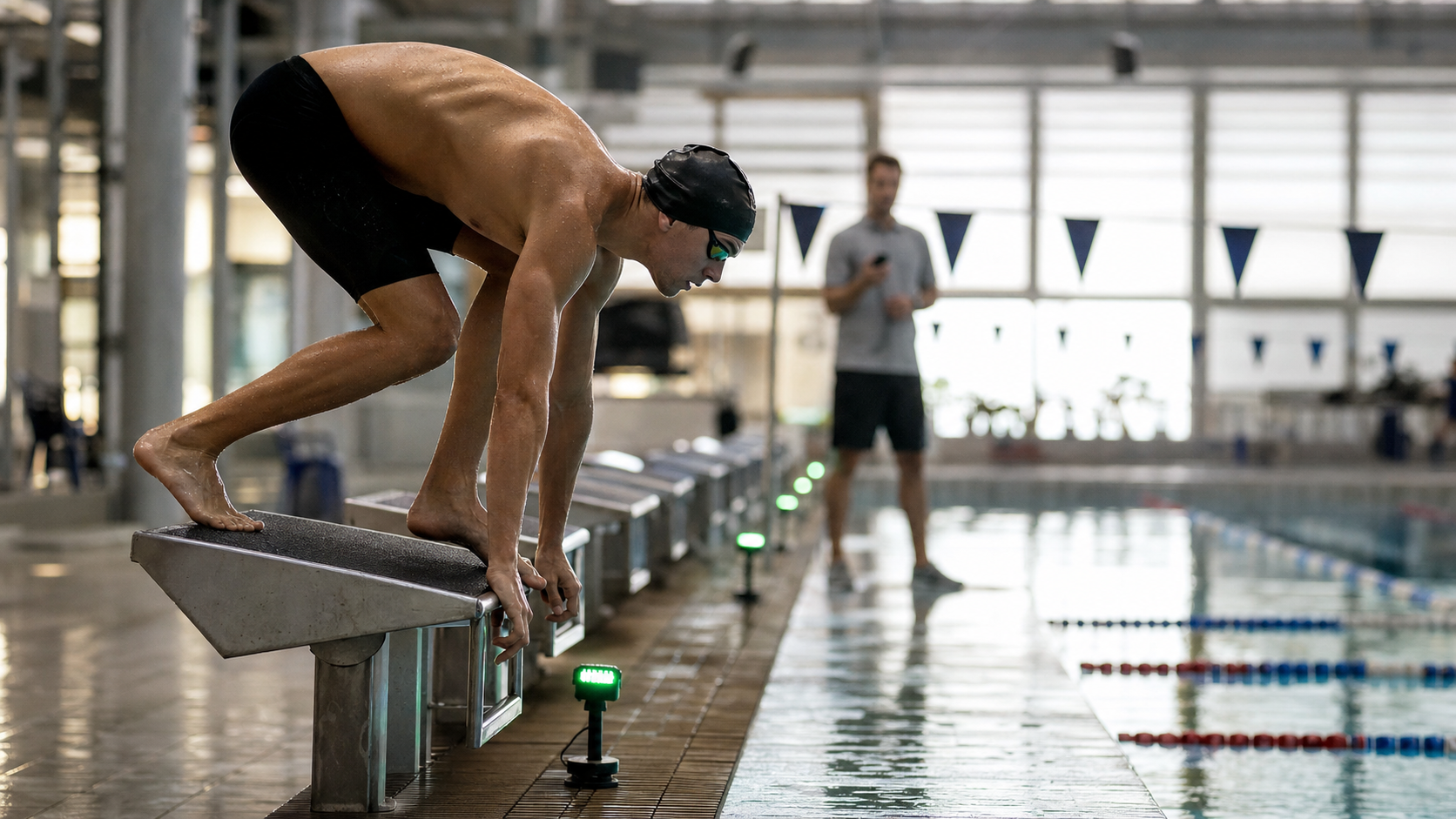
Sprint Start Reaction Time Training
50m freestyle world record holder Cesar Cielo’s start reaction time is approximately 0.62 seconds, while the average amateur swimmer sits at around 0.85 seconds. That 0.23-second gap equates to a five-body-length difference in the 50m event. Can reaction time be trained? The answer is yes.
1. Components of Reaction Time
From hearing the signal to both feet leaving the starting block, that 0.6–0.8 seconds breaks down as follows:
| Phase | Time | Description |
|---|---|---|
| Neural perception | 0.10–0.15 s | The ear receives the sound |
| Brain processing | 0.05–0.08 s | Confirms it as the start signal |
| Neural transmission | 0.03–0.05 s | Signal travels to the muscles |
| Muscle contraction | 0.40–0.55 s | Actual force application and block departure |
2. Factors Affecting Reaction Time
Factor 1: Muscle Pre-Tension
Muscles that are already slightly tensed can generate force more quickly. This is the scientific basis behind the Track Start position.
Factor 2: Nervous System Excitability
The “preparation rhythm” (heart rate, breathing frequency) before a race affects reaction speed. The ideal heart rate is approximately 130–150 bpm.
Factor 3: Mental Focus
Insufficient focus can increase reaction time by 0.1–0.2 seconds. Anticipating the starting signal and mental rehearsal can both help.
Factor 4: Auditory Sensitivity
Some athletes have higher sensitivity to specific sound frequencies, which can be trained in a targeted manner.
3. Training Methods
Method 1: Reaction Light Training
Use reaction lights (such as OmegaLight, FitLight):
- Basic training: Tap as soon as the light turns on → record reaction time
- Target: Hand reaction < 0.2 seconds
- Advanced: Add decoy lights (no response required) to train discrimination
Training frequency: 3 times per week, 10 minutes per session.
Method 2: Gun-Response Training
Play various race start audio files:
- Buzzer sounds
- Electronic whistle sounds
- Real race recordings
- Different volumes and background noise
Training protocol:
- Assume the Track Start position on dry land
- Play audio files at random (including false signals)
- Explode off the blocks immediately upon hearing the correct signal
- Record reaction time
- Perform 20 starts per day
Method 3: In-Water Start Simulation
Perform full start training in the pool:
- Use official starting blocks
- Coach uses a real starting device
- Record block departure time for every start
- 1–2 sessions per week, 8–10 sets per session
Method 4: Nervous System Activation
Activation drills 30 minutes before competition:
- Sprint runs 5×30m
- Box jumps 3×5 reps
- Reaction light drills 10 reps
- Purpose: Elevate the nervous system to race-ready state
4. Mental Training
Anticipation and Rehearsal
Elite athletes often mentally rehearse the entire start process:
- See “Take your marks” → assume the position
- Silently repeat: “The next sound is the start signal”
- Focus on “hearing” rather than “thinking”
- Signal sounds → automatically execute the rehearsed movement
Avoiding False Starts
An excessively short reaction time (< 0.65 seconds) may indicate anticipation rather than reaction, and can be called a false start. FINA rules: one false start results in disqualification.
Safe range: 0.65–0.75 seconds.
5. Age and Gender Differences
According to research:
- Ages 18–25 are the optimal period for reaction time
- After age 30, reaction time increases by approximately 0.02 seconds every 5 years
- The gender difference is about 0.03 seconds (males slightly faster)
- However, training can compensate for these differences
6. Impact of Nutrition and Recovery on Reaction Time
- Caffeine: Consuming 3–6 mg/kg 30–60 minutes before competition can improve reaction time by 0.03–0.05 seconds
- Sleep deprivation: With less than 6 hours of sleep, reaction time is on average 0.1 seconds slower
- Dehydration: At 2% body weight loss from dehydration, reaction time slows by 0.05 seconds
7. Training Monitoring Metrics
It is recommended to build a personal reaction time database:
| Training type | Target |
|---|---|
| Reaction light hand response | < 0.20 s |
| Reaction light foot response | < 0.25 s |
| Dry-land start reaction | < 0.70 s |
| In-water start reaction | < 0.75 s |
| Race start reaction | < 0.72 s |
8. Pre-Race Fine-Tuning
Optimizing reaction time on race day:
- 2 hours before: Moderate meal, adequate hydration
- 1 hour before: Warm-up swim 800–1500m
- 30 minutes before: Neural activation (reaction lights, short sprints)
- 10 minutes before: Mental rehearsal, deep breathing
- 2 minutes before: Put on swimsuit and goggles, take your marks
Conclusion
Although reaction time occupies only a brief moment of a race, it is crucial for sprint events. Through systematic training, amateur athletes can reduce their reaction time from 0.85 seconds to 0.72 seconds within 3 months—saving 0.13 seconds in a 50m race, which can be enough to decide medal placement.
Related Reading
- Swimming Dive Reaction Time Analysis: The Key Impact of Starting Block Technique on Performance
- 50m Freestyle Race Strategy: Reaction Time, Mid-Race Swimming, and Sprinting
- Explosive Power Training for Short-Course Swimming (50m): Neural Preparation for Maximum Speed
- Reaction Time and Athletic Performance: A Complete Coach’s Guide from Neural Components to Sport-Specific Training
西進武嶺 免費訓練分析服務 Intervals | 練不夠還是練過頭?你哪一種類型選手?AI模型告訴你! | 備戰神器 | 公路車 訓練 | CT Yeh
4 年前
FTL 與 SYB 車隊專訪 西進武嶺 實用攻略分享! 2小時 如何練?!你不知道的眉角!新手準備武嶺必看 EP1 | 實力派女車友 | 精華版 | 公路車 | CTYeh
4 年前
CT 喇低賽) 武嶺牽車 才是王道 西進牽車四小時內秘訣 攝手位置 如何判斷 防抽筋小秘訣
7 年前
風櫃嘴 衝刺慢動作回放!
8 年前
戰略) Zwift Race 如何咬在第一集團 如何評估自己要開多少推力 (請開1.5倍速看)
7 年前
Live) 備戰2019彰化經典百K 賽前攻略 (已完賽請看新影片
7 年前
教學) 如何做出專業 慢動作 影片 Slow Motion 120fps GoPro 7 ActionCam AX700 A99II
7 年前
西進武嶺 自製新版AI配速表產生器 x 賽前攻略 抱佛腳! 沒有功率計也可以產生配速表嗎?有什麼其他眉角賽前要注意的呢? | 西進武嶺 / 東進武嶺 KOM 攻略 | 公路車 | CT Yeh
4 年前