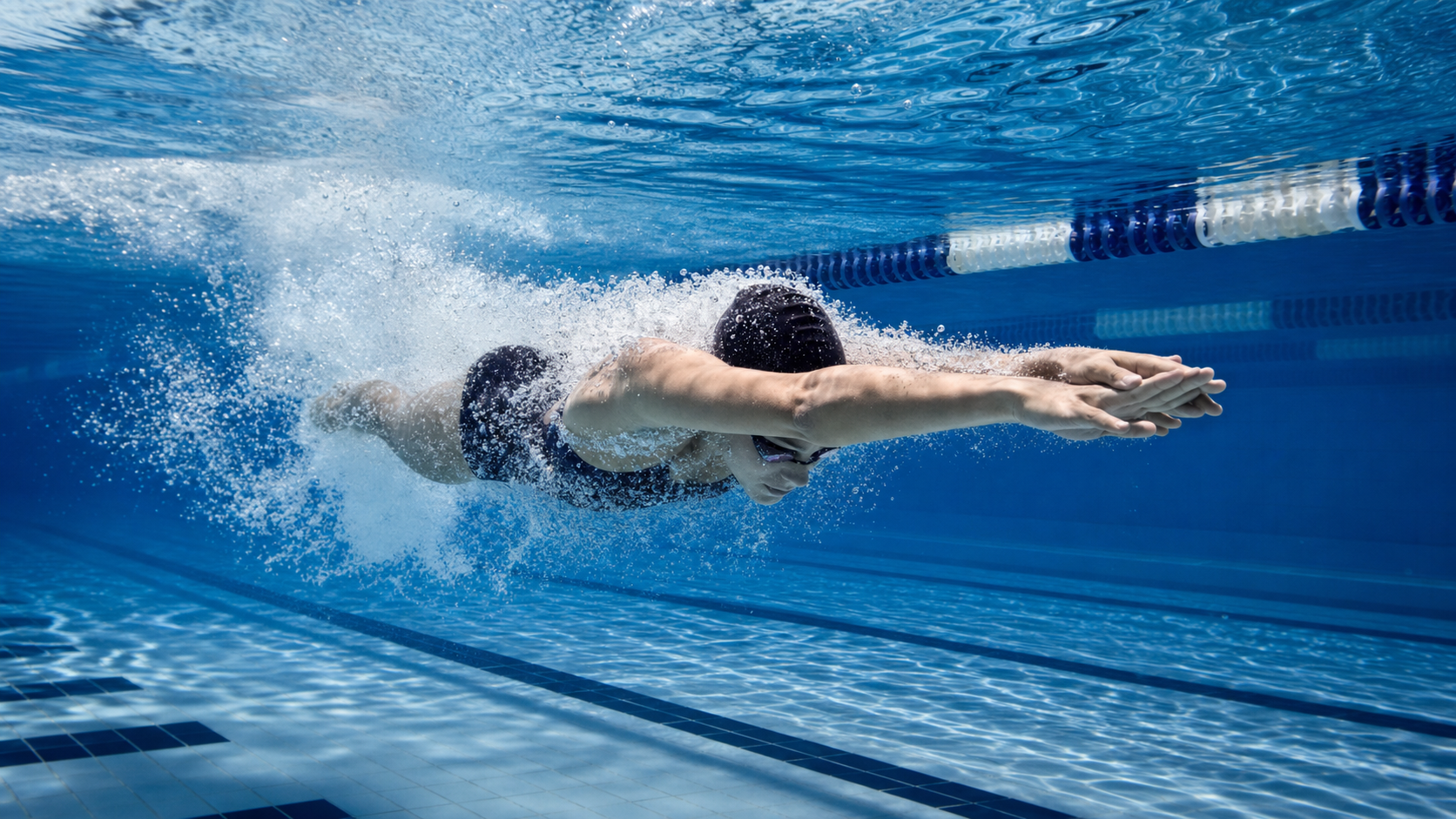
The Science of Streamline Gliding After Entry
The 1.0–1.5 seconds from the moment of entry to the start of the first underwater dolphin kick is the fastest phase of the entire race. Entry speed can reach 6.5 m/s, far higher than the 2.0 m/s swimming speed underwater. But this speed decays rapidly, slowing by about 1.5–2.0 m/s per second. How to extend the effective glide distance of the streamline is one of the core competitive advantages of elite swimmers.
1. Fundamentals of Fluid Mechanics
The drag equation in water:
F_drag = 0.5 × ρ × v² × C_d × A
- ρ: density of water (1000 kg/m³)
- v: velocity
- C_d: drag coefficient (related to body posture)
- A: frontal projected area
The key lies in C_d and A—both are directly affected by body posture. A perfect streamline posture can reduce C_d by 30–40%.
2. Streamline Posture Checklist
Upper Body (from fingers to waist)
- [ ] Hands stacked: top hand wraps over the back of the bottom hand
- [ ] Thumbs hooked over the opposite index finger
- [ ] Arms fully extended forward, elbows locked
- [ ] Ears pressed tightly against the inner upper arms
- [ ] Chin slightly tucked, neck elongated
- [ ] Shoulder blades fully protracted
Torso
- [ ] Abdomen tightened (core engaged)
- [ ] Chest slightly concave
- [ ] Lower back neither sinking nor over-arched
- [ ] Hips, shoulders, and toes aligned in a straight line
Lower Body
- [ ] Legs fully together (thighs, knees, ankles)
- [ ] Toes pointed (plantar flexion)
- [ ] Feet together without crossing
3. Minimizing Frontal Projected Area
The frontal projected area of a good streamline (body silhouette viewed from directly ahead) is approximately 800–1000 cm², while swimmers with poor posture may reach as high as 1500 cm². The differences mainly come from:
- Hands not stacked: adds 100–200 cm²
- Legs separated: adds 200–400 cm²
- Head lifted: adds 150–300 cm²
- Body not straight: adds 100–200 cm²
4. Entry Technique
To establish a good streamline, it must begin from the moment of entry:
- Concentrated entry point: hands, head, hips, and feet pass through the same point in sequence, like “drilling into the water”
- Entry angle: 32–38 degrees is optimal
- Entry depth: at the first full extension, the body should reach a depth of 0.5–0.8 meters
- Streamline transition: maintain streamline after entry; do not immediately angle upward
5. Velocity Curve During the Glide Phase
According to FINA research:
| Time | Velocity | Action |
|---|---|---|
| 0 sec (moment of entry) | 6.5 m/s | Full entry |
| 0.3 sec | 5.5 m/s | Stable glide begins |
| 0.6 sec | 4.5 m/s | Velocity begins to drop significantly |
| 1.0 sec | 3.5 m/s | Approaching underwater dolphin kick speed |
| 1.5 sec | 2.8 m/s | First dolphin kick initiated |
| 2.5 sec | 2.5 m/s | Steady underwater propulsion |
6. When to Initiate the First Dolphin Kick?
Indicators for timing the first dolphin kick:
- Velocity decay point: when speed drops to approximately 2.8–3.0 m/s
- Time-based judgment: 1.0–1.5 seconds after entry
- Feel-based judgment: a noticeable slowdown in body speed
Kicking too early: wastes the high-speed phase of free gliding
Kicking too late: speed has already dropped too low, requiring more effort from the dolphin kick to recover
7. Training Methods
Training 1: Wall Push-Off Streamline Distance Measurement
- Push off the wall with both feet, full streamline
- Record glide distance (tests core stability)
- Men’s target: 8–10 meters
- Women’s target: 7–9 meters
Training 2: Eyes-Closed Streamline in Water
- Push off the wall and glide with eyes closed
- A partner observes whether you drift off course
- Trains proprioception
Training 3: Mirror Posture Check
- Simulate streamline standing up
- Check hand, ear, and abdominal positions in the mirror
- 3 minutes daily
Training 4: Video Analysis
- Use a GoPro to film underwater posture from the side
- Compare with elite swimmer footage to identify differences
- Once per month
8. Shoulder Mobility and Streamline
A good streamline requires full shoulder elevation. Test:
- Lie on your back on the floor
- Extend both arms overhead
- Can both arms lie completely flat on the floor?
- If not, shoulder stretching is needed
Improvement methods:
- Daily “Wall Slide” stretches, 3 sets
- Pectoral stretches
- Latissimus dorsi stretches
9. Quantitative Benchmarks
Indicators of an excellent streamline:
- 5-meter start time (from signal to 5 meters): men < 1.5 sec, women < 1.7 sec
- 15-meter underwater time: men < 5.8 sec, women < 6.4 sec
- Wall push-off 8-meter velocity: should be > 2.3 m/s
Conclusion
Streamline is the “simplest yet hardest to achieve” element of swimming technique. It requires no strength, no skill—only a fully extended body. But that extension demands exceptional proprioception and body control. It is worth every swimmer’s time to refine with precision.
Related Reading
- Underwater Dolphin Kick: The Speed Advantage Within the 15m Rule
- The Hidden Speed in Swimming Turns and Starts: Why Underwater Dolphin Kicking Is the Fastest Phase of the Entire Race
- Start Angle and Entry: How to Maximize Start Distance
- Underwater Dolphin Kick Distance After Entry: Rule Limits and Optimization Strategies
西進武嶺 免費訓練分析服務 Intervals | 練不夠還是練過頭?你哪一種類型選手?AI模型告訴你! | 備戰神器 | 公路車 訓練 | CT Yeh
4 年前
FTL 與 SYB 車隊專訪 西進武嶺 實用攻略分享! 2小時 如何練?!你不知道的眉角!新手準備武嶺必看 EP1 | 實力派女車友 | 精華版 | 公路車 | CTYeh
4 年前
CT 喇低賽) 武嶺牽車 才是王道 西進牽車四小時內秘訣 攝手位置 如何判斷 防抽筋小秘訣
7 年前
西進武嶺 自製新版AI配速表產生器 x 賽前攻略 抱佛腳! 沒有功率計也可以產生配速表嗎?有什麼其他眉角賽前要注意的呢? | 西進武嶺 / 東進武嶺 KOM 攻略 | 公路車 | CT Yeh
4 年前
戰略) Zwift Race 如何咬在第一集團 如何評估自己要開多少推力 (請開1.5倍速看)
7 年前
滑雪新手們慘摔學習全紀錄(請開字幕),滑雪好好玩 | Snowboard + Ski | 岩原 スキー場 | 滑雪APP使用 | GoPro Max
6 年前
風櫃嘴 衝刺慢動作回放!
8 年前
2016 桐花飛舞 單車挑戰 精華片段
10 年前