Translating Land-Based Strength into Water Propulsion: The Science of Swim-Specific Strength Training
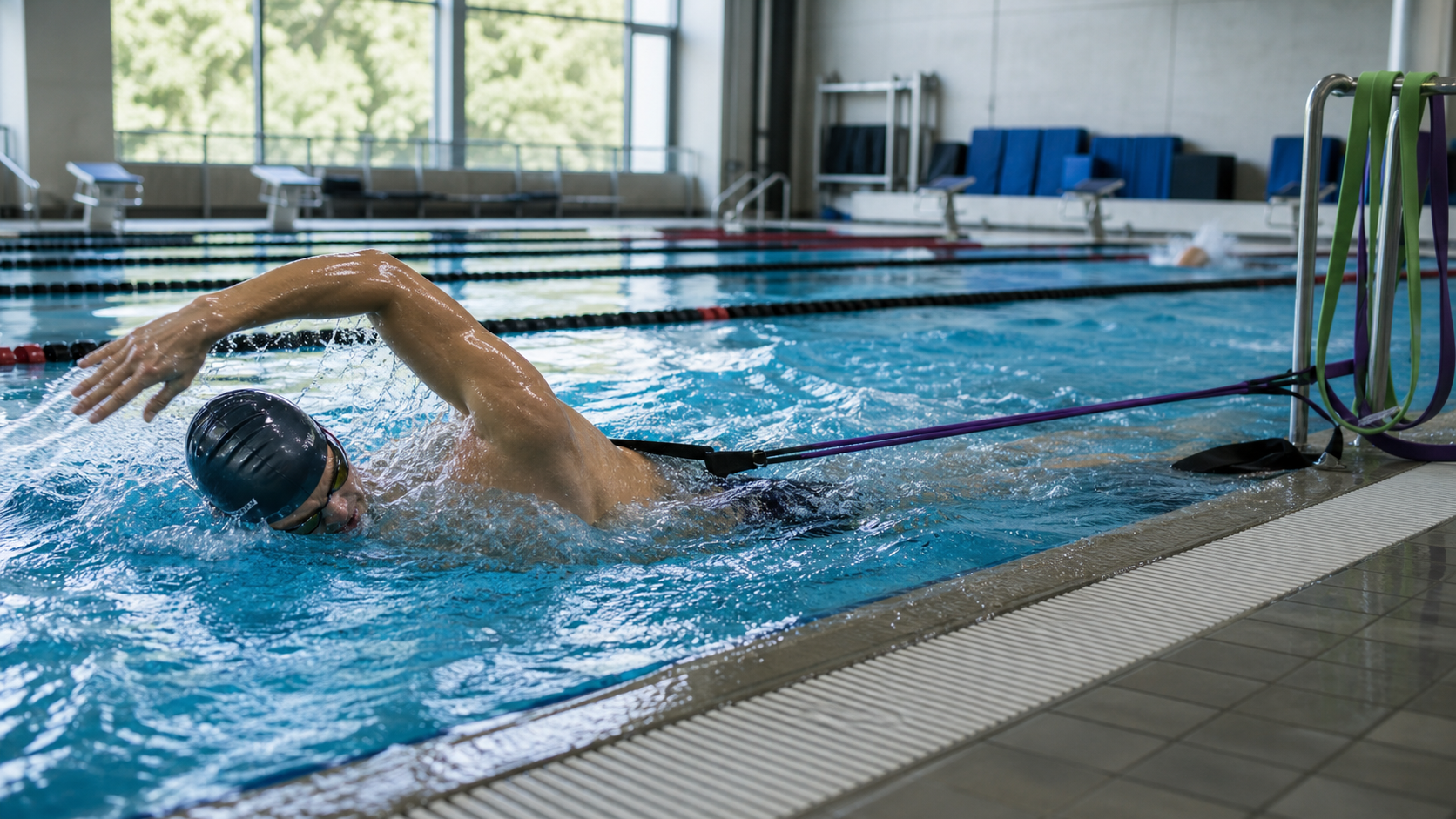
How Land-Based Strength Translates to Propulsion in the Water
Many swimmers invest significant time in land-based strength training—squats, pull-ups, bench presses—only to find limited speed gains once they hit the water. This is because the relationship between “strength” and “propulsion in the water” is not linear; a conversion pathway must be built through sport-specific training.
1. Why Doesn’t Land-Based Strength Directly Equal Speed in the Water?
Reason 1: The Unique Nature of Water Resistance
Water resistance is proportional to the square of velocity, meaning the harder you pull, the greater the resistance you encounter. Blindly increasing strength cannot proportionally increase speed.
Reason 2: Differences in Neuromuscular Adaptation
Land-based training typically involves “short-duration, high-force” power training, whereas swimming requires “medium-duration, medium-force” sustained effort. The nervous system requires different recruitment patterns.
Reason 3: Different Proprioception in the Water
On land, muscles receive proprioceptive feedback through gravity and contact surfaces; in the water, feedback comes from water resistance and body position—a completely different sensory system.
Reason 4: Technical Coupling
Strength must be converted into propulsion through proper technique. For swimmers with poor technique, greater strength may actually create more drag (e.g., incorrect dropped-elbow pull).
2. Core Muscle Groups for Swim-Specific Strength
| Movement | Primary Muscles | Training Exercises |
|---|---|---|
| Catch | Latissimus dorsi, posterior deltoids | Pull-ups, lat pulldowns |
| Pull/Push Phase | Triceps, pectoralis major | Triceps extensions, push-ups |
| Kick | Quadriceps, hip flexors | Squats, leg raises |
| Core Stability | Rectus abdominis, obliques, erector spinae | Planks, Russian twists |
| Turn Push-off | Quadriceps, gluteus maximus | Box jumps, single-leg squats |
3. Bridging Training from Land to Water
Bridge 1: Resistance Band Stroke Simulation
Use a resistance band anchored to a door frame to simulate the freestyle stroke:
- High-elbow catch position
- Slow, controlled pull phase
- 3 sets × 20 reps per side
- Trains neuromuscular patterns
Bridge 2: Weighted Water Paddles
Use water paddles (e.g., Finis Agility Paddle):
- Increases water resistance
- Forces proper technique
- Add 4 × 50m to each session
Bridge 3: Tethered Swimming
Use a stretch cord secured around the waist:
- Swim at full effort without moving forward
- Trains maximal strength conversion
- 30-second sets, 8 sets total
Bridge 4: Weighted Kicking
Attach ankle weights (0.5–1 kg):
- Kick with a kickboard
- Forces hip-driven power
- 50m per set, 8 sets total
4. Periodization of Land-Based Training
Base Phase (12–8 weeks before season)
- Focus: Maximal strength
- Exercises: Squats, deadlifts, pull-ups
- Intensity: 80–90% 1RM
- Reps: 3–6
- Frequency: 2–3 times per week
Strength-Building Phase (8–4 weeks before season)
- Focus: Strength endurance
- Exercises: Circuit training, power movements
- Intensity: 60–75% 1RM
- Reps: 8–12
- Frequency: 2 times per week
Pre-Competition Phase (4–1 weeks before season)
- Focus: Neural activation
- Exercises: Jumps, medicine ball throws
- Intensity: Low weight, high velocity
- Reps: 3–5
- Frequency: 1–2 times per week
5. Swim-Specific Weightlifting Exercises
Exercise 1: Bent-over Row
- Mimics the latter half of the pull phase
- Focuses on the latissimus dorsi
- 4 sets × 8 reps
Exercise 2: Lat Pulldown
- Mimics the full catch-to-pull motion
- Alternate between narrow and wide grips
- 4 sets × 10 reps
Exercise 3: Overhead Medicine Ball Slam
- Mimics the explosive power of the butterfly pull
- Trains the core and shoulders
- 5 sets × 8 reps
Exercise 4: Box Jump
- Trains explosive take-off power
- 80–100 cm height
- 5 sets × 5 reps
Exercise 5: Kettlebell Swing
- Trains hip drive
- Benefits both dolphin kick and breaststroke kick
- 4 sets × 15 reps
6. The Importance of Shoulder Health
Over 60% of swimmers will experience shoulder pain (swimmer’s shoulder). Prevention methods:
- Rotator cuff strengthening: Internal/external rotation with resistance bands
- Posterior shoulder strengthening: Bent-over flyes
- Shoulder stability: YTW exercises
- Avoid excessive bench pressing: No more than once per week
7. Real-World Application: Introducing the FTP Concept to Swimming
Similar to FTP (Functional Threshold Power) in cycling, swimming can also establish a “threshold pace” concept:
- Perform a 30-minute maximal effort swim
- Record the average pace (m/s)
- Use this as the baseline for training zones:
- Recovery: < 75% of threshold pace
- Aerobic: 75–85%
- Threshold: 90–100%
- Anaerobic: > 105%
8. Quantifiable Metrics
Swim-specific indicators for land-based training:
- Vertical jump: Elite men > 65 cm, elite women > 50 cm
- Pull-ups: Elite men > 15 reps, elite women > 8 reps
- Squat 1RM: > 1.5× body weight
- Bench press 1RM: > 1.0× body weight
- 30-second tethered swimming force: Men > 250 N, women > 180 N
9. Nutritional Support
Nutritional focus for strength conversion training:
- Protein: 1.6–2.0 g/kg body weight per day
- Carbohydrates: 3–4 g/kg before training, 1 g/kg after training
- Omega-3: Reduces post-training inflammation, 1–2 g per day
- Hydration: 500–800 ml per hour of training
Conclusion
Land-based strength is the “foundation” of swimming speed, but not the “answer.” A swimmer with explosive strength but rough technique will never beat an opponent with average strength but refined technique. The correct sequence is: build technique first, then add sport-specific strength training, and finally use bridging exercises to convert land-based strength into propulsion in the water. There are no shortcuts on this path, but if you head in the right direction, every week of training will yield measurable progress.
Related Reading
- Land-Based Strength Training for Swimmers: Which Exercises Transfer Best
- Why Swimmers Need Land-Based Strength Training
- Cross-Training for Swimmers: The Transfer of Land-Based Power Training to Swimming Speed
- Land-Based Power for Swimmers: A Complete Guide to Band Stroke Simulation and Shoulder Power Training
福隆鐵人團練隨拍
8 年前
CT 喇低賽) 武嶺牽車 才是王道 西進牽車四小時內秘訣 攝手位置 如何判斷 防抽筋小秘訣
7 年前
戰略) Zwift Race 如何咬在第一集團 如何評估自己要開多少推力 (請開1.5倍速看)
7 年前
西進武嶺 免費訓練分析服務 Intervals | 練不夠還是練過頭?你哪一種類型選手?AI模型告訴你! | 備戰神器 | 公路車 訓練 | CT Yeh
4 年前
CT暗黑廚房) 車友必備 宇宙無敵鮮蚵湯 幫助訓練恢復 天然食補 好市多 超肥鮮蚵 破PR
7 年前
多機位拍片神器 DJI Action 2 拍出速度張力感 | 類空拍機視角 4陣列麥克風超強降風噪 實測! | 公路車 | CT Yeh
3 年前
CT 喇低賽) 單車 比賽總是沒照片? 攝影師的觀點大公開 姿勢就是力量! 請加速1.25倍收看
7 年前
[教學] Premiere 影片 手震 修正 教學 防抖 單眼 影像 GoPro 穩定 Video Stabilization
8 年前