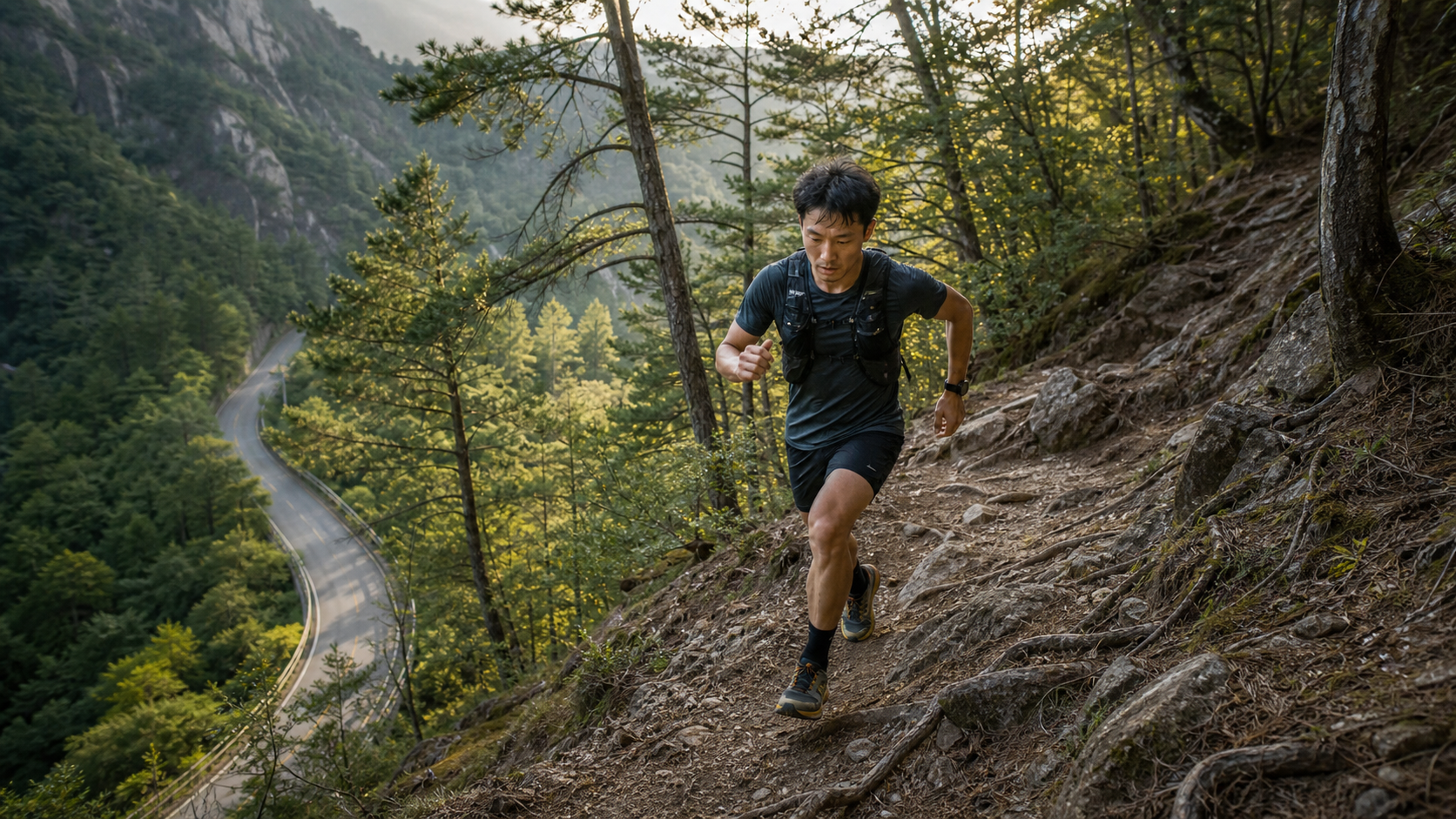
The Blind Spot of Road Running Thinking
Many road runners attempting their first trail race see “20K Trail” and estimate with a road-running mindset: “5:30/km × 20K = 110 minutes.” Yet the actual finish time is 3 or even 4 hours. The reason isn’t poor fitness—it’s using the wrong metrics.
Trail Running Time Prediction Formula
The industry commonly uses the Naismith Rule with trail adjustments:
- Flat terrain: follow road running pace
- Every 100m of climbing: add 10 minutes
- Technical descents: not necessarily time-saving; those with poor technique may actually be slower
- Mud, rocks, roots: add 1-2 minutes per kilometer
Example: 20K Trail Race, D+ 1200m
| Calculation Item | Time |
|---|---|
| Road pace 5:30/km × 20K | 110 minutes |
| Climbing 1200m × 10 min/100m | 120 minutes |
| Technical section compensation (5K × 1.5 min) | 7.5 minutes |
| Estimated Total Time | Approximately 4 hours |
The Three Metrics to Watch
1. Vertical Gain (D+)
The core difficulty of a trail race is the D+/distance ratio:
| D+/Distance | Difficulty |
|---|---|
| < 20 m/km | Gentle trail |
| 20-40 m/km | Moderate technical |
| 40-60 m/km | Alpine type |
| > 60 m/km | Pure climbing route |
2. Heart Rate vs RPE
On the trails, heart rate is heavily influenced by terrain, altitude, and psychological stress. Zone 2 on trails may correspond to Zone 3 heart rate. It’s recommended to switch to RPE (Rate of Perceived Exertion) instead:
- RPE 4-5: Can hold a long conversation, ultramarathon cruising
- RPE 6-7: Can speak in short sentences, half-day race pace
- RPE 8-9: Can only utter single words, short-distance trail surges
3. Movement Efficiency (Move Time vs Elapsed Time)
When trail running, you stop to drink, check trail markers, and scramble up rock slabs on all fours. Garmin’s auto-pause will misjudge this. It’s recommended to look at elapsed time and factor aid station stops into your plan.
Common Mistakes
- Starting too fast: Road runners are used to opening up in the first 5K, but on trails this will kill you in the later stages
- Refusing to walk: On gradients over 12%, walking saves more energy than running; forcing a run will spike your heart rate
- Carrying only water: Trail running requires electrolytes and solid carbohydrates; drinking only water will cause cramping
4-Week Transition from Road to Trail
| Week | Main Training |
|---|---|
| Week 1 | Find a park with stairs, practice steady stepping up and down |
| Week 2 | Add a mix of suburban hiking and light running, 6-8K |
| Week 3 | Full trail LSD of 90 minutes |
| Week 4 | Simulate race rhythm, including aid station rehearsal |
Conclusion
Trail running is not an extension of road running—it’s a different sport. Put away your road pace charts and learn to read D+, RPE, and terrain. That’s the first step onto the trails.
Related Reading
- Track Running vs Road Running Speed Differences: The Impact of Environmental Factors on Pace
- Trail Race Pacing: Why You Shouldn’t Look at Garmin on the Trails
- The Complete Trail Race Preparation Guide: A Systematic Approach from Race Selection to Finish
- Road Running Pace Calculator: Equivalent Pace Conversion Across Different Distances
崇越盃武嶺冠軍高手 賽前JJSC 群峰會精華!對應大數據分析,會有落差嗎?/ feat. JJSC中部公路車約騎 /公路車 / CT Yeh
2 年前
Live) 備戰2019彰化經典百K 賽前攻略 (已完賽請看新影片
7 年前
西進武嶺各路段 前8000名 大數據分析 配速攻略/功率/心律/推力比/維持率/踏頻/踏瓦比/牽車率 大公開 | 建大盃 NeverStop 可參考 | 公路車 | CT Yeh
5 年前
FTL 與 SYB 車隊專訪 西進武嶺 實用攻略分享! 2小時 如何練?!你不知道的眉角!新手準備武嶺必看 EP1 | 實力派女車友 | 精華版 | 公路車 | CTYeh
4 年前
#公路車 #西進武嶺 配速配瓦實驗 坡度分析 四小時內攻略 建大盃 NeverStop #西進武嶺攻略
6 年前
東進武嶺 西進武嶺 AI 配速 上線囉 公路車
5 年前
2019 夏季KOM 5小 完賽心得 準備攻略 東進武嶺 夏季登山王之路 Taiwan KOM Challenge
7 年前
西進武嶺 自製新版AI配速表產生器 x 賽前攻略 抱佛腳! 沒有功率計也可以產生配速表嗎?有什麼其他眉角賽前要注意的呢? | 西進武嶺 / 東進武嶺 KOM 攻略 | 公路車 | CT Yeh
4 年前