Trail Running Downhill Technique: Full Breakdown of Center of Gravity, Cadence, Vision, and Braking Muscle Training
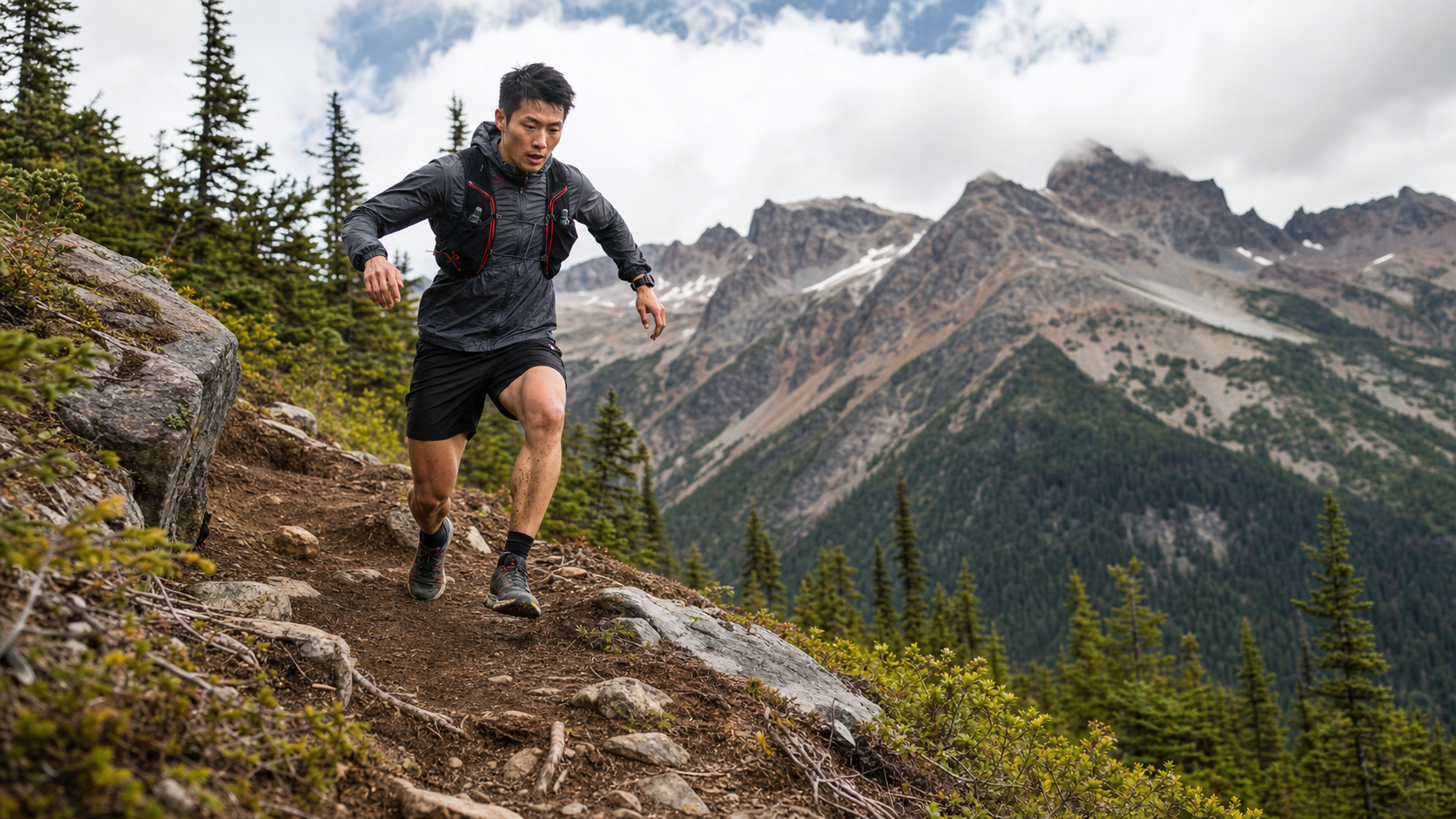
Why Is Downhill Difficult?
When running downhill, your legs absorb 3-4 times your body weight in impact, and your quadriceps undergo eccentric contraction (producing force while lengthening)—the contraction type most prone to muscle damage. Runners with poor technique will: brake, lean back, stare only at their feet, and take overly long strides.
Technique Point 1: Center of Gravity
Common Mistakes
- Leaning back (fear of falling): weight shifts to the heels, maximizing the braking effect
- Leaning too far forward: loss of stability, unable to react to rocks
Correct Posture
- Slight forward lean: chest aligned with the mid-foot
- Core engaged: stabilizes the torso
- Arms spread out: like wings for balance (especially on technical terrain)
Technique Point 2: Cadence and Stride Length
The key phrase for downhill is “short strides, high cadence”:
| Terrain | Recommended Cadence (spm) | Stride Length |
|---|---|---|
| Gentle downhill (-3 to -7%) | 180-190 | Moderate, can open up |
| Moderate downhill (-8 to -12%) | 190-200 | Shortened, foot lands under center of gravity |
| Steep downhill (> -12%) | 200+ | Very short, almost shuffling in place |
| Technical rocky sections | No set rhythm | Adapt randomly to terrain |
Overly long strides cause heel-striking, creating a braking effect and knee impact. Your foot should land directly beneath your center of gravity, with forefoot or midfoot striking.
Technique Point 3: Look Ahead
Beginners keep their eyes glued to their feet—this is wrong:
- Look 2-3 steps ahead: gives your brain time to assess and react
- Scan the terrain for 1-2 seconds before entering technical sections: memorize your foot placements for the next 5-10 steps
- Don’t stare at cliffs or drops: fear will make your body lean back
Technique Point 4: Braking Muscle Training (Eccentric Quadriceps Strengthening)
The quadriceps (especially the vastus lateralis and rectus femoris) are the primary muscles for downhill running. Common training exercises:
Basic Exercises
| Exercise | Sets | Intensity |
|---|---|---|
| Slow squats (4-second descent) | 4×10 | Bodyweight or added load |
| Rear-foot-elevated split squats | 3×8/leg | With dumbbells |
| Walking lunges (forward + lateral) | 3×10/leg | Bodyweight |
| Nordic hamstring curls | 3×6 | Advanced |
Specific Drills
- Slow stair descent: 3 seconds per step, 100 steps continuously
- Repeated downhill runs: find a 200m moderate slope, run down easy, walk back up, repeat 8-10 times
- Eccentric box step-downs: jump up, then step down slowly (3-second descent)
3-Week Pre-Race “Downhill Loading” Training
Delayed onset muscle soreness (DOMS) from downhill running requires repeated exposure to adapt:
- Week -3: 5K downhill training (300m cumulative descent)
- Week -2: 8-10K downhill training (500m cumulative descent)
- Week -1: Taper, only one short downhill stimulus
This “Repeated Bout Effect” can reduce downhill soreness by 40-50% on race day.
Summary of Common Mistakes
- Clenching fists: upper body tension transfers to the lower body
- Staring at your toes: loses forward-looking judgment
- Heel braking: increases strain on knees and quadriceps
- Not training downhill: only training uphill leads to downhill breakdown in races
Conclusion
Downhill running is a “technical skill” in trail running, not a test of courage. Master the four key elements—center of gravity, cadence, gaze, and muscle strength—and downhill can become a weapon to overtake your rivals, rather than a source of delayed onset muscle soreness.
Related Reading
- Trail Running Downhill Technique: Managing Deceleration Muscles, Cadence, and Braking Force
- Trail Running Downhill Technique: Center of Gravity Control, Foot Placement Selection, and Knee Protection
- The Complete Downhill Technique Guide: Center of Gravity Control, Gaze Guidance, the Physics of Braking Timing, and Progressive Training Methods
- The Complete Guide to Downhill Running Technique: From Muscle Mechanics to Practical Training
CT 喇低賽) 武嶺牽車 才是王道 西進牽車四小時內秘訣 攝手位置 如何判斷 防抽筋小秘訣
7 年前
公路車 爬坡 破PR 紀錄 小技巧 分享
6 年前
單車 梅山36灣 坡度介紹 路段介紹 空拍 (相關遊記影片,請參考說明或我的頻道喔,歡迎訂閱)
6 年前
CT 喇低賽) 單車 比賽總是沒照片? 攝影師的觀點大公開 姿勢就是力量! 請加速1.25倍收看
7 年前
大禹嶺 到 武嶺牌樓 全程前後實況錄影 | 北進武嶺 | 東進武嶺 | KOM | 訓練台 | 坡度分析 | Taiwan KOM Last 10 km HARD | 公路車
6 年前
FTL 與 SYB 車隊專訪 西進武嶺 實用攻略分享! 2小時 如何練?!你不知道的眉角!新手準備武嶺必看 EP1 | 實力派女車友 | 精華版 | 公路車 | CTYeh
4 年前
一日北高/長距離團騎 常見問題補充篇 / 組團或跟團的眉角 / 壯車友容易被瘦車友慢性拉爆 / 原來屁股痛可能是這個原因...? / 風場配速法 / 公路車 / CT Yeh
2 年前
一日北高常見問題大集合 | 攻略 | 路線 | 訓練 | 補給 | 自行車 單車 | 一日雙城 | 雙塔 | TWB北高360 | 屁股痛
6 年前