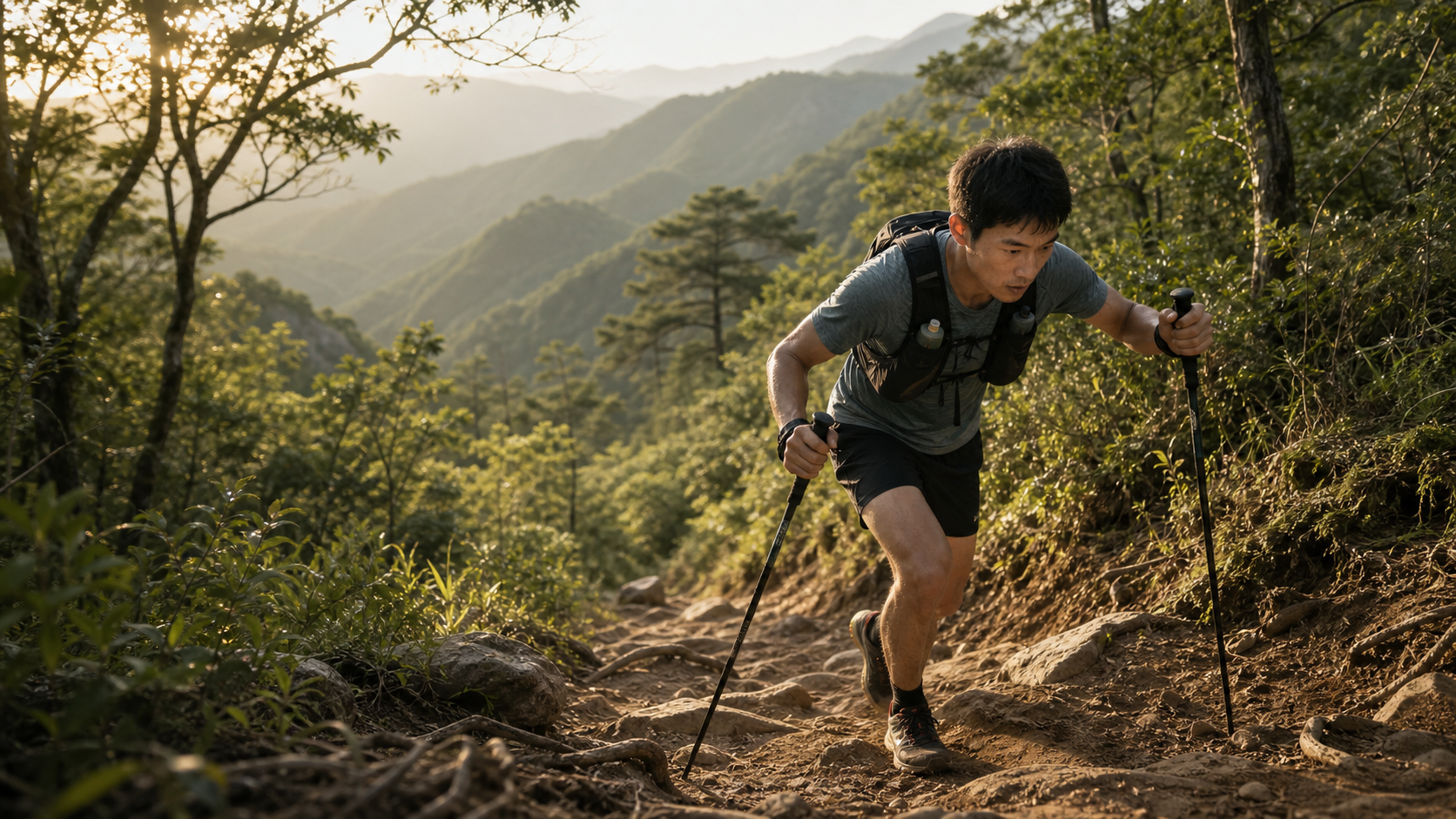
The Scientific Benefits of Trekking Poles
Research shows that using trekking poles:
- Uphill energy expenditure drops by 8-15%
- Knee impact reduced by 25-30%
- Improved balance, ankle sprain rate drops by 30%
- But only if you “know how to use them”
Dual-Pole Rhythm Technique
1. Diagonal Pole Plant
The most common and most efficient rhythm:
Left foot forward → Right pole plants
Right foot forward → Left pole plants
Similar to Nordic walking, steady rhythm, ideal for long-distance climbs.
2. Same-side Pole Plant
Left foot forward + Left pole plants simultaneously
Right foot forward + Right pole plants simultaneously
Less natural, suited for steep climbs or rocky steps, allowing upper-body explosive drive.
3. Double Pole
Plant both poles forward simultaneously
Lean body forward, push with both poles simultaneously
Take a long stride
Best for:
- Short explosive steep climbs (within 5-10 steps)
- Ascending rocky steps one by one
- Crossing fallen logs
4. Pole-Walking
Plant both poles 30-50cm ahead, use the upper body to pull yourself forward:
- Suited for long steep climbs
- Upper-body muscles share the load from the lower body
- Heart rate actually rises (increases whole-body exertion)
Grip Techniques
1. Standard Grip
- Thread hand through the wrist strap (from bottom up)
- The wrist strap bears the pushing force
- Fingers grip the pole handle lightly
- Adjust the wrist strap so it doesn’t wobble
2. Ski Pole Grip
- Palm presses down on the pole top
- The entire palm exerts force
- Suited for explosive power on steep climbs
3. Rocky Step Grip
- One hand grips the middle of the pole
- One hand grips the handle
- Movement is like using a walking stick
Pole Length Setting
Formula Method
Height × 0.66-0.68 = Pole length (cm)
| Height (cm) | Recommended Pole Length (cm) |
|---|---|
| 160 | 105-110 |
| 170 | 115-120 |
| 180 | 120-125 |
| 190 | 125-130 |
Fine-Tuning Method
Stand straight, grip the handle with elbows at 90 degrees, the pole tip should just touch the ground.
Dynamic Adjustment
- Uphill: Shorten by 5-10cm (higher planting point for the pole tip)
- Downhill: Lengthen by 5-10cm (lower support point for the pole tip)
- Folding poles are harder to adjust, just use a fixed length
When to Stow Poles
When should you not use poles?
Gentle Slopes / Flat Ground Where You Can Run
- Poles hinder arm swing
- Wastes energy
- Quickly stow them on the back of your vest
Fast Technical Downhills
- Poles may catch on rocks or tree roots
- Balance is actually disrupted
- Stow them and let both arms swing freely
Crossing Streams or Chain-Assisted Sections
- Both hands are needed to grab ropes or hold onto rocks
- Stow poles to avoid tripping
Stowing Techniques
1. Quick Stowing
- Folding poles: Unfold in 3-5 seconds
- Telescoping poles: Collapse in 10-15 seconds
- Practice until you can do it without looking
2. Placement
- Upright on the back of the vest: Less bouncing while running
- Side pocket of the vest: Quick access
- Held in hand while collapsed: For short-distance transitions
Progressive Two-Pole Training
Weeks 1-2: Get Used to the Grip
- Walk on flat ground for 10 minutes practicing grip
- Familiarize yourself with the diagonal pole plant rhythm
Weeks 3-4: Actual Use
- Use poles on gentle slopes for 30 minutes
- Don’t chase speed, build rhythm
Weeks 5-6: Steep Slope Practice
- Use poles for the entire 300-500m climb
- Switch between diagonal / same-side rhythms
Weeks 7-8: Race Pacing
- Full gear with weighted practice
- Simulate stowing poles at aid station stops
Common Mistakes
Mistake 1: Planting Poles Too Far Ahead
- Poles planted 1m ahead of the body
- No pushing force, just a cane effect
- Correct: Plant poles 30-50cm ahead of your feet
Mistake 2: Gripping Too Tightly
- Fingers over-gripping
- Forearms fatigue prematurely
- Correct: Let the wrist strap bear the weight, keep fingers relaxed
Mistake 3: Rhythm Not Matching Stride
- Chaotic pole-planting and footwork
- Correct: Build rhythm at a slow pace first, then speed up
Mistake 4: Not Stowing Poles
- Holding them while running on gentle slopes
- Wastes 5-10% of energy
- Correct: Stow them for gentle slopes / flat ground lasting more than 3 minutes
Mistake 5: Poles Too Short or Too Long
- Hunched over using them, or overreaching
- Correct: Adjust according to the formula and fine-tune on site
Pole Selection Key Points
Material
| Material | Weight | Durability | Price |
|---|---|---|---|
| Aluminum Alloy | Heavy (250-300g) | High | Low |
| Carbon Fiber | Light (180-220g) | Medium | High |
| Carbon + Aluminum Hybrid | Medium (200-260g) | High | Medium |
Folding Mechanism
- Folding (3-section): Short collapsed length (35-40cm), quick to deploy
- Telescoping: Long collapsed length (60-70cm), length adjustable
- Folding poles are the first choice for trail running
Pole Tips
- Tungsten carbide tip: Best grip on hard ground
- Rubber tip: For city pavement, rock
- Snow basket: For snow use, purchased separately
Race Day Pole Strategy
- Confirm before the race whether poles are allowed on the course (a few races don’t allow them)
- Plan the sections where you’ll use them (e.g., only needed after a certain CP)
- Practice the stowing rhythm on the trail
- Spare parts: tips, wrist straps (in case of wear)
Conclusion
Trekking poles are the “third and fourth legs” of trail running. Used correctly, they can save 25-30% of your energy; used incorrectly, they become dead weight. Master the dual-pole diagonal rhythm, learn when to stow them, and practice regularly—your climbs will be 10-15% faster than your competitors on race day.
Related Reading
- Trekking Pole Usage: The Secret Weapon That Saves 20% Energy
- Trail Running Uphill Technique: Cadence, Push-off, and Efficient Power Distribution
- Trail Running Uphill Technique: Stride and Arm Movements for Climbing Efficiency
- Uphill Interval Training: 10×100m Hill Sprints for Leg Strength and Running Efficiency
武嶺配速表最佳使用方式 #bike
1 年前
白沙屯媽祖進香在家走!UREVO 坡度自調走步機 / 可連接訓練遊戲APP MyWhoosh / 邊看直播邊走起來 / CT Yeh
11 個月前
公路車 爬坡 破PR 紀錄 小技巧 分享
6 年前
CT 喇低賽) 武嶺牽車 才是王道 西進牽車四小時內秘訣 攝手位置 如何判斷 防抽筋小秘訣
7 年前
ThinkRider 智騎 XXPRO 訓練台,高階機種功能 只要 1/3價格!? 實測功率對比、噪音實測 / 公路車 / CT Yeh
1 年前
單車 一日北高 ( 雙城 ) 肥宅雙人瘋狂行 紀錄片 REACTO
10 年前
如果Pogačar騎西進武嶺可以多快?會破2嗎?各種情況深度推估探討 / 公路車 / CT Yeh
2 年前
大禹嶺 到 武嶺牌樓 全程前後實況錄影 | 北進武嶺 | 東進武嶺 | KOM | 訓練台 | 坡度分析 | Taiwan KOM Last 10 km HARD | 公路車
6 年前