T2 Transition Tactics: Flexible Strategies from Dismounting to Running—Tying Shoelaces While Running
文章導覽
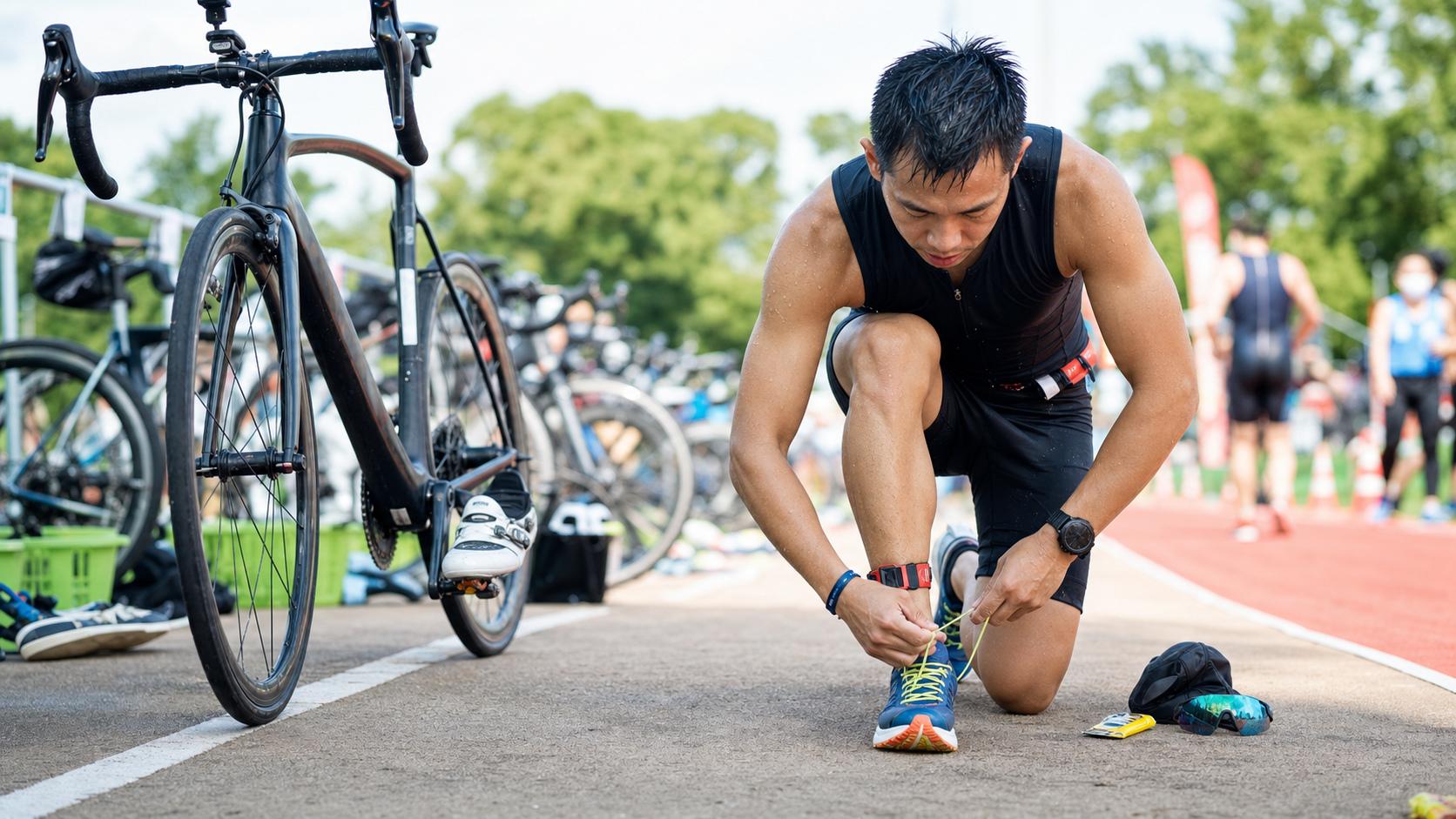
T2 Transition Tactics: The Flexible Strategy from Dismount to Run Start—Tying Laces While Running
T2 (Transition 2, bike-to-run transition) is simpler than T1, but age-groupers still average 2–3 minutes, while elites take only 30–60 seconds. The gap comes down to one core concept: T2 actions can be completed while running.
1. The Complete T2 Timeline
| Stage | Time (Age-Group) | Time (Elite) |
|---|---|---|
| Pre-dismount prep (removing shoes) | 5–10 sec | 5–10 sec |
| Dismount Line dismount | 5–10 sec | 3–5 sec |
| Running bike into transition area | 20–40 sec | 15–25 sec |
| Racking bike, removing helmet | 10–20 sec | 5–8 sec |
| Putting on running shoes | 30–60 sec | 10–15 sec |
| Grabbing nutrition, putting on cap and sunglasses | 20–40 sec | 5–10 sec |
| Running out of transition area | 10–20 sec | 5–10 sec |
| Total time | 1:40–3:20 | 0:48–1:23 |
The gap from age-group to elite can be 1–2 minutes.
2. The Flying Dismount Technique
Dismounting is the first technical point of T2.
Age-Group Approach
- Start braking 50 meters before the Dismount Line
- Stop, then step off one leg at a time
- Walk to the transition area with shoes off
Elite Approach (Flying Dismount)
- Unfasten shoe laces 100 meters before the Dismount Line (feet stay in, shoes remain on the pedals)
- 20 meters from the Line, lift the right leg, swing it over the rear wheel, and sit on the side of the saddle
- 3 meters from the Line, plant the left foot and grab the saddle with the right hand
- Push the bike and run into the transition area
Time saved: 15–30 seconds
3. Removing Cycling Shoes While Running
Key technique: leave cycling shoes on the pedals
- 200 meters from the transition area, pull your feet out of the cycling shoes and rest them on top of the shoes
- Keep pedaling; speed drops only 5–10%
- After the dismount, push the bike barefoot
- After the race, the cycling shoes stay on the pedals and staff will collect them
Advantages:
- No need to remove shoes inside the transition area (saves 10–15 seconds)
- Pushing the bike barefoot is more stable
- Saves the sweat inside the cycling shoes too
4. Elastic Laces: The Biggest Time-Saver in T2
Tying a standard bow with regular laces takes 15–25 seconds; elastic laces take only 3–5 seconds (just slip your foot in).
Recommended brands:
- Lock Laces
- Xtenex
- Yankz
- Nathan Run Laces
Installation notes:
- Tension adjustment: shoes stay on when standing on tiptoes; toes can move when sitting
- Test them at least 3 times during training beforehand
- Point the lock outward to avoid rubbing the top of your foot
5. Checklist of Actions You Can Complete While Running
After T2, from the transition area to the first kilometer, these actions can be completed while running:
| Action | Where to do it while running |
|---|---|
| Putting on cap | 50 meters after leaving transition area |
| Putting on sunglasses | 100 meters |
| Tightening laces (if elastic laces) | 200 meters |
| Tearing open energy gel wrapper | 300 meters |
| Rotating race belt (number to the front) | 500 meters |
| Starting watch run mode | Already started before leaving transition area |
Conclusion: Inside T2, elites only do three things—“rack the bike, put on running shoes, grab nutrition”—everything else is done while running.
6. Nutrition Pickup Strategy
Age-Group Approach
- Looking for nutrition while putting on shoes in the transition area
- Nutrition scattered on a towel, not consolidated
Elite Approach
- Nutrition packs pre-attached to a race belt (placed next to the running shoes)
- Enter transition area, sit down → grab belt and put it on → grab running shoes → head out
- Belt holds: 2 gels, salt tablets, race number, sunglasses
Time saved: 20–30 seconds
7. The “Transition Run” After Leaving the Transition Area
The first 500 meters after leaving the transition area are critical for body adjustment. Pacing strategy:
| Distance | Pace | Heart Rate | Purpose |
|---|---|---|---|
| 0–200m | 30s/km slower than target | Don’t check | Neural switching |
| 200–500m | 15s/km slower than target | Don’t check | Blood flow redistribution |
| 500m–1km | Close to target pace | First check | Calibration |
| After 1km | Target pace | Monitor | Steady execution |
If you sprint out of the gate, your heart rate will spike in the first 2 kilometers, affecting the entire marathon.
8. T2 Practice Methods
Solo Practice
Once a week, do a “no-bike” T2 simulation:
- Run 5 minutes to enter the “bike rack” position
- Simulate racking the bike, putting on cap, shoes, and grabbing nutrition
- Run out for 5 minutes
Embedded Practice in Bricks
Time every T2 in short brick sessions. Targets:
- Week 1: complete within 90 seconds
- Week 4: complete within 60 seconds
- Week 8: complete within 45 seconds
9. Common Mistakes
- Removing cycling shoes too late: Pulling your feet out only at the Dismount Line, causing a frantic dismount
- Running shoes not oriented correctly: Having to find the right direction when putting on shoes, wasting 5 seconds
- Run cap in the wrong place: Spending 10 seconds looking for the cap
- Wrong entry/exit direction: Running the wrong route and getting stopped by officials, adding a 30-second penalty
- Standing while putting on shoes in the transition area: You should sit down for better balance
10. Realistic Time Targets
| Level | T2 Time Target |
|---|---|
| Finisher | 2–3 minutes |
| Mid-pack | 1.5–2 minutes |
| Strong age-grouper | 1–1.4 minutes |
| Elite age-grouper | 45–60 seconds |
| Pro | 30–45 seconds |
The key to optimizing T2 is not “transitioning faster,” but “thinking about which actions can be deferred to the run segment.”