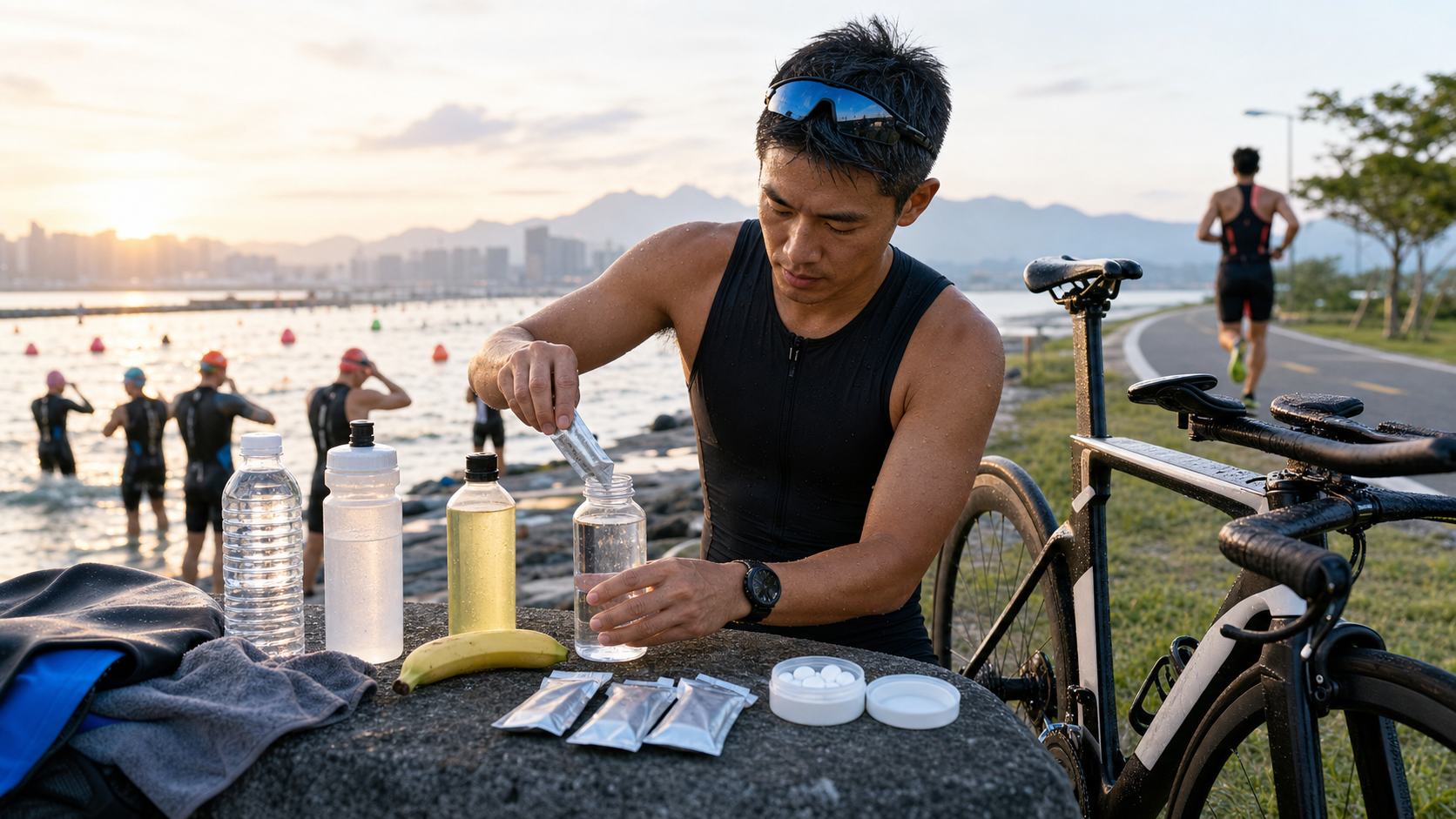
Why Should the Three Segments Be Considered Separately?
The biggest challenge in triathlon isn’t physical fitness—it’s whether your digestive system can keep up. The horizontal position during the swim, the forward-lean on the bike, and the vertical impact of the run place completely different stresses on your gut. A one-size-fits-all fueling approach will almost always fail at distances of IM 70.3 and beyond.
Segment 1: 60 Minutes Before the Swim
The swim leg (1.5–3.8 km) typically ends within 25–70 minutes, and you cannot fuel during the race. So the focus is on “being well-fueled beforehand without bloating.”
| Time Point | Content | Amount |
|---|---|---|
| 3 hours before | White toast + honey + banana | 80–100 g carbs |
| 60 minutes before | Sports drink | 300–400 ml |
| 15 minutes before | Energy gel | 1 pack (25 g carbs) |
Avoid: High-fiber foods, dairy, and fried foods. Cold swim water reduces stomach blood flow, and eating too much fat the night before can cause nausea in the water.
Segment 2: The Bike Leg Is the “Prime Fueling Window”
On the bike, your body is leaning forward, your position is stable, and your heart rate is relatively low—it’s the only time your gut can digest properly. Pack 80% of your total race fueling into this segment.
- Target intake: 60–90 g carbs per hour (glucose + fructose in a 2:1 ratio)
- Fluids: 500–750 ml per hour
- Electrolytes: 500–800 mg sodium per hour
Sample Bike Leg Menu (for IM 226)
| Time Period | Content |
|---|---|
| Hour 1 | 1 energy bar + 500 ml sports drink |
| Hour 2 | 2 energy gels + water + 1 salt tablet |
| Hour 3 | Half a banana + 500 ml sports drink |
| Hour 4 | 2 energy gels + water + salt tablet |
| Final 30 minutes | Water only, prepare for the run |
Segment 3: The Run Leg Is “Digestive Hell”
The vertical impact of running makes stomach contents slosh up and down. Combined with dehydration and rising core temperature, gut absorption efficiency drops to 50%.
Run Leg Fueling Principles
- Switch to liquids and gels: Solid food is nearly impossible to digest
- Take small, frequent sips: Drink 100–150 ml at each aid station—don’t chug
- Lower the concentration: Dilute energy gels with plenty of water
- Bring in the cola: In the later stages of the race (after 30 km), cola’s caffeine + simple sugars make it the classic lifesaver
Run Leg Timeline (IM Marathon Segment)
- 0–10 km: 1 energy gel every 30 minutes + sports drink
- 10–25 km: Energy gel + salt tablet + water
- 25–35 km: Cola replaces the sports drink
- 35 km–finish: Plain water + cola; energy gels depending on how your stomach feels
The Fueling Gap During Transitions
T1 (Swim → Bike): Don’t rush to eat in the first 10 minutes after mounting the bike. Let your heart rate stabilize and your breathing settle first.
T2 (Bike → Run): Stop solid food 30 minutes before dismounting. Eat nothing for the first 5 km after T2 to let your gut adapt to the impact of running.
“Gut Training” in Practice
This fueling volume isn’t something you can digest naturally from day one. You need to deliberately practice during long-distance training: force yourself to take in 60 g/hr of carbs on every long ride, and after 6–8 weeks, your gut will adapt.
Conclusion
Triathlon fueling is a “stomach endurance race.” Fuel up before the swim, pack it in on the bike, and do damage control on the run. Master these three segment principles, and the PB will come naturally.
Related Reading
- Open-Water Long-Distance Fueling: Energy Strategies for the Triathlon Swim Leg
- Triathlon Nutrition Strategy: A Complete Pre-Race, Mid-Race, and Post-Race Fueling Plan
- Nutrition Tactics for Triathlon: How to Keep Fueling Through Swim-Bike-Run
- Balanced Triathlon Training Across Three Disciplines: Time Allocation for Swim, Bike, and Run
靠單車減肥35公斤 心得分享與整理
7 年前
西進武嶺 免費訓練分析服務 Intervals | 練不夠還是練過頭?你哪一種類型選手?AI模型告訴你! | 備戰神器 | 公路車 訓練 | CT Yeh
4 年前
2019 夏季KOM 5小 完賽心得 準備攻略 東進武嶺 夏季登山王之路 Taiwan KOM Challenge
7 年前
Live) 備戰2019彰化經典百K 賽前攻略 (已完賽請看新影片
7 年前
FTL 與 SYB 車隊專訪 西進武嶺 實用攻略分享! 2小時 如何練?!你不知道的眉角!新手準備武嶺必看 EP1 | 實力派女車友 | 精華版 | 公路車 | CTYeh
4 年前
CT暗黑廚房) 車友必備 宇宙無敵鮮蚵湯 幫助訓練恢復 天然食補 好市多 超肥鮮蚵 破PR
7 年前
一日北高前的高裝檢 | 北高 360 | 挑戰11小時的裝備 | 一日雙塔 | 補給
6 年前
一日北高常見問題大集合 | 攻略 | 路線 | 訓練 | 補給 | 自行車 單車 | 一日雙城 | 雙塔 | TWB北高360 | 屁股痛
6 年前