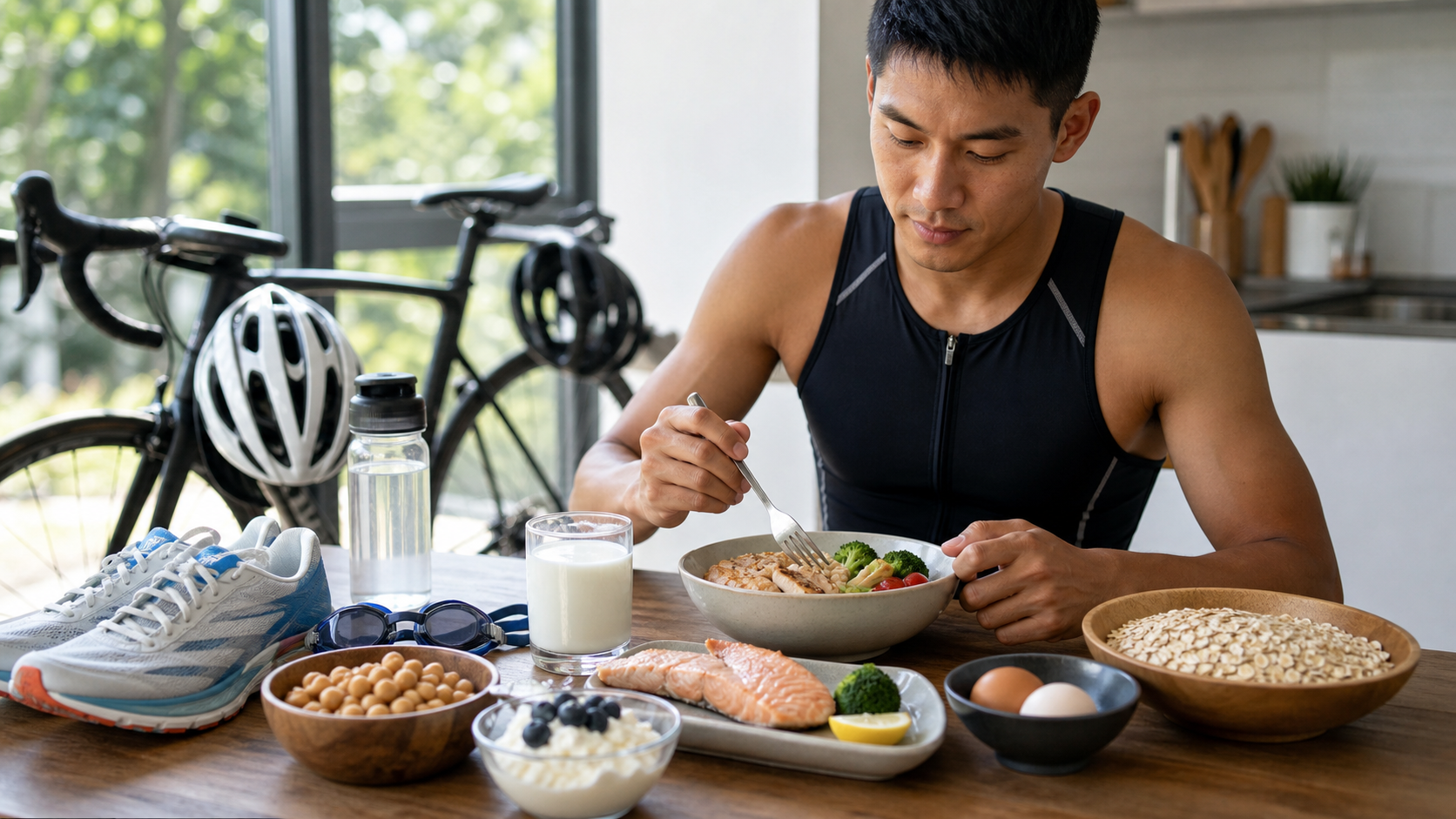
The “Minimum” vs. “Optimal” Protein Intake
The International Society of Sports Nutrition (ISSN) recommendations for endurance athletes:
- Minimum: 1.2 g/kg/d (to prevent muscle loss)
- Recommended: 1.4–1.7 g/kg/d (general training)
- Optimal: 1.8–2.2 g/kg/d (high training volume or weight loss phase)
Because triathletes have long training hours + three disciplines, muscle breakdown is greater than in single-sport athletes, so the recommendation falls at 1.6–2.0 g/kg/d.
1.6 vs 2.0: What’s the Difference?
For a 70 kg athlete:
- 1.6 g/kg = 112 g/day
- 2.0 g/kg = 140 g/day
The 28 g difference may seem small, but spread across 365 days × training = a total difference of 10,000 g. This gap affects:
- Post-training recovery speed (12–24 hours difference)
- Injury rate (15–20% lower in the high-protein group)
- Muscle mass retention at season’s end
- Immune system (the low-protein group gets colds 2–3 times more often)
Recommended Intake by Training Phase
| Phase | Recommended g/kg/d | Rationale |
|---|---|---|
| Base Phase | 1.6 | Moderate training volume |
| Build Phase | 1.8 | High-intensity muscle breakdown |
| Peak Phase | 1.8 | Maintain strength |
| Taper | 2.0 | Reduced volume but preserve muscle |
| Post-race Recovery | 2.0 | Tissue repair |
| Weight Loss Phase | 2.2 | Prevent muscle loss |
| Injury Period | 2.0 | Tissue repair |
How to Distribute Across the Day?
The key to protein absorption is spreading it out, not the total amount.
Golden Rule: 25–35 g Every 3–4 Hours
Research shows that absorption efficiency drops when a single meal exceeds 40 g. So instead of cramming 60 g into one meal, split it into two meals of 30 g each.
Daily Distribution for a 70 kg Athlete (Total 140 g)
| Meal | Protein g | Source |
|---|---|---|
| Breakfast (07:00) | 30 g | 2 eggs + 250 ml milk + oatmeal |
| Snack (10:00) | 20 g | Greek yogurt + nuts |
| Lunch (12:30) | 35 g | 120 g chicken breast + rice |
| Post-training (16:00) | 25 g | 1 scoop whey protein + banana |
| Dinner (19:00) | 35 g | 120 g salmon + eggs |
| Before bed (22:00) | 25 g | 150 g cottage cheese or casein |
Protein Source Comparison
| Food | Protein Content | Complete Amino Acids | Triathlon Recommendation |
|---|---|---|---|
| Chicken breast (100 g) | 31 g | Complete | First choice during training |
| Salmon (100 g) | 22 g | Complete + Omega-3 | 1–2 times/week |
| Beef (100 g) | 26 g | Complete + Iron + Zinc | 1–2 times/week |
| Eggs (1 egg) | 7 g | Complete + Choline | 2 daily |
| Greek yogurt (200 g) | 20 g | Complete + Probiotics | Daily |
| Cottage cheese (100 g) | 11 g | Casein | First choice before bed |
| Whey protein (30 g powder) | 24 g | Complete + Fast absorption | Post-training |
| Soybeans (100 g dry) | 36 g | Complete (plant-based) | For vegetarians |
| Chickpeas (100 g dry) | 19 g | Incomplete | Pair with rice to complement |
The 30-Minute Post-Training Window
Within the 30–60 minutes when muscle synthesis is at its peak after training:
- Target: 20–30 g of fast-absorbing protein
- First choice: Whey protein + high-GI carbs (3:1 ratio)
- Alternative: 400 ml chocolate milk (16 g protein + 50 g carbs)
Protein Before Bed
The body continues repairing during sleep, but you go 7–9 hours without food. Eating 20–30 g of casein (slow-release) 30–60 minutes before bed maintains nighttime amino acid supply.
Options:
- 150 g cottage cheese
- 1 scoop casein powder
- 200 g Greek yogurt + nuts
How to Tell If You Need 1.6 or 2.0?
When 1.6 g/kg/d Is Enough
- Training < 10 hours per week
- No weight loss goal
- Muscle soreness subsides within 24 hours post-training
- Body fat within normal range
When 2.0 g/kg/d Is More Suitable
- Training > 15 hours per week
- IM 226 race preparation period
- Simultaneously cutting fat
- Frequently feeling fatigued, slow muscle recovery
- Age 40+ (protein utilization declines in older adults)
What Happens with Excess?
Protein > 2.5 g/kg/d offers no additional benefit, and:
- Increases kidney burden (harmless for healthy individuals, but those with impaired kidney function should be cautious)
- Displaces carbohydrate intake
- Increases fluid requirements
Conclusion
Triathlon protein needs fall between 1.6–2.0 g/kg/d, leaning toward 2.0 in the Build Phase and 1.6 in the Base Phase. Spreading it across 5–6 meals of 25–35 g each is far more effective than cramming it into one meal.
Related Reading
- Protein Intake During Fat Loss: 2g/kg or 2.4g/kg Per Day? Precise Calculations for Endurance Athletes
- Protein Needs for Runners: Timing and Food Sources for 1.4–1.7 g/kg Intake
- Protein Requirements Explained: How Endurance and Power Athletes Differ
- Triathlon Nutrition Strategy: A Complete Fueling Plan from Training Days to Race Day
16/02/16 - 夜訪中社路 緩慢進步中
10 年前
西進武嶺 免費訓練分析服務 Intervals | 練不夠還是練過頭?你哪一種類型選手?AI模型告訴你! | 備戰神器 | 公路車 訓練 | CT Yeh
4 年前
CT暗黑廚房) 車友必備 宇宙無敵鮮蚵湯 幫助訓練恢復 天然食補 好市多 超肥鮮蚵 破PR
7 年前
靠單車減肥35公斤 心得分享與整理
7 年前
2016/4/20 - 中社路 夜騎 半年甩肉14KG 後測
10 年前
福隆鐵人團練隨拍
8 年前
CT 喇低賽) 武嶺牽車 才是王道 西進牽車四小時內秘訣 攝手位置 如何判斷 防抽筋小秘訣
7 年前
如果Pogačar騎西進武嶺可以多快?會破2嗎?各種情況深度推估探討 / 公路車 / CT Yeh
2 年前