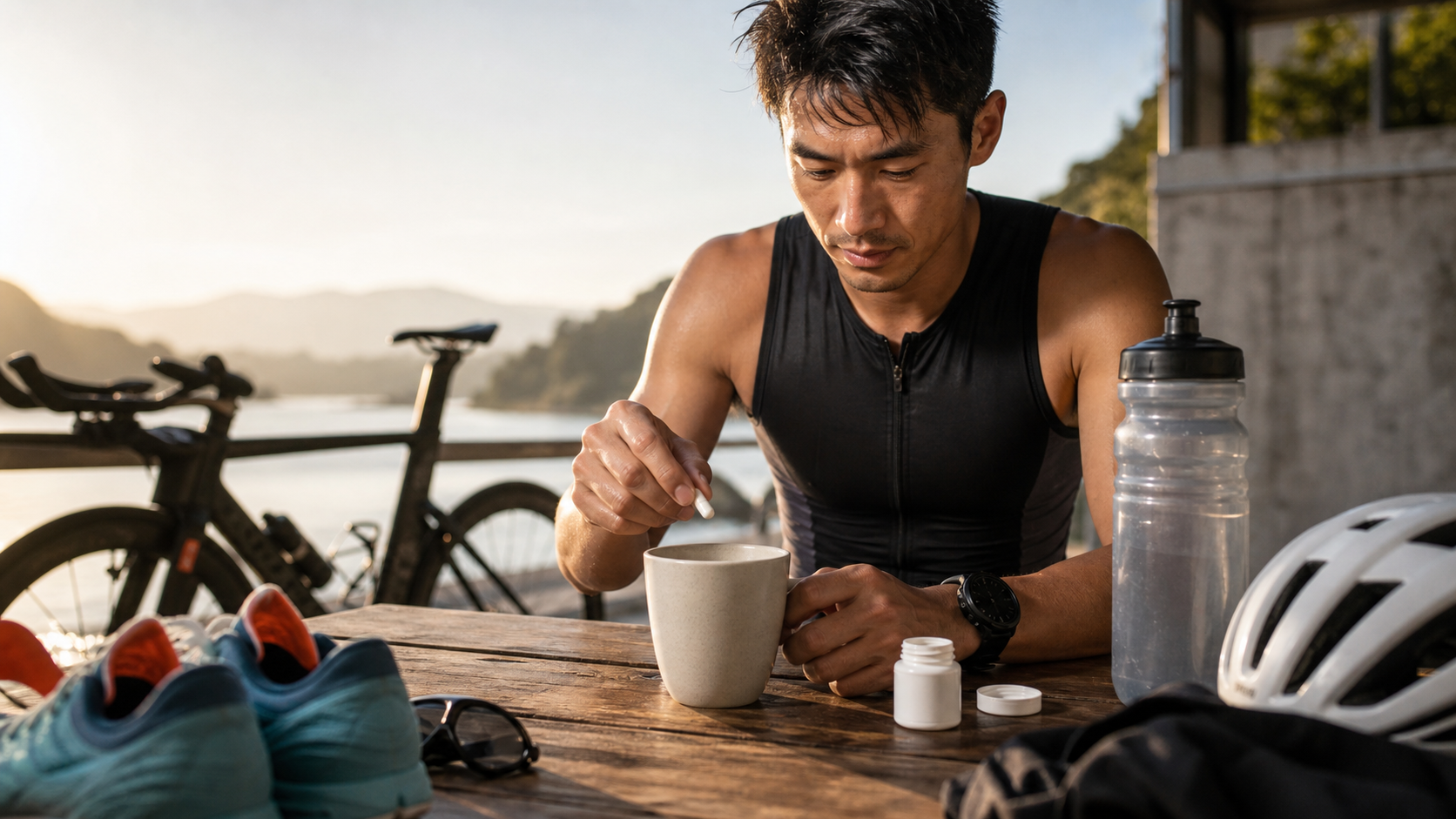
Why Is Caffeine Useful in Competition?
Caffeine is the only legal supplement recognized as effective by the IOC in sports nutrition. Mechanism:
- Blocks adenosine receptors: Reduces fatigue perception, increases alertness
- Increases adrenaline: Raises heart rate and contractility
- Promotes fat oxidation: Spares glycogen
- Lowers perceived exertion: Same intensity feels easier
Effect: Endurance performance improves by 1–4% (IM 226 = 5–25 minutes).
The Problem: Tolerance
For those who consume caffeine daily, the body develops tolerance within 5–7 days:
- Adenosine receptor count increases (compensatory mechanism)
- 200 mg on race day is equivalent to drinking nothing
- To regain the effect, you’d need 400–600 mg (but side effects increase significantly)
The Core Logic of Caffeine Periodization
By cyclically adjusting intake between high and low, you prevent the body from adapting, resetting the effect for race day.
Triathlon Annual Periodization Strategy
Base Phase: Low-Caffeine Weeks
- Training intensity is low; no need for a caffeine boost
- 50–100 mg daily (1 small coffee or tea)
- Key focus: let the body desensitize
Build Phase: Moderate-Caffeine Weeks
- Use caffeine only on high-intensity training days (e.g., before threshold workouts)
- 30 minutes before training: 3 mg/kg (70 kg = 210 mg, about 1 Americano)
- Other days: drop to 0–50 mg
Peak Phase: Low-Caffeine Taper
- Gradually reduce 7–10 days before race day
- Drop to 0 mg 3 days before the race (complete withdrawal)
- Key focus: maximize the effect on race day
Managing Withdrawal Side Effects
Abruptly stopping completely can cause:
- Headache (most common, within 48 hours)
- Fatigue, decreased concentration
- Low mood
Mitigation: gradual reduction
| Days Before Race | Caffeine Amount |
|---|---|
| D-10 | 75% of usual |
| D-7 | 50% |
| D-5 | 25% |
| D-3 | 0 mg |
| D-2 to D-1 | 0 mg |
| Race Day | Full dose 6 mg/kg |
Race-Day Caffeine Strategy
The Golden Dose
- Total: 3–6 mg/kg (70 kg athlete = 210–420 mg)
- Timing: 60 minutes before the start + split doses during the race
Full IM 226 Timeline
| Time | Dose | Source |
|---|---|---|
| 60 min before start | 200 mg | 1 caffeine tablet or 1 Americano |
| Bike hour 4 | 50 mg | 1 caffeinated energy gel |
| Bike hour 5 | 50 mg | 1 caffeinated energy gel |
| Run 10 km | 50 mg | 1 caffeinated energy gel |
| Run 25 km | 50 mg | Cola 250 ml + caffeine gel |
| Run 35 km | 30 mg | Cola 200 ml |
| Total | 430 mg (6 mg/kg) |
IM 70.3 Timeline
| Time | Dose |
|---|---|
| 60 min before start | 200 mg |
| Bike hour 2 | 50 mg |
| Run 7 km | 50 mg |
| Run 14 km | 50 mg |
| Total | 350 mg (5 mg/kg) |
Caffeine Source Comparison
| Source | Caffeine Amount | Characteristics |
|---|---|---|
| Americano (240 ml) | 95–165 mg | Amount inconsistent |
| Espresso (30 ml) | 60–80 mg | Amount consistent |
| Black tea (240 ml) | 40–60 mg | Contains L-Theanine, smoother |
| Green tea (240 ml) | 25–45 mg | Contains antioxidants |
| Energy drink (250 ml) | 80–160 mg | Contains other additives |
| Cola (330 ml) | 30–50 mg | Convenient late in race |
| Caffeine tablets | 100–200 mg | Precise dosing |
| Caffeinated energy gels | 25–100 mg | For use during racing |
Recommendation: Use coffee during training (for enjoyment), use caffeine tablets on race day (for precision).
Side-Effect Warnings
Exceeding 6 mg/kg or being caffeine-sensitive may cause:
- Palpitations, arrhythmia
- Anxiety, tremors
- Gastrointestinal discomfort, diarrhea
- Insomnia (affecting the night before the race)
- Excessive urination
Individual Differences: The CYP1A2 Gene
Caffeine metabolism rate is determined by the CYP1A2 gene:
- Fast metabolizers (CYP1A2 AA): Good caffeine response, fewer side effects; can use 6 mg/kg
- Slow metabolizers (CYP1A2 AC/CC): Longer caffeine half-life, more side effects; recommended to use only 2–3 mg/kg
You can use genetic testing (e.g., 23andMe) to find out which type you are.
How to Test During Training?
6–8 weeks before a major race, do two “caffeine simulation days”:
- 60 minutes before a long session simulating race intensity, consume 3 mg/kg
- Record: training performance, gastrointestinal response, heart-rate response, side effects
- Find the optimal dose for yourself
The Synergy of Caffeine + Carbohydrates
Research shows:
- Caffeine + carbohydrates: Carbohydrate absorption rate increases by 26%
- Caffeine + glucose: Muscle glycogen resynthesis accelerates by 66%
Drinking cola during a race (caffeine + glucose) works better than you might think.
Benefits of a Caffeine Fast
Schedule 2–3 “caffeine fast weeks” per year (7–14 days at complete 0 mg):
- Resets adenosine receptor sensitivity
- Reduces long-term dependence
- Improves sleep quality
Best placed during the off-season after the racing season ends.
Conclusion
The core of caffeine periodization: Low in Base, Moderate in Build, Withdraw in Peak, Explode on Race Day. For athletes who drink 3 cups of coffee daily, 200 mg on race day is wasted; but athletes who drink little on a daily basis, taper off before the race, and supplement precisely on race day can fully harvest caffeine’s 1–4% performance boost. In an IM, that’s a 5–25 minute difference.
Related Reading
- Caffeine Periodization Strategy: Maximizing Ergogenic Gains on Race Day
- The Complete Guide to Caffeine Supplementation: Dosage, Timing, and Genetic Differences—A Coach’s Guide to Using Caffeine Correctly
- Caffeine Supplementation Strategies for Cycling: Benefits, Timing, and Side-Effect Management
- Caffeine and Athletic Performance: The Legal Ergogenic Aid for Enhancing Endurance and Power Output
12/9 曜越Tomashinii 免費約騎,海倫咖啡 星巴克吃到飽😍 #公路車 #cycling
2 年前
西進武嶺 免費訓練分析服務 Intervals | 練不夠還是練過頭?你哪一種類型選手?AI模型告訴你! | 備戰神器 | 公路車 訓練 | CT Yeh
4 年前
CT暗黑廚房) 車友必備 宇宙無敵鮮蚵湯 幫助訓練恢復 天然食補 好市多 超肥鮮蚵 破PR
7 年前
五指山約騎,居然包場海倫咖啡無料吃喝! 牽車都比我快...大羞辱QQ | CHPT3 x 曜越單車活動小記錄 | 全程iPhone 14 Pro 4K電影級 拍攝| 公路車 | CT Yeh
3 年前
靠單車減肥35公斤 心得分享與整理
7 年前
2021 96聯賽 桃園市長盃 4K多視角實況 當天選手瓦數/推力比/均速/時間 即時數據分析 | 公路車 | CT Yeh
5 年前
#公路車 #西進武嶺 配速配瓦實驗 坡度分析 四小時內攻略 建大盃 NeverStop #西進武嶺攻略
6 年前
Live) 備戰2019彰化經典百K 賽前攻略 (已完賽請看新影片
7 年前