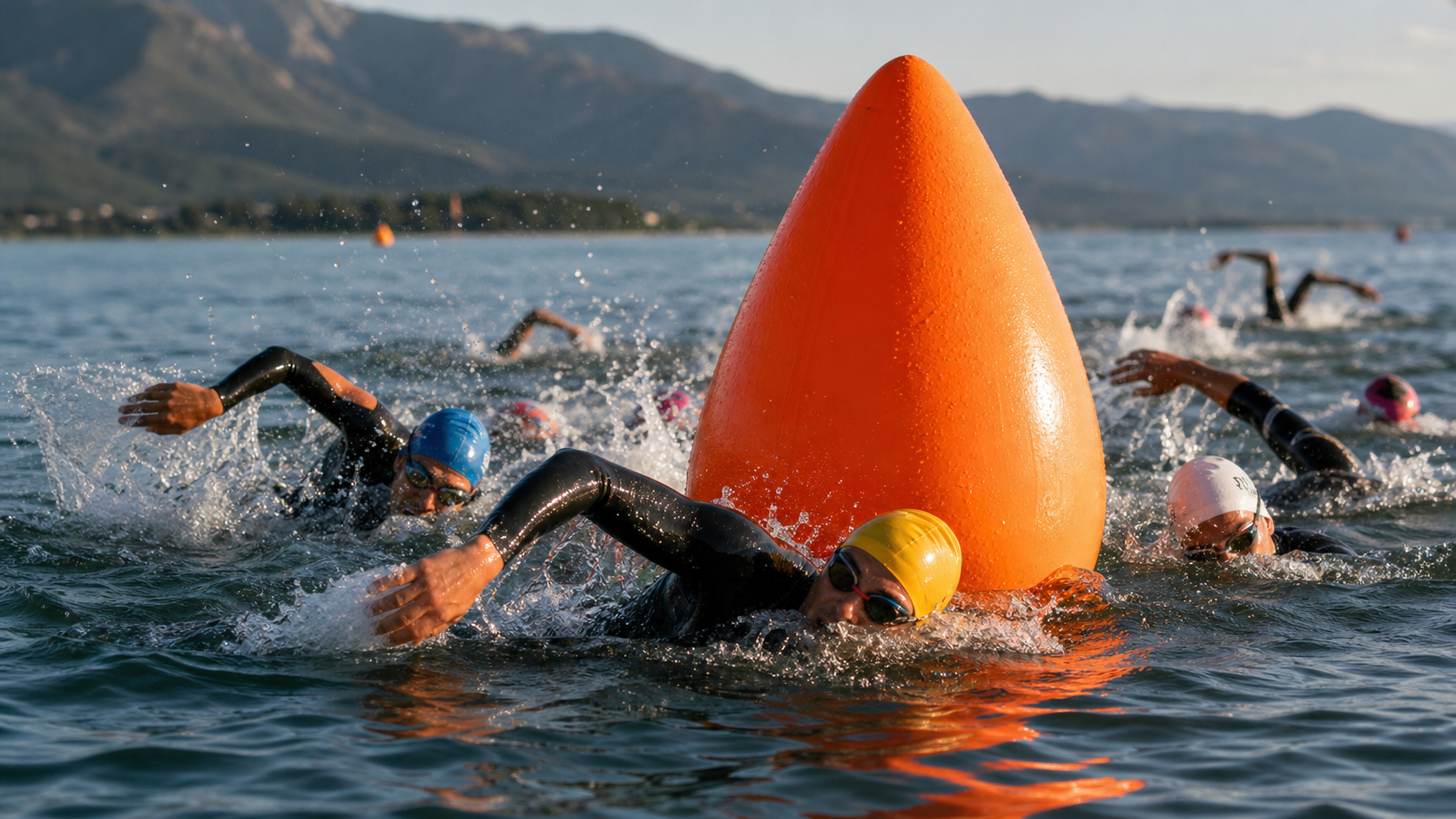
Why Buoy Turns Are So Chaotic
In a 200-meter-wide body of water, all swimmers must round the same 60-centimeter buoy. The turning point concentrates:
- High-density crowds (more congested than after the start)
- Speed changes (slowing down to turn)
- Directional chaos (some want to cut inside, others want to avoid the pack)
- Energy expenditure (turning requires extra movements)
Statistics show that each buoy takes an average of 8-15 seconds, while skilled swimmers only take 5-7 seconds.
Three Buoy Layouts and How to Handle Them
1. 90-Degree Turn Buoy (Most Common)
Swim in from one side, turn 90 degrees, and continue. Commonly found on triangular or square courses.
Inside-line approach:
- Start slowing down 20 meters before the buoy
- When the buoy is on your right, switch to left-side breathing for the final 5 meters
- Turn naturally as you catch water with your left hand
- Push hard on the first stroke after the turn to accelerate
Outside-line approach:
- Pass 2-3 meters around the buoy
- Avoids crowding but adds 3-5 meters to your route
- Suitable for swimmers who want to avoid conflict
2. 180-Degree Reverse Buoy (Turnaround Point)
Swim to the end and turn back toward the start. Common on out-and-back courses.
Techniques:
- Use a “standing turn”: stop before the buoy, tread water, and turn around
- Or a “flip turn”: similar to freestyle somersault (high difficulty)
- Most amateur swimmers are safer using the standing turn
3. Consecutive Buoys (Zigzag Pattern)
2-3 buoys arranged in sequence, requiring alternating left and right turns.
Techniques:
- Don’t fight for the inside line at every buoy, or you’ll get squeezed out
- Take the inside line at the first buoy and the outside at the second to spread the risk
- Maintaining rhythm matters more than fighting for position
Inside-Line Turn Technical Details
Winning the inside line is the best strategy for rounding buoys:
Step 1: Position Early (50 meters from the buoy)
- Start drifting inward from your current position
- Shift inward 1 meter every 10 strokes
- By the time you’re 20 meters from the buoy, you should already be on the inside
Step 2: Control Speed (10 meters from the buoy)
- Don’t sprint full speed toward the buoy
- Slow down to 80% speed, leaving room to react
- Observe the positions of swimmers around you
Step 3: The Turn Itself (0-2 meters from the buoy)
- Buoy on your right: catch with your right hand → pull → turn naturally
- Buoy on your left: catch with your left hand → pull → turn naturally
- Turn angle of 60-90 degrees, depending on the buoy layout
Step 4: Accelerate Away (5 meters past the buoy)
- Take 5-8 powerful strokes in a row
- Rebuild your speed
- Check the pack’s position and decide whether to keep drafting
Escape Techniques When Boxed In
The most common problem when rounding buoys is being squeezed between the buoy and other swimmers:
Scenario 1: Buoy on the right, swimmer on the left, you’re trapped
Wrong: Force your way into the gap by the buoy
Right: Slow down for half a second, let the other swimmer pass, and go around from behind
Scenario 2: Two swimmers boxing you in from both sides
Wrong: Push them away forcefully
Right: Drop 0.5 meters and escape underwater
Scenario 3: Pushed away from the buoy, forced to the outside
Wrong: Try to force your way back to the inside line
Right: Accept the extra 3-5 meters, and accelerate to catch the pack
Rules on Buoy Contact and Grabbing
FINA rules:
- Touching the buoy: Legal, no penalty
- Grabbing the buoy to rest: Legal, but someone nearby may push you
- Using the buoy as a pivot to push off: Illegal, may result in disqualification
- Intentionally hitting an official’s boat: Illegal
Visual Identification of Buoys
Buoy colors at major events:
| Color | Purpose |
|---|---|
| Yellow/Orange | Turn buoys (must be rounded) |
| Red | Finish or start buoys |
| White | Course markers (no need to round; treat as guides) |
| Green | Aid stations or safety boats |
Always confirm the color definitions during the pre-race course inspection to avoid rounding the wrong buoy.
Training Methods
- Pool cone drills: Place floating cones in the pool to practice 90-degree turns
- Teammate simulation: Have 3-5 swimmers round the same buoy simultaneously
- Flip turns: Practice applying freestyle flip turns in open water
- Pre-race course inspection: Swim the course once and memorize the buoy positions
Conclusion
Rounding buoys is a dual test of technique and psychology. Skilled swimmers can save 3-5 seconds at each buoy; a 1500-meter race with 4 buoys means saving 12-20 seconds, enough to change your ranking. Practicing buoy turns at least once a week will show a clear difference in competition.
Related Reading
- Open Water Turn Buoys: Turning Technique and Inside/Outside Position Strategy
- Open Water Turn Buoy Technique: The Best Line and Speed for Staying Close to the Buoy
- Complete Open Water Race Analysis: Positioning, Rounding Buoys, Pack Swimming, and Rolling Start Strategies
- Open Water Swimming Tactics: Positioning, Drafting, Buoy Turns, and Surviving the Pack
CT 喇低賽) 武嶺牽車 才是王道 西進牽車四小時內秘訣 攝手位置 如何判斷 防抽筋小秘訣
7 年前
西進武嶺 免費訓練分析服務 Intervals | 練不夠還是練過頭?你哪一種類型選手?AI模型告訴你! | 備戰神器 | 公路車 訓練 | CT Yeh
4 年前
2023桃園團體繞圈賽 / 海鷗繞圈賽 | 全程空拍數據版 | 公路車 | CT Yeh
2 年前
#公路車 #西進武嶺 配速配瓦實驗 坡度分析 四小時內攻略 建大盃 NeverStop #西進武嶺攻略
6 年前
新屋團體繞圈賽 | 眾多菁英好手賽道奔馳 | 千瓦女子軍團 | 無敵交管狂獲好評 明年你一定不能錯過 | #公路車
5 年前
2025 海鷗團體繞圈賽 網路直播 超激烈裁判長視角 / EIPC 李廷威、Waypoint 等眾多高手競爭 / feat. 卡密兒主持 / 海鷗繞圈賽
9 個月前
2023桃園團體繞圈賽/環台賽等級拍攝/賽事精華/ 10人一隊缺一不可!50隊廝殺大場面 / 第三屆 海鷗繞圈賽 /公路車/CT Yeh
2 年前
碟煞公路車 優缺點?換車一年半實際經驗分享 / 公路車 / CT Yeh
2 年前