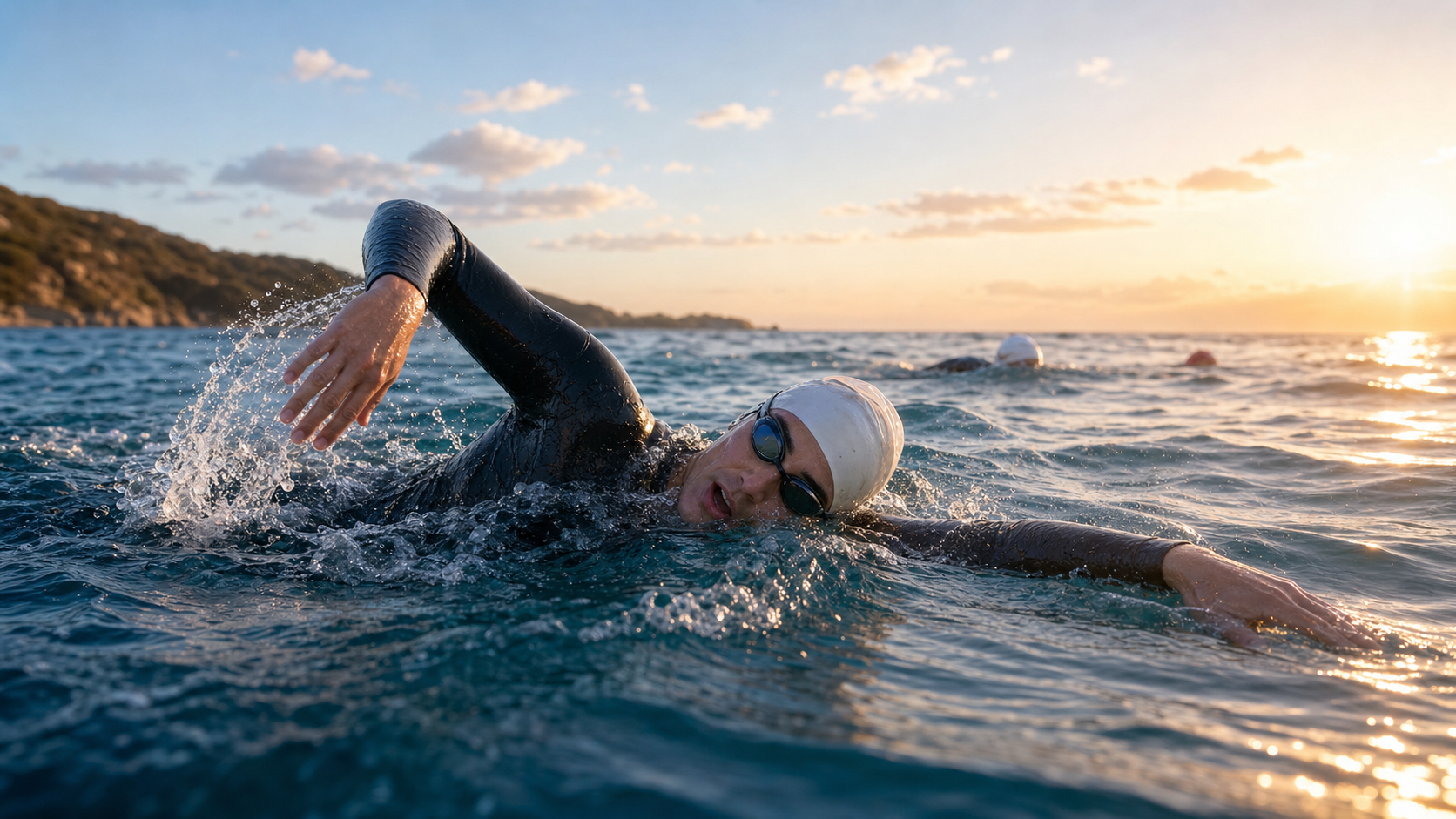
Why Bilateral Breathing Is Essential in Open Water
In a pool, unilateral breathing can work well, but in open water there are four key reasons you must breathe bilaterally:
- Wave avoidance: Breathe to the opposite side of where the waves are coming from
- Glare avoidance: Breathe to the opposite side of where the sun is
- Observation: Being able to see competitors’ positions on both sides
- Balance: Avoiding long-term shoulder fatigue on one side
Types of Breathing Rhythms
2-Stroke Breathing (Unilateral)
- Breathe once every 2 arm strokes
- Always on the same side
- Not recommended for open water
3-Stroke Breathing (Bilateral)
- Breathe once every 3 arm strokes
- Automatically alternates sides
- Most commonly used in open water
4-Stroke Breathing (Unilateral)
- Breathe once every 4 arm strokes
- Same as 2-stroke, unilateral
- Advanced unilateral technique
5-Stroke Breathing (Bilateral)
- Breathe once every 5 arm strokes
- Longer intervals between breaths
- Advanced bilateral, used for short-distance sprints
7-Stroke Breathing (Bilateral)
- Breathe once every 7 arm strokes
- Close to breath-holding
- Special tactic for 25-50m sprints
Three Major Tactical Scenarios
Scenario 1: Responding to Wave Direction
Waves from the right:
  - Switch to 2-stroke breathing on the left
  - Or use 4-stroke breathing on the left

Waves from the left:
  - Switch to 2-stroke breathing on the right
  - Or use 4-stroke breathing on the right

Waves from directly behind:
  - Use 3-stroke bilateral breathing (either side is safe)
Scenario 2: Sun Position
In morning races, the sun rises in the east:
- Start heading east: Sun ahead, both sides will be glaring
- Start heading west: Sun behind, no impact
- Start heading north: Sun on the right, switch to left-side breathing
- Start heading south: Sun on the left, switch to right-side breathing
Scenario 3: Drafting Position
When you are swimming behind someone:
- They are ahead and to the right: Breathing to the left means you can’t see them, switch to right-side breathing
- They are ahead and to the left: Switch to left-side breathing
- They are directly ahead: Breathe on either side, but sight regularly to confirm your position
Learning Steps for Bilateral Breathing
Week 1: Forced Bilateral
- Spend 1/3 of each session using 3-stroke breathing
- Add 100 meters on the uncomfortable side each day
- Accept that pace will drop 5-10%
Week 2: Rhythm Stabilization
- Spend 1/2 of the time using 3-stroke breathing
- Force deep breaths on the weak side
- Pace gap narrows to 3-5%
Week 3: Tactical Application
- Use 3-stroke breathing for the entire session
- Begin practicing 5-stroke breathing
- Try switching between 2-stroke and 3-stroke
Week 4: Free Switching
- Switch dynamically based on the situation
- Do it without thinking
- Pace comparable to unilateral breathing
When to Switch Breathing Rhythms
When to Switch to 2-Stroke (Unilateral)
- Final 100 meters of a sprint (need more oxygen)
- Waves clearly coming from one side
- Sun glare that must be avoided
- Checking a competitor’s position while drafting
When to Switch to 5-Stroke
- Short-distance sprints (25-50 meters)
- Wanting to observe a farther target
- Training lung capacity
When to Maintain 3-Stroke
- General cruising pace
- No obvious external factors
- Wanting to conserve energy
Breathing Technique Details
1. Breathing Angle
- Standard: Head rotates 90 degrees
- Open water: Head rotates 100-110 degrees (a bit more)
- Avoid: Lifting the head (breaks horizontal body position)
2. Breathing Timing
- Start rotating the head during the catch phase
- Mouth clears the water at the end of the pull
- Mouth goes back in the water at the moment of hand entry
- Entire motion takes 0.5-0.7 seconds
3. Inhalation and Exhalation
- Quick inhale: Complete within 0.3 seconds (mouth wide open)
- Slow exhale: Continuous exhalation underwater (nose + mouth)
- Ratio: Inhale-to-exhale ratio of 1:2 (1 second inhale, 2 seconds exhale)
Training for the Weak Side
Most people have a “preferred breathing side,” and the weak side requires dedicated training:
Drill 1: Unilateral Strengthening
- Swim 200 meters using only the weak side for breathing
- 3 times per week
- For 4 consecutive weeks
Drill 2: Breaking the Preference
- Force bilateral breathing even in races
- Accept the initial discomfort
- After 1-2 months, the weak side will become strong
Drill 3: Breath Control
- Deliberately take large breaths when breathing on the weak side
- Train the respiratory muscles on the weak side
- Build confidence on the weak side
The Relationship Between Breathing and Pace
Breathing rhythm directly affects pace:
| Rhythm | Pace Impact | Suitable Distance |
|---|---|---|
| 2-stroke | Baseline speed | All distances |
| 3-stroke | -2~-5% | Mid-to-long distance |
| 4-stroke | -5~-8% | Mid-distance |
| 5-stroke | -8~-12% | Short-distance sprint |
| 7-stroke | -15~-20% | 25m sprint |
Training Methods
- 3+2 Alternation: Swim 50m with 3-stroke, 50m with 2-stroke, repeat
- Rhythm Cards: Change rhythm every 100m
- Pace Control: Hold 1:30/100m, test comfort at different rhythms
- Open-Water Practice: Outdoor bilateral breathing practice twice a month
Conclusion
Bilateral breathing is the basic threshold for open water, but being able to switch between different rhythms based on the situation is what truly separates advanced swimmers. Many athletes stay at the “can breathe bilaterally” stage without using it as a tactical weapon. Investing 1-2 months in dedicated training can save 30-60 seconds in a race and significantly reduce risk.
Related Reading
- Open-Water Breathing Strategy: Choosing Between Unilateral and Bilateral Breathing by Situation
- Freestyle Breathing Technique: Bilateral Breathing Training Methods and Race Applications
- Open-Water Breathing Rhythm: Techniques for Maintaining Long-Distance Performance
- Freestyle Bilateral Breathing: Learning Methods, Pros and Cons
多機位拍片神器 DJI Action 2 拍出速度張力感 | 類空拍機視角 4陣列麥克風超強降風噪 實測! | 公路車 | CT Yeh
3 年前
#公路車 #Vo2Max #最大攝氧量 測驗 體驗 | 心肺測試
6 年前
CT 喇低賽) 武嶺牽車 才是王道 西進牽車四小時內秘訣 攝手位置 如何判斷 防抽筋小秘訣
7 年前
風櫃嘴 衝刺慢動作回放!
8 年前
類空拍神器 Feiyu Pocket 2s (有優惠連結)三軸穩定 運動攝影機 開箱!比GoPro 還強的滑順視角!三小時長時間錄影 行車記錄器 | 環花東365實測 | 公路車 CT Yeh
4 年前
下雨天就是要改車 #ceramicspeed #bike
1 年前
如何把 GoPro 影片 翻轉 批次 轉正?
6 年前
碟煞公路車 銑面器 !? 原來銑完差這麼多! 降低蹭碟機率! | TIME 公路車 保養小記錄 | CT Yeh
3 年前