What Is Panic in the Water
Open Water Panic is an acute anxiety response. Common signs include:
- A sudden feeling of being unable to breathe (hyperventilation)
- Heart rate spiking to 180+ bpm
- Stiff, uncoordinated limbs
- Tunnel vision, dizziness
- An intense urge to grab onto anything (lifeguards, buoys, other competitors)
- Loss of sense of direction
Statistics show:
- First-time open water swimmers: 30-40% will experience panic
- Amateur athletes during races: 10-15% will experience it
- Elite athletes: < 2% will experience it
- Fatal drowning cases: 80% are triggered by panic
Panic Triggers
Environmental Factors
- Sudden drop in water temperature (more than 5°C colder than expected)
- Inability to see the bottom (fear of deep water)
- Large waves, poor visibility
- Getting tangled in seaweed or debris
Physiological Factors
- Inhaling water, swallowing water
- Cramps
- Wetsuit too tight
- Heart rate too high
Psychological Factors
- Fear of the distance
- Getting kicked or pushed
- Inability to see the shore
- Anxiety about falling behind
Three-Step Self-Rescue Process
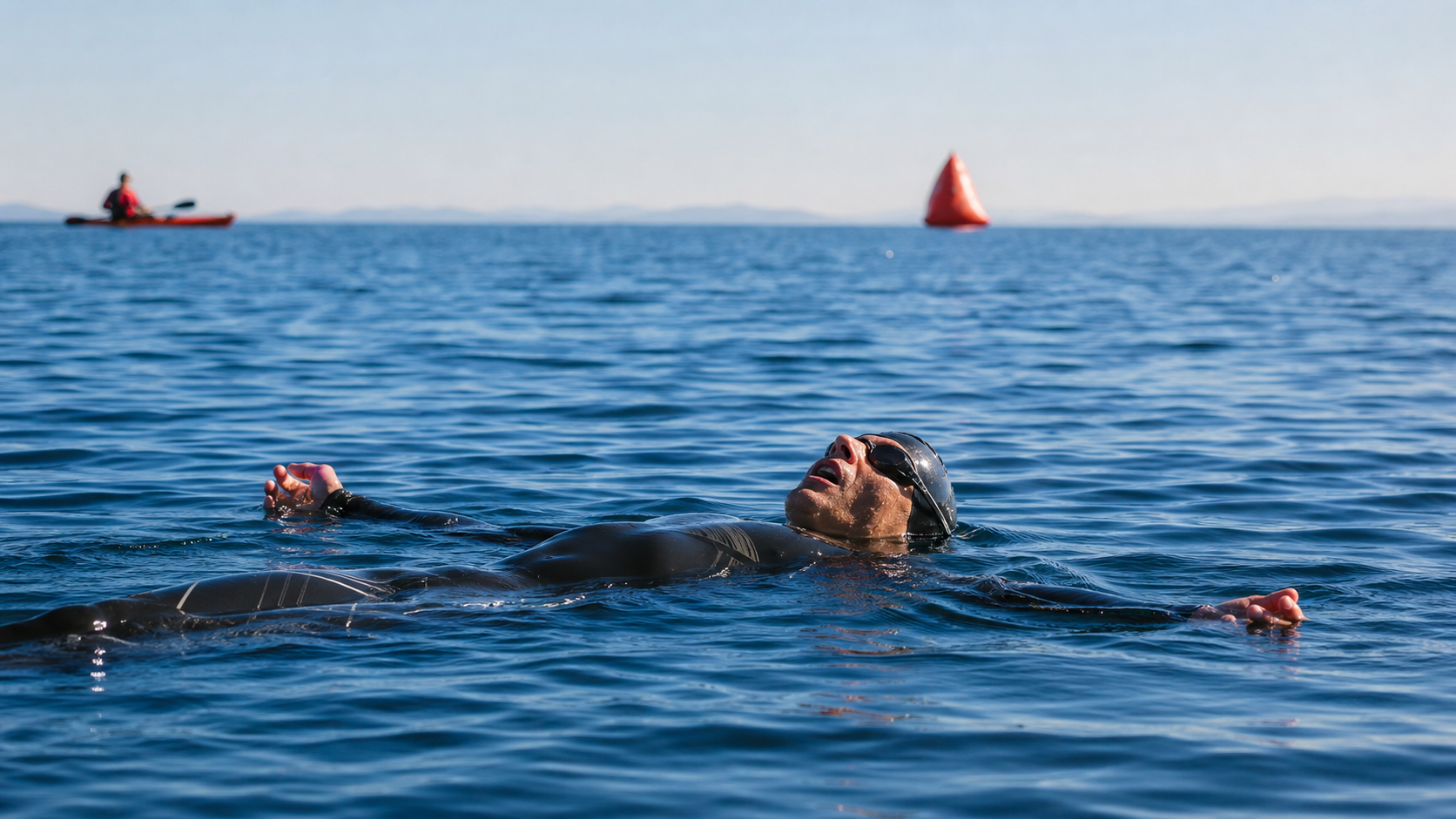
Step 1: Flip Over and Float (30 seconds)
The first thing to do the moment you feel panic:
- Stop swimming: Don’t force yourself to continue
- Flip onto your back: Back down, belly up
- Spread your arms and legs: To increase buoyancy
- Tilt your head back: Keep your mouth above the water
- Take 3 deep breaths: Inhale through the mouth, exhale through the nose
Floating on your back is the most energy-efficient position. You won’t sink, and it allows you to rest and recover.
Step 2: 4-7-8 Breathing Technique (30 seconds)
A rapid calming method used by the military in the field:
- Inhale for 4 seconds: Slowly through the nose
- Hold for 7 seconds: While on the surface
- Exhale for 8 seconds: Slowly through the mouth
- Repeat 3 times: 57 seconds total
This breathing technique can:
- Lower heart rate by 20-30 bpm
- Reset your breathing rhythm
- Activate the parasympathetic nervous system
- Restore rational thinking
Step 3: Mental Reset (30 seconds)
Once your breathing is restored, reassess:
- Confirm your position: Where am I? How far from shore?
- Reset your goal: Don’t think about the finish line; think about the next buoy
- Set your pace: Resume at 70% speed
- Breathe to one side: Start with your dominant side to re-establish rhythm
Responding to Different Types of Panic
Type 1: Triggered by Inhaling Water
- Symptoms: Sudden coughing, inability to breathe
- Response: Backstroke + cough out the water continuously + breathe calmly
- Resume: After 1-2 minutes
Type 2: Triggered by Cramps
- Symptoms: Severe leg pain, unable to kick
- Response: Backstroke + massage the cramped area with your hands + stretch
- Resume: Use a pull buoy motion (arms only, no kicking)
Type 3: Fear of Depth
- Symptoms: Suddenly realizing the water is very deep
- Response: Don’t look down + fix your gaze on a distant target + regulate your breathing
- Resume: Tell yourself, “Water depth doesn’t affect swimming”
Type 4: Crowd Crush
- Symptoms: Being squeezed so much you can’t breathe, heart rate spikes
- Response: Swim 5-10 meters to either side + adjust with backstroke
- Resume: Choose a less crowded route
Type 5: Fear of Distance
- Symptoms: Breaking down when you see how far is left
- Response: Don’t look at the finish line + break it down into “next buoy” segments
- Resume: Mentally divide the distance into 200m units
Distress Signals
If self-rescue fails to recover, you must call for help:
Standard Distress Signals
- Raise one hand: Indicates “I need help”
- Raise both hands: Indicates an emergency
- Lie on your back, tread water, and shout: A lifeguard will come immediately
After the Lifeguard Arrives
- Grab the flotation device the lifeguard provides (don’t grab the lifeguard themselves)
- Breathe calmly
- Follow instructions
- Important: Being rescued is nothing to be ashamed of—it’s far better than drowning
Pre-Race Preparation to Prevent Panic
Mental Preparation
- Visualize success: For 1 week before the race, imagine the entire race process daily
- Familiarize yourself with the venue: Visit and scout the site 1-2 days before the race
- Lower expectations: Don’t set unrealistic performance goals
- Accept discomfort: Open water naturally involves some discomfort
Physical Preparation
- Get enough sleep: 7-8 hours, to avoid fatigue triggering panic
- Eat appropriately: Eat half a bowl of rice plus fruit 2 hours before the race
- Warm up thoroughly: Swim for 10-15 minutes before the race
- Check your gear: Wetsuit, goggles, and swim cap all fit properly
Technical Preparation
- Backstroke ability: Must be able to float on your back for 5+ minutes
- Treading water skills: Able to tread water for 1 minute
- Bilateral breathing: To handle different wave directions
- Long-distance experience: Must have swum 1.2 times the race distance during training
Simulating Panic in Training
To be able to cope during a race, practice these drills regularly:
Drill 1: Deliberately Inhaling Water
- Midway through a pool swim, deliberately inhale a mouthful of water
- Practice recovering with backstroke
- Repeat 5 times to build confidence
Drill 2: Swimming with Eyes Closed
- Swim 25 meters with your eyes closed
- Simulate the fear of not seeing your target
- Learn to judge direction using hearing and touch
Drill 3: Crowding Drill
- Have 3-5 people swim crowded together in the same lane
- Practice responding when squeezed
- Build mental resilience
Drill 4: Gradual Open Water Adaptation
- First session: Swim 100m, focusing on “not panicking”
- Second session: Swim 500m
- Third session: Swim 1500m
- Build confidence progressively
Post-Race Review
If you experienced panic during a race:
- Record when it happened: At which kilometer?
- Record the trigger: What caused it?
- Record your response: What method did you use to recover?
- Improve for next time: How can you prevent it from happening again?
Conclusion
Panic is not cowardice; it’s your body’s protective response. Even world-class athletes have experienced panic. What matters is not “never panicking,” but “knowing how to rescue yourself when panic strikes.” Every athlete entering open water should master the 3-step self-rescue process and turn it into an instinct. Remember: nothing in the water is more important than safety, and withdrawing from a race when necessary is a brave choice.
Related Reading
- Open Water Mental Challenges: Overcoming Isolation and Panic to Regain Confidence in the Water
- Overcoming Open Water Swimming Fear: A Systematic Approach to Mental Barriers
- Emergency Response to Failed Breathing in Open Water: Essential In-Water Calming Techniques for Triathletes
- Open Water Safety and the Science of Hypothermia: Water Temperature, Wetsuit Limits, and Cold Shock Self-Rescue
[教學] Premiere 影片 手震 修正 教學 防抖 單眼 影像 GoPro 穩定 Video Stabilization
8 年前
CT 喇低賽) 武嶺牽車 才是王道 西進牽車四小時內秘訣 攝手位置 如何判斷 防抽筋小秘訣
7 年前
FTL 與 SYB 車隊專訪 西進武嶺 實用攻略分享! 2小時 如何練?!你不知道的眉角!新手準備武嶺必看 EP1 | 實力派女車友 | 精華版 | 公路車 | CTYeh
4 年前
2023桃園團體繞圈賽 / 海鷗繞圈賽 | 全程空拍數據版 | 公路車 | CT Yeh
2 年前
滑雪新手們慘摔學習全紀錄(請開字幕),滑雪好好玩 | Snowboard + Ski | 岩原 スキー場 | 滑雪APP使用 | GoPro Max
6 年前
一日北高常見問題大集合 | 攻略 | 路線 | 訓練 | 補給 | 自行車 單車 | 一日雙城 | 雙塔 | TWB北高360 | 屁股痛
6 年前
西進武嶺 免費訓練分析服務 Intervals | 練不夠還是練過頭?你哪一種類型選手?AI模型告訴你! | 備戰神器 | 公路車 訓練 | CT Yeh
4 年前
2025 海鷗團體繞圈賽 網路直播 超激烈裁判長視角 / EIPC 李廷威、Waypoint 等眾多高手競爭 / feat. 卡密兒主持 / 海鷗繞圈賽
9 個月前