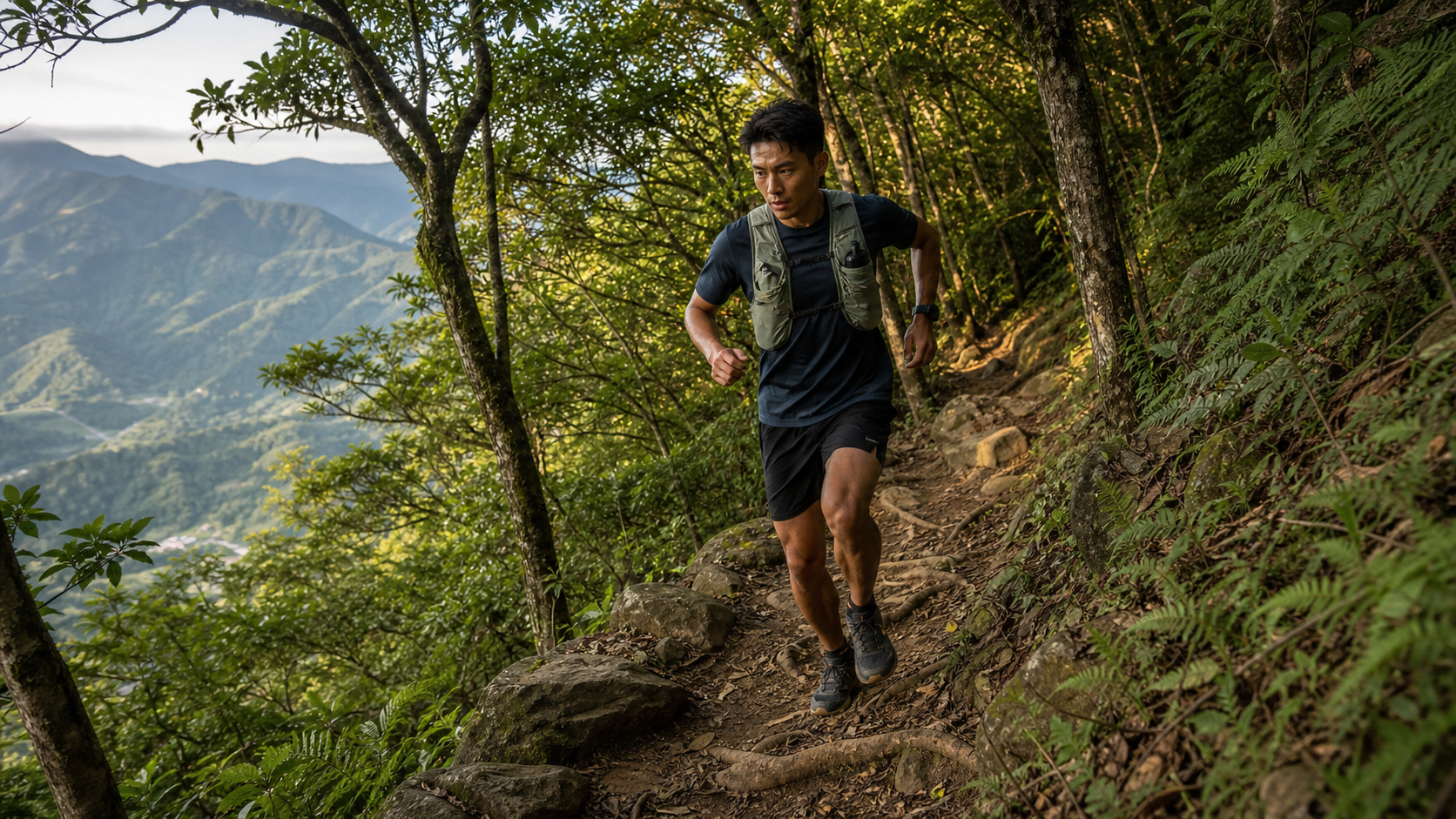
The Pacing Paradox of Trail Racing
On the road, you watch your Garmin and run 5:00/km; on the trails, watching your Garmin and running 5:00/km would be a disaster. Here’s why:
- Pace is meaningless: Uphill 8:00, downhill 4:00, flats 5:30—the average has no reference value
- GPS error is significant: Under tree canopy, GPS distance can underreport by 10-15%
- Heart rate drifts faster: Terrain changes cause heart rate to spike wildly
- Energy expenditure is non-linear: Steep climbs burn 2-3 times more calories per minute than flats
What You Should Look At Instead
Primary Metric: Rate of Perceived Exertion (RPE)
RPE on a 1-10 scale:
- 1-3: Warm-up pace
- 4-5: Can run and chat comfortably (suitable for 50K+ trail races)
- 6-7: Can speak short sentences (suitable for 25-50K trail races)
- 8-9: Can only utter single words (suitable for 10-25K trail surges)
- 10: Unable to speak (finish-line sprint)
In a trail race, you should maintain RPE 5-7 most of the time, adjusting based on distance.
Secondary Metric: Heart Rate
Heart rate is worth checking, but don’t chase the numbers. Focus on the “drift trend”:
- Heart rate steadily rising → intensity too high, need to slow down or refuel
- Heart rate stable → intensity is appropriate
- Heart rate dropping along with pace → accumulated fatigue, this is normal
Supporting Metric: Rate of Ascent
More meaningful than pace is “vertical ascent per hour” (VAM):
- Amateur trail runners climbing VAM: 500-800 m/h
- Elite trail runners climbing VAM: 1000-1200 m/h
- Hiking pace VAM: 300-400 m/h
Uphill Pacing Strategy
Gentle Slopes (3-6%)
- Maintain running form, shorten stride
- Pace may drop 20-40 sec/km
- Heart rate 5-8 bpm higher than on flats
Moderate Slopes (6-12%)
- Alternate between “power hiking” and short jogs
- Keep heart rate below 90% of max
- Use trekking poles (if allowed) to save 20% of effort
Steep Slopes (12%+)
- Power hike directly
- Push off with hands on knees for assistance
- Don’t force a run just to “save face”
Downhill Pacing Strategy
Gentle Downhills
- Let the speed out, but stay within your comfort zone
- Keep cadence at 180+, let stride extend naturally
- Make up time lost on the climbs
Steep Downhills
- Shorten stride, lean center of gravity back
- Watch your foot placement to avoid ankle rolls
- Heart rate may actually drop, but eccentric leg contractions take a toll
- Don’t bomb downhill excessively just to “save time”
Refueling Rhythm
Refueling matters more in trail races than road races:
- Every 30 minutes: 100-150 ml water + 50-100 mg sodium
- Every 45 minutes: 30-60g carbs (energy gels/chews/chewable food)
- At every aid station: Top off your bladder, stay 30-60 seconds (don’t skip this time)
Mental Pacing: Segment Thinking
For trail races over 25K, break the race into “aid station to aid station” segments:
- Don’t think about the finish line
- Only think about “getting to the next aid station”
- Set a small goal for each segment
- Reassess after completing each one
Conclusion
Trail racing is “the opposite of pacing philosophy”: let go of the pace numbers and feel the terrain with your body. Treat the watch as a recording tool, not a commander. Those who finish are the ones who have learned to “run without watching the pace.”
Related Reading
- Trail Running vs. Road Running: Why Pace Judgment Shouldn’t Rely Only on Kilometers
- Trail Running Heart Rate Training: Why Heart Rate Is Unreliable on Trails and You Should Look at RPE
- Road Running Heart Rate Pace vs. GPS Pace: Which Is More Accurate
- Road Running GPS Watch Pace Error: Why Your Pace Isn’t Accurate
Garmin Edge 1050 旗艦車錶 全台首測!/ 環法冠軍指定 / 對比Edge 1040改進哪些? / 公路車 / CT Yeh
2 年前
西進武嶺 自製新版AI配速表產生器 x 賽前攻略 抱佛腳! 沒有功率計也可以產生配速表嗎?有什麼其他眉角賽前要注意的呢? | 西進武嶺 / 東進武嶺 KOM 攻略 | 公路車 | CT Yeh
4 年前
#公路車 #西進武嶺 配速配瓦實驗 坡度分析 四小時內攻略 建大盃 NeverStop #西進武嶺攻略
6 年前
武嶺配速表最佳使用方式 #bike
1 年前
西進武嶺各路段 前8000名 大數據分析 配速攻略/功率/心律/推力比/維持率/踏頻/踏瓦比/牽車率 大公開 | 建大盃 NeverStop 可參考 | 公路車 | CT Yeh
5 年前
崇越盃武嶺冠軍高手 賽前JJSC 群峰會精華!對應大數據分析,會有落差嗎?/ feat. JJSC中部公路車約騎 /公路車 / CT Yeh
2 年前
西進武嶺 免費訓練分析服務 Intervals | 練不夠還是練過頭?你哪一種類型選手?AI模型告訴你! | 備戰神器 | 公路車 訓練 | CT Yeh
4 年前
Garmin Edge 1040 重大韌體更新!! / 1050功能全下放!? / 坡度反應變快了嗎?/ 快速對比實測 / 公路車 / CT Yeh
1 年前