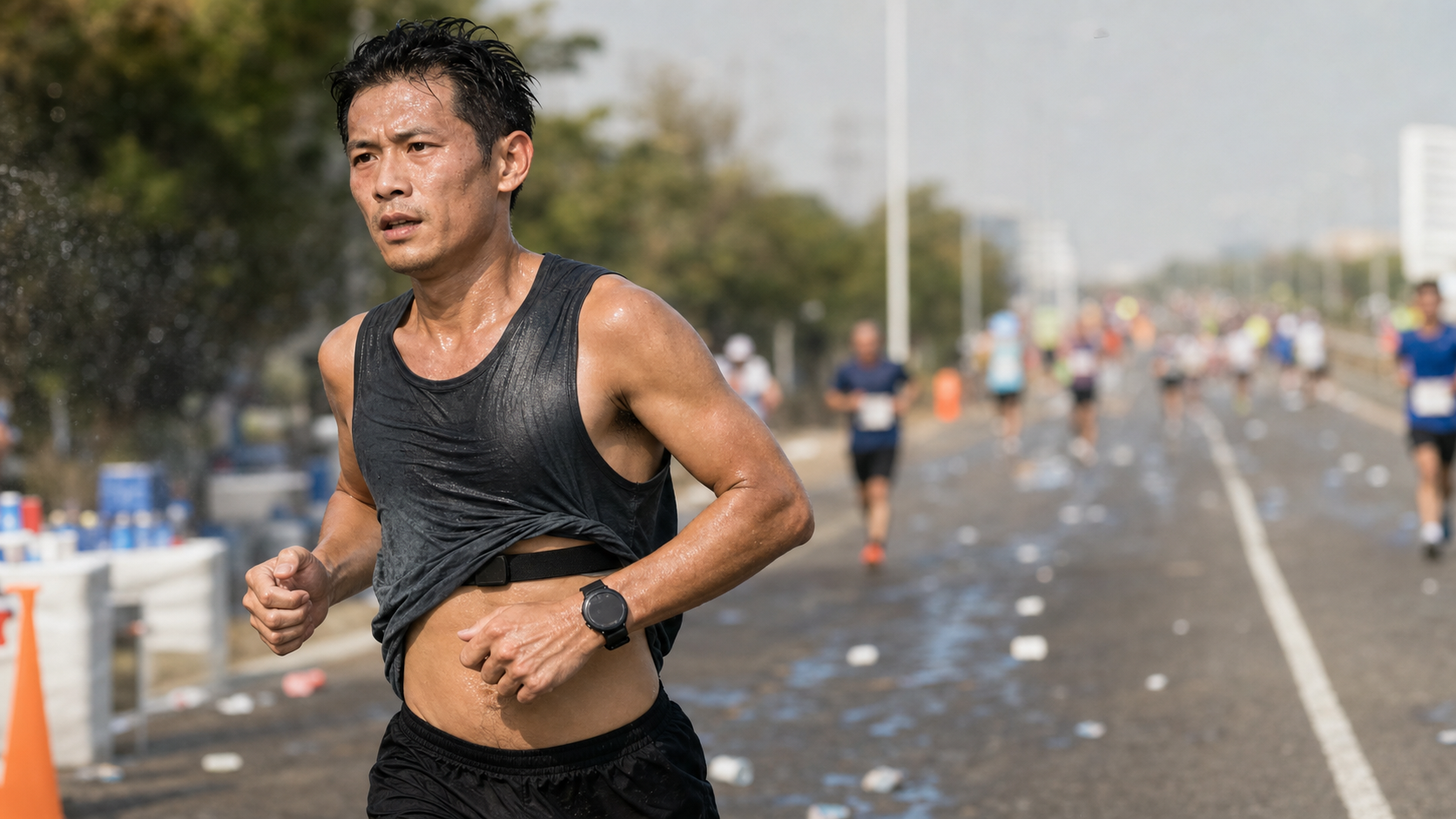
What Is Heart Rate Drift
Heart Rate Drift (HR Drift) refers to the phenomenon where heart rate naturally rises over time even when pace and intensity remain unchanged.
Typical example: running a full marathon at 5:00/km, heart rate changes:
| Kilometer | Pace | Heart Rate |
|---|---|---|
| 5K | 5:00 | 152 |
| 15K | 5:00 | 158 |
| 25K | 5:00 | 165 |
| 35K | 5:00 | 172 |
| 42K | 5:00 | 178 |
Pace didn’t change, but heart rate drifted 26 bpm.
Causes of Drift
Primary Cause 1: Rising Core Temperature
Muscles continuously generate heat, raising core temperature by 0.3-0.5°C per hour. To dissipate heat, skin blood vessels dilate, and the heart must pump faster to maintain oxygen supply to muscles.
Primary Cause 2: Reduced Plasma Volume
Sweat loss reduces blood volume (1% body weight dehydration reduces plasma by 2-3%). Stroke volume decreases, forcing heart rate up to compensate.
Primary Cause 3: Glycogen Depletion
Glycogen is more efficient for energy production than fat. As glycogen runs low, the body is forced to burn fat, requiring more oxygen and a faster heart rate at the same pace.
Primary Cause 4: Neural Fatigue
Motor cortex output declines, requiring more neural stimulation to maintain pace, raising sympathetic nervous system activity and heart rate.
Quantifying the Degree of Drift
Typical drift for amateur runners in a full marathon:
- Good hydration + cool weather: +3-5 bpm per hour
- Normal conditions: +5-8 bpm per hour
- Dehydration + hot weather: +10-15 bpm per hour
If drift exceeds 10 bpm/h, be alert—a late-race collapse may be coming.
Why Drift Slows You Down in the Latter Half
When heart rate drifts above 92% of max:
- Lactate clearance rate falls below production rate → muscle soreness intensifies
- Respiratory compensation → hyperventilation, sodium-potassium imbalance
- Cooling mechanisms near their limit → core temperature keeps rising
- Nervous system protective mechanism kicks in → automatic slowdown (central governor theory)
The result is a pace collapse.
Countermeasures
Strategy 1: Heart Rate Ceiling Alerts
Set watch alerts:
- First 21K: 85% of max heart rate
- 21-35K: 88% of max heart rate
- After 35K: may push up to 92%
If exceeded, slow down 5-10 seconds/km.
Strategy 2: Active Cooling
At every aid station:
- One cup of water to drink
- One cup of water over the head and neck (don’t pour on the chest—it can chill your internal organs)
- Use sponges to cool armpits and inner thighs
Cooling can reduce drift by 2-4 bpm.
Strategy 3: Hydrate and Replenish Salt
- One cup of sports drink every 5K (not just water)
- One salt tablet every 10K (especially in hot weather)
- Don’t wait until you’re thirsty (by then you’re already 2% dehydrated)
Strategy 4: Pace Buffer
If you expect heart rate drift, run 5-8 seconds/km slower in the first half. This keeps your “post-drift” heart rate within a controllable range.
Measuring Your Own Drift Rate in Training
Perform a “Heat Test”:
- At a similar time of day and temperature as your race
- Run for 90 minutes at 5K pace + 60 seconds
- Record the average heart rate of the first 30 minutes (HR1) and the last 30 minutes (HR2)
- Drift rate = (HR2 - HR1) / HR1
A drift rate above 5% means your “aerobic base” needs strengthening.
Conclusion
Heart rate drift is not an equipment malfunction—it’s a physiological certainty. Understanding it, anticipating it, and managing it is a required course for advanced runners. Building in a “buffer for drift” in the first half is far smarter than “fighting the drift” in the second half.
Related Reading
- The Science of Cardiac Drift: Why Heart Rate Keeps Rising While Pace Stays the Same
- Heart Rate Drift in Road Running: Causes and Countermeasures for Rising Heart Rate at a Constant Pace
- Monitoring Heart Rate Drift: A Barometer of Aerobic Efficiency in Long Runs
- Cardiac Drift: A Physiological Phenomenon in Long-Distance Cycling
西進武嶺 免費訓練分析服務 Intervals | 練不夠還是練過頭?你哪一種類型選手?AI模型告訴你! | 備戰神器 | 公路車 訓練 | CT Yeh
4 年前
2016 桐花飛舞 單車挑戰 精華片段
10 年前
西進武嶺 自製新版AI配速表產生器 x 賽前攻略 抱佛腳! 沒有功率計也可以產生配速表嗎?有什麼其他眉角賽前要注意的呢? | 西進武嶺 / 東進武嶺 KOM 攻略 | 公路車 | CT Yeh
4 年前
水金九不厭五分 10度寒流冷到不願停!feat. 卡卡 / 公路車 / CT Yeh
6 個月前
JE22 百里任務體驗,心跳不能過150,三小時內有可能...? 沒有天時地利難度有多高? / 公路車 / CT Yeh
1 年前
#公路車 #Vo2Max #最大攝氧量 測驗 體驗 | 心肺測試
6 年前
西進武嶺配速器 3.0更新 / NEW 免功率FTP估算! / 大數據xAI體能模型 / 如何模擬人止關前集團效應 / 配速儲存功能 / AI全台自行車賽事行事曆 / 公路車 / CT Yeh
1 年前
Garmin Edge 1050 旗艦車錶 全台首測!/ 環法冠軍指定 / 對比Edge 1040改進哪些? / 公路車 / CT Yeh
2 年前