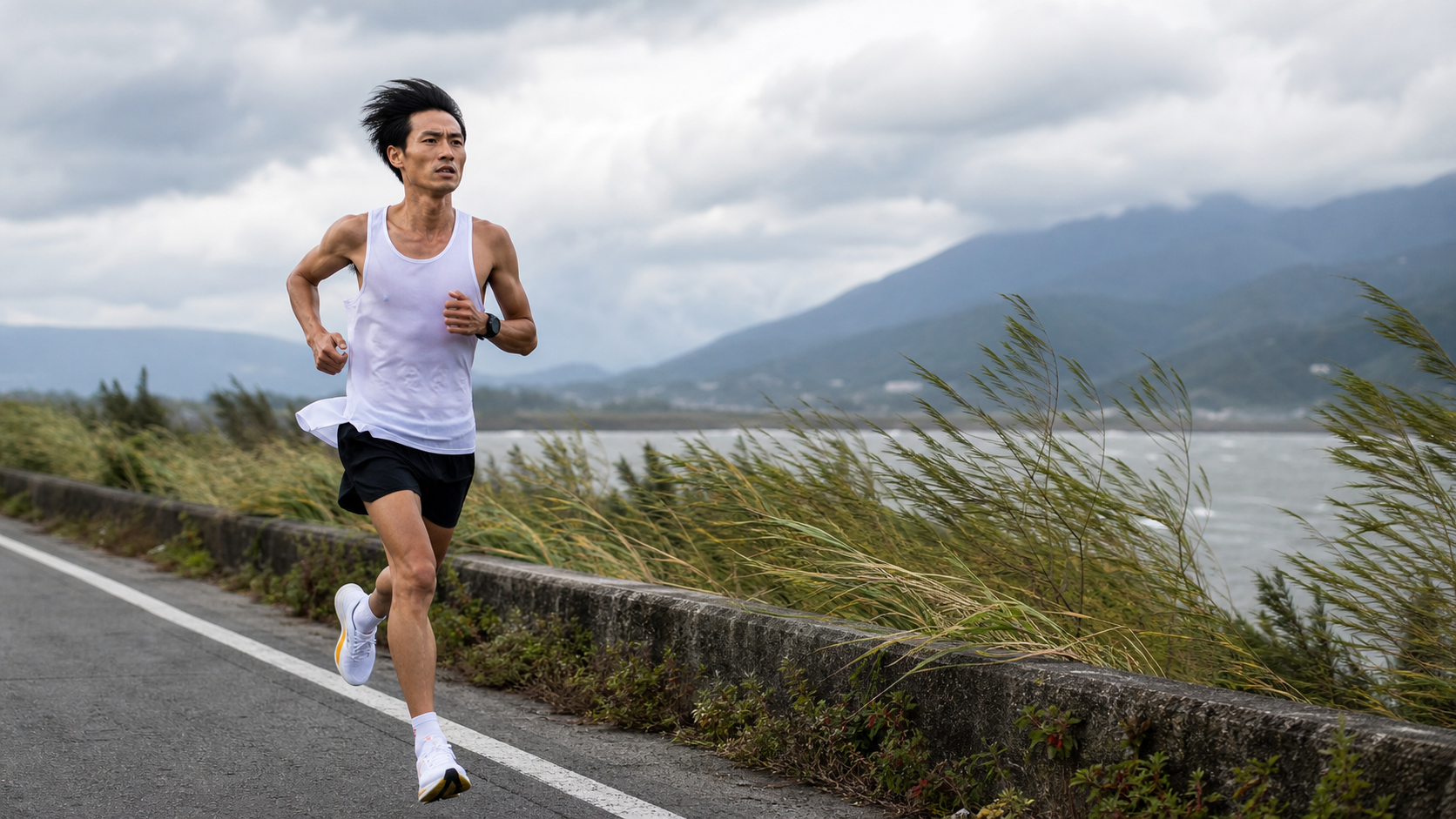
Quantifying Wind Resistance
Energy expended to overcome air resistance while running:
- No wind: about 4-7% of total energy goes to fighting air resistance
- 10 km/h tailwind: resistance decreases, saving 4-6%
- 10 km/h headwind: resistance increases, costing 10-15% more
- 20 km/h headwind: resistance increases, costing 25-35% more
The Cost of Headwind Pacing
Sports Engineering 2019 wind tunnel experiment + real-run validation:
| Wind Speed (km/h) | Pacing Impact (sec/km) |
|---|---|
| 20 tailwind | -10 |
| 10 tailwind | -5 |
| No wind | 0 |
| 10 headwind | +8 |
| 20 headwind | +20 |
| 30 headwind | +35 |
Note: Headwinds and tailwinds are asymmetric. The cost of a headwind far outweighs the benefit of a tailwind.
What to Adjust in a Headwind
The answer: adjust your pace, not your heart rate.
Why You Can’t Maintain Your Original Pace
Maintaining 5:00/km into a headwind means expending 15% more energy. Accumulated over a full marathon:
- 350-500 kcal extra expenditure
- Increased heart rate drift
- Near-certain collapse after 30K
Why You Can’t Maintain Your Original Heart Rate
If you only watch heart rate, your pace may drop 15-20 sec/km in a headwind, losing 8-15 minutes in total time.
The Compromise: Heart Rate as Ceiling, Pace as Target
Settings:
- Heart rate ceiling unchanged (e.g., max 85%)
- Pace allowed to drop 5-10 sec/km (depending on wind speed)
- Wind speed > 15 km/h: consider abandoning the PB goal and switching to a steady finish
Pre-Race Wind Assessment
Check the weather one week before the race:
- Windy.com: 3-hourly forecasts, high accuracy
- CWA (Central Weather Administration): Taiwan local forecasts
- Course direction: search for the route GPX and check the main orientation
Adjust your pace target based on wind direction and speed:
| Wind Speed | Race Strategy |
|---|---|
| < 5 km/h | Normal PB goal |
| 5-15 km/h | Reserve 30-60 seconds |
| 15-25 km/h | Reserve 90-180 seconds |
| > 25 km/h | Abandon PB, focus on finishing |
In-Race Coping Techniques
Technique 1: Find a Windbreak Pack
Follow 1-2 meters behind another runner in a headwind to save 4-7% of energy. But note:
- Don’t step directly on the runner’s heels
- Someone taller and bigger than you provides a more effective windbreak
- Pace groups are natural windbreak packs
Technique 2: Body Posture Adjustments
In a headwind:
- Lean your upper body slightly forward by 5 degrees (don’t bend at the waist)
- Reduce arm swing amplitude by 20% (decrease frontal area)
- Shorten stride by 5-10% and increase cadence (avoid being pushed off course during the airborne phase)
Technique 3: Using the Course Direction
Many Taiwan courses are out-and-back routes. Expect to slow down on the headwind section, and don’t deliberately speed up to “make up” time on the tailwind section (you can’t recover that much). Distribute your effort based on the principle of “average effort.”
The Tailwind Trap
A tailwind is not a free gift. The traps:
- Mental relaxation: It feels easy, and your pace unconsciously quickens
- Worse heat dissipation: Relative wind speed drops with a tailwind, reducing skin cooling, and core temperature rises faster
- The turnaround later: On out-and-back routes, the former tailwind becomes a headwind, creating a jarring contrast
Wind Resistance and Clothing
Small details make a big difference:
- A loose T-shirt has 5-8% more wind resistance than a tight racing singlet
- Over a full marathon, this can amount to 30-60 seconds
- The wind resistance impact of caps and sunglasses is minimal (< 1%)
- A cap’s effect on heat dissipation is actually more significant
Conclusion
Wind resistance is an often-overlooked factor in pacing philosophy. Understanding it, quantifying it, and responding to it allows you to pace rationally on windy courses (such as coastal races). In a headwind, what you should adjust is your pace, not your heart rate.
Related Reading
- The Impact of Wind Resistance on Pacing: Quantifying How Headwinds and Tailwinds Affect Marathon Pace
- Heat-Adjusted Pacing Rules: How Many Seconds to Slow Down for Every 5°C Rise
- The Art of Headwind Training: How to Turn Wind Resistance into Your Training Partner
- Pacing Differences Between Rainy and Sunny Runs: Breaking Down 5 Variables That Slow You Down 20 sec/km
一日北高前的西濱集訓 | 跟著11小時軍團 | 300W踩不動的大逆風 | 輪車破風差幾瓦?
6 年前
西進武嶺 自製新版AI配速表產生器 x 賽前攻略 抱佛腳! 沒有功率計也可以產生配速表嗎?有什麼其他眉角賽前要注意的呢? | 西進武嶺 / 東進武嶺 KOM 攻略 | 公路車 | CT Yeh
4 年前
#公路車 #西進武嶺 配速配瓦實驗 坡度分析 四小時內攻略 建大盃 NeverStop #西進武嶺攻略
6 年前
西進武嶺配速器 3.0更新 / NEW 免功率FTP估算! / 大數據xAI體能模型 / 如何模擬人止關前集團效應 / 配速儲存功能 / AI全台自行車賽事行事曆 / 公路車 / CT Yeh
1 年前
西進武嶺各路段 前8000名 大數據分析 配速攻略/功率/心律/推力比/維持率/踏頻/踏瓦比/牽車率 大公開 | 建大盃 NeverStop 可參考 | 公路車 | CT Yeh
5 年前
西進武嶺 免費訓練分析服務 Intervals | 練不夠還是練過頭?你哪一種類型選手?AI模型告訴你! | 備戰神器 | 公路車 訓練 | CT Yeh
4 年前
#公路車 #Fitting 靠人工智慧APP 幫你調整單車
6 年前
水金九不厭五分 10度寒流冷到不願停!feat. 卡卡 / 公路車 / CT Yeh
6 個月前