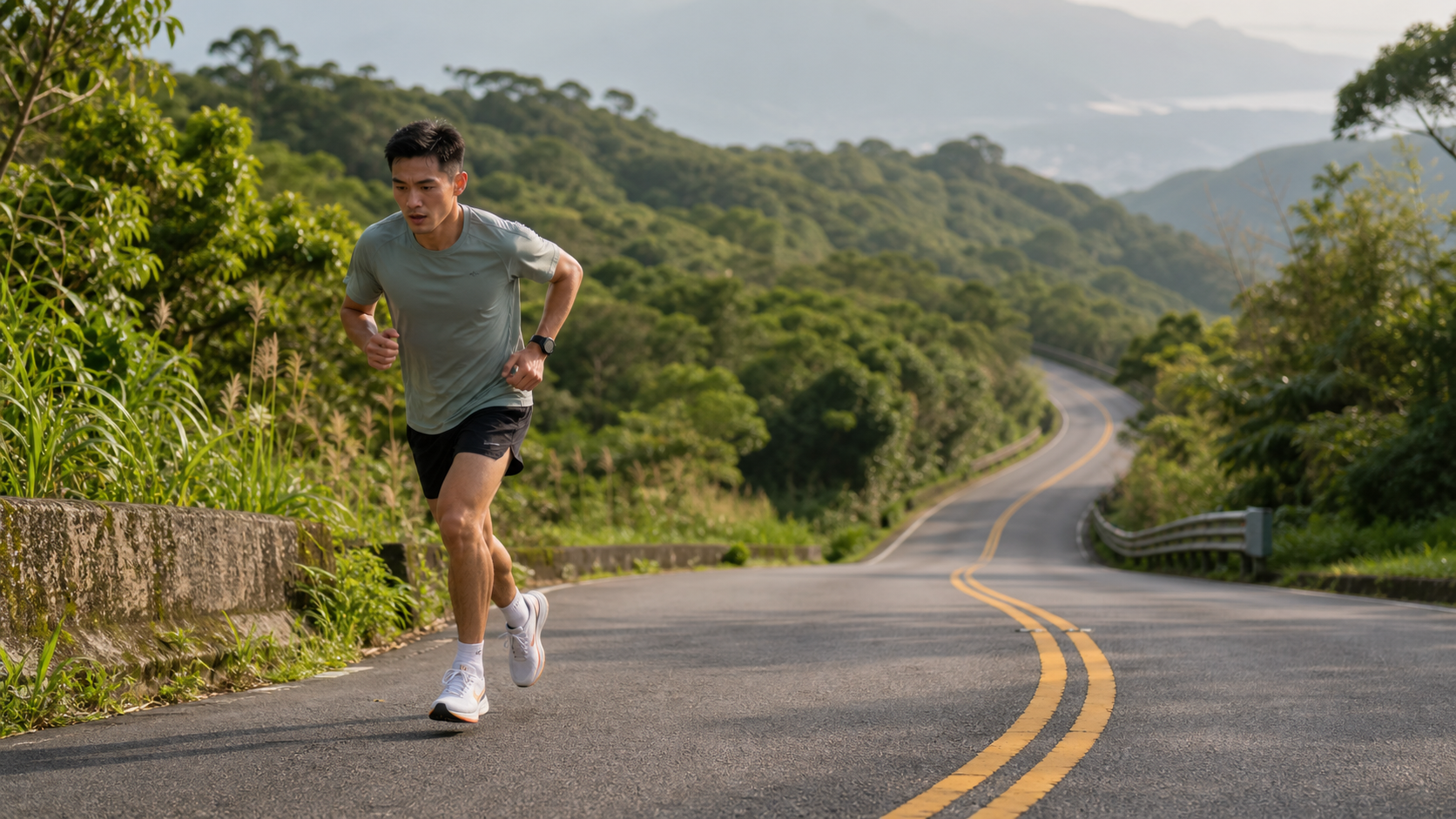
Why Gradient Needs to Be Quantified
Taiwanese race courses are almost never completely flat. Even a “flat course” has 50-100m of cumulative elevation gain. Without quantified gradient pacing, it’s impossible to make rational decisions.
How Strava GAP (Grade Adjusted Pace) Works
Strava’s GAP algorithm is based on:
- Uphill: For every 1% gradient, energy expenditure increases by about 12%
- Downhill: For every 1% gradient, energy expenditure decreases by about 7% (gentle downhill) or increases (steep downhill)
- Inflection point: Around -10% gradient, steep downhills actually consume more energy (eccentric contraction)
Pace Adjustment Quick-Reference Table
Based on a flat pace of 5:00/km:
Uphill
| Gradient | Equivalent Pace | Pace Difference |
|---|---|---|
| +1% | 5:08 | +8 sec |
| +2% | 5:17 | +17 sec |
| +3% | 5:27 | +27 sec |
| +5% | 5:48 | +48 sec |
| +7% | 6:13 | +73 sec |
| +10% | 6:55 | +115 sec |
| +15% | 8:15 | +195 sec |
Downhill
| Gradient | Equivalent Pace | Pace Difference |
|---|---|---|
| -1% | 4:55 | -5 sec |
| -2% | 4:50 | -10 sec |
| -3% | 4:46 | -14 sec |
| -5% | 4:39 | -21 sec |
| -7% | 4:35 | -25 sec |
| -10% | 4:40 | -20 sec (eccentric load begins) |
| -15% | 5:00 | 0 sec (maintain landing control) |
Uphill Pacing Philosophy
Short Hills (< 200m)
Maintain heart rate directly, sacrifice pace, and resume rhythm immediately after cresting. No need to deliberately accelerate through.
Medium Hills (200-1000m)
Shift to a lower gear: shorten stride by 10-15%, keep cadence at 180+. Heart rate may climb to 90% max, then settle back within 1K after the crest.
Long Hills (> 1000m)
Adopt the “steady effort” principle: keep heart rate stable at 85-88% max, allow pace to drop 30-60 sec/km. Mentally treat long hills as “a different type of terrain”—don’t compare them to flat ground.
Downhill Pacing Philosophy
Gentle Downhills (-1 ~ -4%)
The phase where you gain speed for free. Release speed, but don’t deliberately push faster. Heart rate will actually drop 3-5 bpm. Can be used as a recovery segment.
Moderate Downhills (-4 ~ -8%)
Speed naturally increases, but you need to control your center of gravity. Let your stride extend naturally, and pay attention to landing cushioning. Heart rate stays stable.
Steep Downhills (-8% and beyond)
Counterintuitive: steep downhills are actually very hard on the legs. Eccentric contraction consumes energy, and micro muscle damage accumulates. Legs feeling weak in the later stages is usually caused by steep downhills.
Strategy:
- Shorten stride, lean center of gravity back
- Increase cadence to 190+
- Pace should actually be slower than on -5% gradients
- Heart rate can drop, but leg load is extremely high
Pre-Race Course Analysis
Analyze the course 1 week before the race:
- Download the GPX: From the official source or Strava
- Import into analysis tools: Strava Routes, Karoo, Garmin Connect
- Identify the gradient distribution:
- Cumulative elevation gain (total m)
- Steepest gradient (%)
- Main concentrated climbing sections
- Calculate equivalent pace: Based on target time + cumulative elevation gain, work backward to find the “average gradient pace”
The Impact of Cumulative Elevation Gain
Strava rule of thumb: For every 100m of cumulative elevation gain, marathon time increases by 1-2 minutes.
Using a 3:30 marathon target as an example:
- Flat course: 5:00/km (target achieved)
- 300m cumulative elevation gain: actual finish 3:33-3:36
- 600m cumulative elevation gain: actual finish 3:36-3:42
- 1000m cumulative elevation gain (mountain marathon): actual finish 3:45-4:00
Training Support
To master gradient pacing, you need:
Workout 1: Uphill Intervals
Find a 3-5% hill of 200-400m, run hard uphill + jog down for recovery. Do this 1-2 times per week.
Workout 2: Sustained Long Hills
Find a gentle 800-1500m slope, maintain LT intensity for 4-6 reps. Build a feel for gradient pacing.
Workout 3: Downhill Control
Find a -5% gentle downhill, deliberately maintain a “fast but controlled” cadence of 190+, training neuromuscular coordination.
Conclusion
Gradient is not an “accident”—it’s an inherent property of the course. Calculate the equivalent pace in advance using GAP, allocate effort according to terrain during the race, and your total time will always be smarter than “following the watch’s average pace.” Every 1% gradient equals roughly 8-10 sec/km—this number should be etched into every marathon runner’s mind.
Related Reading
- GAP Grade Adjusted Pace: Equivalent Effort Calculation for Uphill and Downhill Running
- Uphill Pace Adjustment: Pace Conversion Formula for Every 1% Increase in Gradient
- Equivalent Flat Pace for Climbing: Conversion Formula Between Gradient and Pace
- The Impact of Course Elevation on Pace: How Many Seconds Slower per 100m of Climb
公路車 爬坡 破PR 紀錄 小技巧 分享
6 年前
#公路車 #Fitting 靠人工智慧APP 幫你調整單車
6 年前
西進武嶺配速器 3.0更新 / NEW 免功率FTP估算! / 大數據xAI體能模型 / 如何模擬人止關前集團效應 / 配速儲存功能 / AI全台自行車賽事行事曆 / 公路車 / CT Yeh
1 年前
西進武嶺 免費訓練分析服務 Intervals | 練不夠還是練過頭?你哪一種類型選手?AI模型告訴你! | 備戰神器 | 公路車 訓練 | CT Yeh
4 年前
西進武嶺各路段 前8000名 大數據分析 配速攻略/功率/心律/推力比/維持率/踏頻/踏瓦比/牽車率 大公開 | 建大盃 NeverStop 可參考 | 公路車 | CT Yeh
5 年前
RAMP FTP Test 直播 究竟能撐到幾瓦 訓練台 Gravat Zwift
6 年前
單車 梅山36灣 坡度介紹 路段介紹 空拍 (相關遊記影片,請參考說明或我的頻道喔,歡迎訂閱)
6 年前
武嶺配速表最佳使用方式 #bike
1 年前