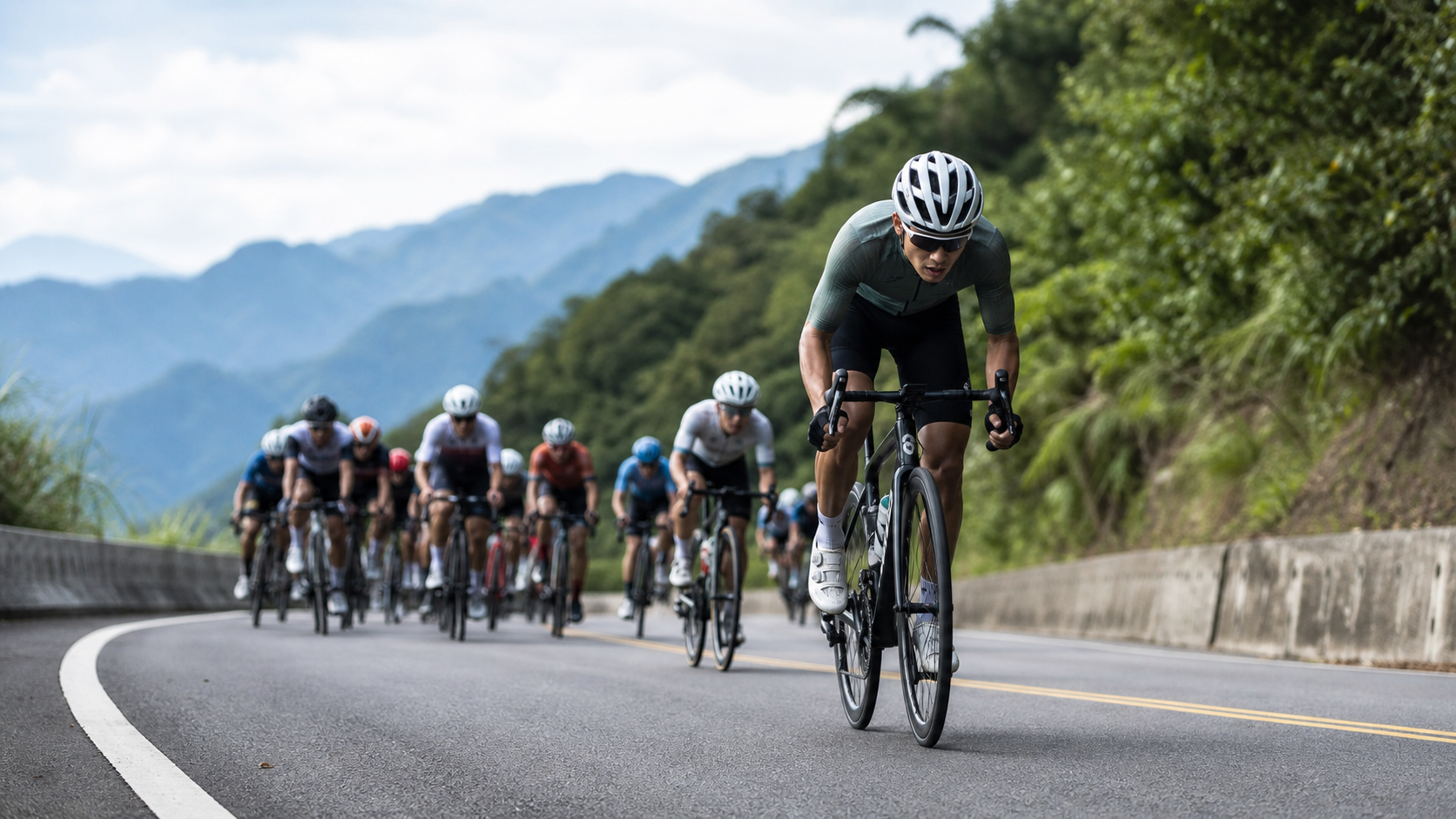
Counter-attack: The Window of Opportunity After an Opponent’s Attack
The deadliest move in a race isn’t the attack—it’s the counter-attack. The moment an opponent’s attack is reeled back in, the peloton is at its most vulnerable state—that’s the golden 10 seconds for a counter.
The Physical Advantage of a Counter-attack
When the peloton catches the attacker ahead, the following happens:
- The peloton’s speed drops instantly from chase mode (55 km/h) to cruising (45 km/h)
- The riders who led the chase are gasping for air, unable to launch again immediately
- The peloton’s attention relaxes, thinking “the danger is over”
- The field stretches out front to back, and density decreases
At this moment, the counter-attacker only needs 700-800 W for 5 seconds to open a 10-second gap—far easier than attacking directly.
Timing the Counter-attack
Watch the attacker ahead
- Where he gets caught: If he’s caught just 5-10 meters ahead → the peloton’s speed hasn’t dropped yet, not a good time
- 5-10 seconds after he’s caught: The peloton is just starting to relax → perfect timing
- 30+ seconds after he’s caught: The peloton has recovered to normal → too late
Watch the peloton’s leaders
- The lead rider is gasping, shoulders heaving: he just finished his pull, can’t chase again immediately
- The lead rider drops to the back: during the rotation, the front speed will drop
- The lead rider is looking around: attention is divided
Power Distribution: More Efficient Than an Attack
A counter-attack requires 30-40% less power than a direct attack, because the peloton’s speed is already dropping.
Example (rider with FTP = 300 W):
- Direct Attack: needs 1000 W for the first 10 seconds
- Counter-attack: only needs 700 W for the first 10 seconds
Why? Because during a direct attack, the peloton is still cruising at 50 km/h; during a counter-attack, the peloton has already slowed to 45 km/h, so the relative speed difference is only 5 km/h.
Classic Case: Pogačar’s Counter-attack Aesthetics
Tadej Pogačar is the master of the modern counter-attack. His pattern:
- He doesn’t attack first—he lets his rivals (Vingegaard, Roglič) make the first move
- The moment they get caught, he immediately launches with 200 W more power
- 30 seconds after he jumps, his rivals have no energy left to respond
- He takes the stage win solo, and extends his GC lead by another 30 seconds
2023 Tour de France, Galibier stage: Vingegaard attacked and was caught 2 km later. Pogačar launched 8 seconds after the catch, soloed over the Galibier summit, and won by 1 minute 48 seconds.
Team Tactics for the Counter
A solo counter is easy to chase down; the strongest move is the “double attack-counter” tactic:
- Teammate A attacks first (even knowing it will fail)
- The peloton chases teammate A at full effort
- The moment he’s caught, teammate B (the leader) counter-attacks
- The peloton is already fatigued and can’t mount a second chase
This is a common tactic used by strong teams like INEOS and UAE in Grand Tours.
The Psychological Advantage of the Counter
Beyond the physical side, a counter-attack also has psychological destructive power:
- The rivals have just finished chasing and mentally think “finally, that’s dealt with”
- Your counter makes them realize “we chased for nothing”
- Morale drops significantly, and their willingness to chase again decreases
Application in Amateur Racing
In amateur races (90-160 km), counter-attack timing:
- Mass-start road races: counter immediately after someone’s failed attack
- Criteriums: counter after someone attacks on lap two (before fatigue accumulates in your rivals)
- Time-trial circuit races: an attack-counter opportunity comes roughly every 5 laps
The Reverse of the Counter: Waiting for the Counter
If you’re the attacker, how do you avoid being counter-attacked?
- Don’t get caught easily: fight to the last second, making your rivals pay the maximum price
- Drop back to the middle of the peloton immediately after being caught: don’t be a target
- Scan your surroundings: identify who the potential counter-attackers are, and mark them
Conclusion
The counter-attack is the smartest move in racing. Let others burn their energy as bait, and you harvest the results from behind. Next time you race, don’t rush to be the first to attack—be the second to counter. More often than not, that’s who wins.
Related Reading
戰略) Zwift Race 如何咬在第一集團 如何評估自己要開多少推力 (請開1.5倍速看)
7 年前
多機位拍片神器 DJI Action 2 拍出速度張力感 | 類空拍機視角 4陣列麥克風超強降風噪 實測! | 公路車 | CT Yeh
3 年前
西進武嶺 免費訓練分析服務 Intervals | 練不夠還是練過頭?你哪一種類型選手?AI模型告訴你! | 備戰神器 | 公路車 訓練 | CT Yeh
4 年前
2025 海鷗團體繞圈賽 / 前八強賽事精華!/ 環台賽等級拍攝 / 國手菁英隊伍較勁 / CT Yeh #公路車
8 個月前
CT 喇低賽) 武嶺牽車 才是王道 西進牽車四小時內秘訣 攝手位置 如何判斷 防抽筋小秘訣
7 年前
DJI Osmo Action 5 Pro 首發最強!單車運動攝影機! 一顆電池錄完KOM 西進武嶺? / 超狂夜拍效果 / 4奈米AI晶片/ 一鍵數據合成 / 公路車 / CT Yeh
1 年前
西進武嶺 自製新版AI配速表產生器 x 賽前攻略 抱佛腳! 沒有功率計也可以產生配速表嗎?有什麼其他眉角賽前要注意的呢? | 西進武嶺 / 東進武嶺 KOM 攻略 | 公路車 | CT Yeh
4 年前
Live) 備戰2019彰化經典百K 賽前攻略 (已完賽請看新影片
7 年前