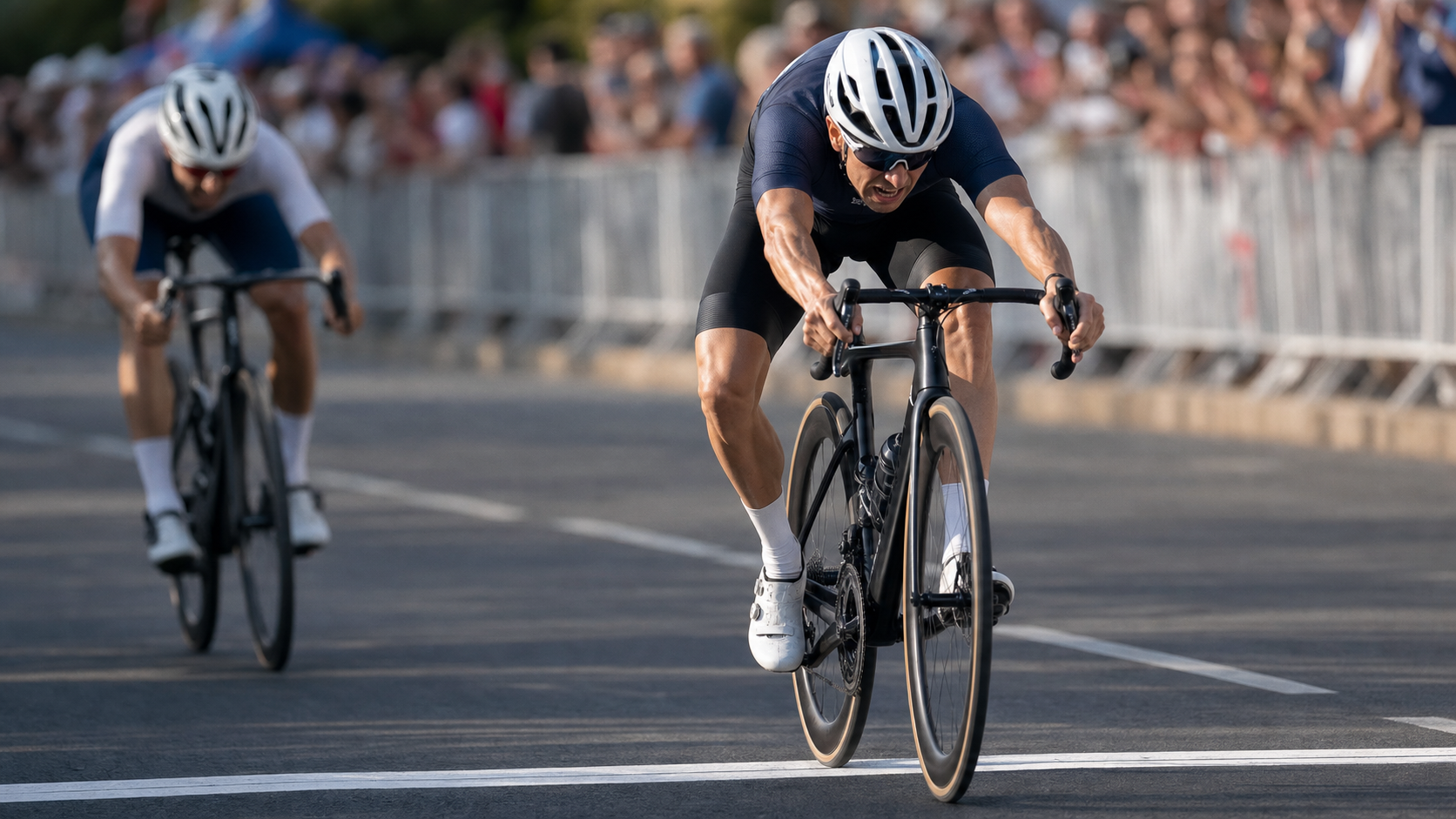
Finish-Line Sprint Mechanics: The Art of the Bike Throw
At the 2017 World Championship road race, Peter Sagan beat Michael Matthews by 0.5 cm at the bike. That 0.5 cm was the result of the “Bike Throw” technique.
What Is a Bike Throw?
Five meters before the finish line, sprinters perform an explosive “push” motion:
- Arms forcefully push the handlebars forward
- Body shifts backward (behind the saddle)
- Result: the bike itself flies forward 20-30 cm
Those 20-30 cm are often the difference between gold and silver.
The Physics Behind the Bike Throw
According to the conservation of momentum:
Total momentum of rider + bike remains unchanged
Rider moves backward ↔ Bike moves forward
When you push the bike forward with your arms:
- Your center of mass moves backward 5-10 cm
- The bike’s center of mass moves forward 20-30 cm (the bike is lighter than the rider)
- Finish-line timing is based on the “leading edge of the front wheel” crossing the line
So even if your body doesn’t move forward, the wheel crosses the line—you win.
Standard Bike Throw Breakdown
1. Ready Position (5-10 meters before the finish)
- Standing sprint, hands on the drops
- Body leaning forward, core engaged
- Cadence maintained at 120-130 rpm
2. Timing of the Throw
- Timing: approximately 3-5 meters before the finish line
- Too early: you decelerate after the throw and get passed instead
- Too late: not enough time to push the bike across the line
3. Executing the Motion
- Simultaneous actions: arms forcefully push the handlebars forward, hips whip back behind the saddle
- Lock the wrists: to prevent the handlebars from twisting and causing a crash
- Eyes on the line: don’t look at your opponents
4. After Crossing the Line
- Immediately return your body to the saddle: restore your center of gravity
- Decelerate gradually: to avoid losing control at high speed
- Save the celebration until you’ve fully slowed down (there are celebration crashes at the line every year)
How Much Distance Can a Bike Throw Gain?
According to a 2019 study by INSEP (French National Institute of Sport):
| Sprint Speed | Distance Gained from Throw | Equivalent Time Difference |
|---|---|---|
| 60 km/h | 18 cm | 0.011 sec |
| 65 km/h | 22 cm | 0.012 sec |
| 70 km/h | 28 cm | 0.014 sec |
| 75 km/h (pro level) | 32 cm | 0.015 sec |
0.015 seconds—that is the difference between gold and silver.
Risks of the Bike Throw
1. Crashing
- Wrists not locked, handlebars twist → immediate crash
- Front wheel lifts off the ground during the throw → even worse crash
- Stage 21 of the 2019 Giro d’Italia: Démare threw too early, the bike wobbled out of control, and he nearly crashed
2. Losing Sprint Rhythm
- The throw is the “final move”—once it’s done, you have nothing left
- If there are still 10 meters to go, you’ll decelerate after the throw and get passed
3. Rule Violations (Rare)
- Deviating from a straight line or affecting opponents → disqualification
- The 2017 Tour de France Sagan vs Cavendish incident: Sagan was disqualified for an alleged elbow strike on Cavendish
Training the Bike Throw
Drill 1: Low-Speed Simulation
- On a trainer, sprint at 80% effort
- Simulate the throw motion “3 meters before” a target
- Feel the coordination between pushing with the arms and shifting the hips back
Drill 2: Real-World Practice on a Track
- On the straight of a 400-meter track
- Practice the motion at a slow 30 km/h
- Confirm the bike stays stable and doesn’t deviate from a straight line
Drill 3: High-Speed Race Simulation
- At the end of a training session, do sprint practice
- Find a teammate as a comparison to see who crosses the line first
- 5-10 bike throws per week to build muscle memory
Common Mistakes
- Throwing too early: 10 meters still remain after the throw, the bike decelerates and you get passed
- Arms not pushing all the way through: not enough force, only gaining 5 cm
- Body not shifting backward: violates conservation of momentum, the bike moves forward less
- Stopping pedaling: losing power, decelerating immediately after the throw
- Turning your head to look at opponents: your body follows and the bike drifts off line
National Team Sprinter Training Periodization
- Base Period (Nov-Jan): low-speed simulation
- Preparation Period (Feb-Mar): real-world track practice
- Race Period (Apr-Sep): attempt it at the end of every race
Top sprinters like Caleb Ewan and Jasper Philipsen have been practicing the bike throw since their junior years, giving them deeply ingrained muscle memory.
Conclusion
The bike throw is the art of 0.1 seconds. A peak power of 1900 W doesn’t necessarily beat Caleb Ewan’s 1700 W, because Ewan’s bike throw earns him an extra 30 cm. Next time you sprint for the line, remember—wherever the finish line is, that’s where your wheel needs to go.
Related Reading
- Road Bike Sprint Technique: Body Position and Power Output in the Final 200m
- The Art of the Sprint Stage: A Top Sprinter’s Final 300 Meters
- Road Bike Sprint Preparation: Complete Steps for Gearing, Cadence, and Weight Transfer
- Braking Technique and Distance Control: Front/Rear Brake Distribution, Wet vs Dry Conditions, and Emergency Braking Practice
CT 喇低賽) 武嶺牽車 才是王道 西進牽車四小時內秘訣 攝手位置 如何判斷 防抽筋小秘訣
7 年前
公路車 爬坡 破PR 紀錄 小技巧 分享
6 年前
戰略) Zwift Race 如何咬在第一集團 如何評估自己要開多少推力 (請開1.5倍速看)
7 年前
靠單車減肥35公斤 心得分享與整理
7 年前
洗單車神器 吹水機! 實際洗車用用看 暴力洗鍊條大法 | 公路車 | CT Yeh
4 年前
Live) 備戰2019彰化經典百K 賽前攻略 (已完賽請看新影片
7 年前
#公路車 #Fitting 靠人工智慧APP 幫你調整單車
6 年前
FTL 與 SYB 車隊專訪 西進武嶺 實用攻略分享! 2小時 如何練?!你不知道的眉角!新手準備武嶺必看 EP1 | 實力派女車友 | 精華版 | 公路車 | CTYeh
4 年前