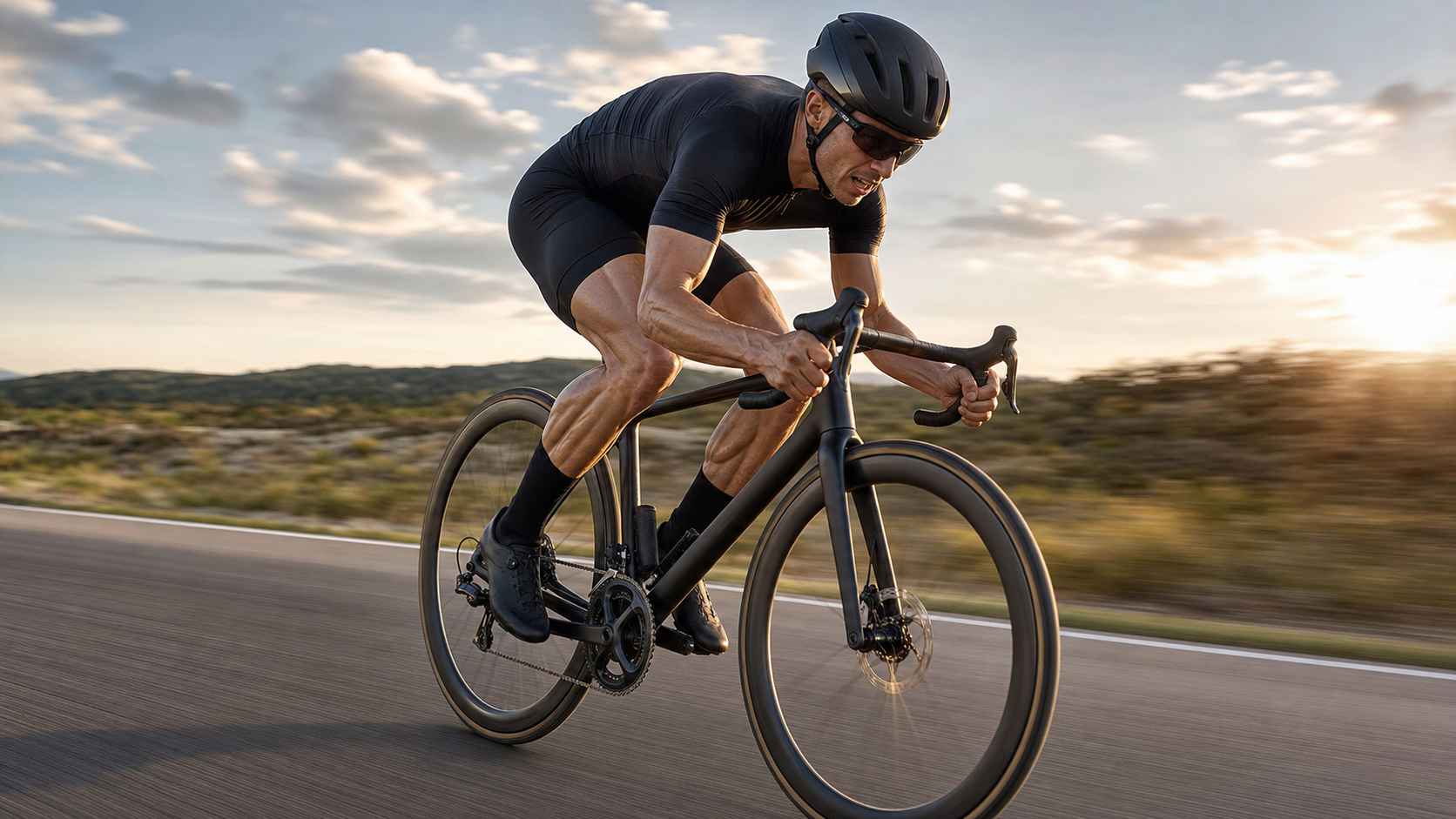
Sprint Physique Science: Why Are Sprinters All Thick-Thighed?
Ever seen photos of Caleb Ewan, Jasper Philipsen, or Mark Cavendish? These top sprinters all share a common trait: thigh circumference of 65-72 cm, with a relatively lean upper body. This isn’t a coincidence—it’s a physiological necessity of sprinting.
Sprinter vs. Climber Physique Comparison
| Metric | Sprinter | Climber (e.g., Pogačar) |
|---|---|---|
| Height | 165-180 cm | 170-185 cm |
| Weight | 70-78 kg | 60-66 kg |
| Thigh circumference | 65-72 cm | 55-60 cm |
| Upper arm circumference | 32-36 cm | 26-30 cm |
| Body fat percentage | 6-9% | 5-7% |
| Peak Power | 1700-1900 W | 1100-1400 W |
| W/kg (5min) | 6.5-7.0 | 7.0-7.5 |
| W/kg (FTP) | 5.5-6.0 | 6.5-7.0 |
Why Are Sprinters’ Thighs Thick?
1. Muscle Cross-Sectional Area Determines Explosive Power
Maximum muscle strength ≈ muscle cross-sectional area. Thicker thighs → more muscle fibers → greater instantaneous explosive power.
Physiological formula:
Maximum strength = muscle fiber cross-sectional area × force per unit area
Sprinting requires an instantaneous output of 1900 W—impossible without thick thighs.
2. Fast-Twitch Muscle Fiber Ratio
Sprinters’ thighs contain 60-70% fast-twitch muscle fibers (Type II), while climbers have only 30-40%.
| Muscle Fiber Type | Characteristics | Ratio |
|---|---|---|
| Type I (slow-twitch) | High endurance, low output | Sprinters 30-40%, climbers 60-70% |
| Type IIa (fast-twitch, aerobic) | Intermediate | Both ~20-30% |
| Type IIx (fast-twitch, anaerobic) | High explosive power, easily fatigued | Sprinters 30-40%, climbers 10-20% |
Muscle fiber ratio is partly determined by genetics, but training can shift Type IIa toward Type IIx.
Why Are Sprinters Heavier?
Sprinters weigh 70-78 kg—10-15 kg more than climbers. Reasons:
1. Flat-Road Speed Is Proportional to Absolute Power
Air resistance ∝ v²
Required power = resistance × speed ∝ v³
Power requirement at 50 km/h: 400-450 W (regardless of body weight). So riders with high absolute power (regardless of weight) can reach high speeds.
2. Body Weight Provides Downward Pedaling Force
During standing sprints, body weight = “extra force” pushing the pedals down. A 70 kg rider delivers 100 N more downward force than a 60 kg rider.
3. Climbing on Flat Roads Is Secondary
Sprinters don’t win on W/kg—as long as they can hold the peloton’s pace and have absolute power for the final sprint.
Why Is the Upper Body Relatively Lean?
Sprinters’ upper bodies are slightly bulkier than climbers’, but not as muscular as weightlifters’. Reasons:
- Aerodynamic demands: The leaner the upper body, the lower the CdA and the faster the speed
- Energy efficiency: Upper-body muscles require oxygen; too much is wasteful
- Core just needs to be sufficient: The core must stabilize the upper body, but lateral strength isn’t needed
Sprinters’ Training Design
1. Weight Training: Muscle Mass Development
Squat:
- Weight: 80-90% of 1RM
- Sets: 5 sets × 5 reps
- Frequency: 2 times per week
- Purpose: Increase thigh muscle mass and maximum strength
Deadlift:
- Weight: 75-85% of 1RM
- Sets: 4 sets × 6 reps
- Frequency: 1-2 times per week
- Purpose: Back, glutes, hamstrings
Leg Press:
- Weight: 80% of 1RM
- Sets: 4 sets × 8 reps
- Purpose: Quadriceps-specific work
2. On-Bike Training: Neuromuscular Connection
Heavy-Gear Starts:
- Start from a standstill in 53×14
- Practice the nervous system recruiting all muscle fibers
- Once per week, 10 reps
Peak Power Training:
- 6 × 8-second all-out efforts, 5 minutes rest between
- Purpose: Nervous system adaptation to maximal output
3. Nutrition: Maintaining Muscle Mass
Sprinters’ daily protein intake:
- 2.0-2.4 g/kg body weight (70 kg rider = 140-170 g/day)
- Consume 30 g of protein within 30 minutes after training
- Eat plenty on weight-training days (cannot be in a low-calorie deficit like climbers)
National Differences: European vs. Asian Sprinters
European Sprinters
- Taller build, larger frame
- Peak Power 1800-1900 W
- Example: Jasper Philipsen (180 cm, 75 kg)
Asian Sprinters
- Smaller build, more refined frame
- Peak Power 1400-1600 W
- Example: Wu Yi-Ta (170 cm, 68 kg)
Advantages of Asian riders:
- More agile in corners (lower center of gravity)
- Suited to criterium races with many turns
- More competitive on Asian race circuits (mostly circuit races)
Can Amateur Riders Develop a “Sprinter Physique”?
Partially:
- Weight training + high-protein diet can add 5-10 kg of muscle mass
- Peak Power can improve from 1000 W to 1300-1500 W
- But fast-twitch muscle fiber ratio is hard to change significantly (genetic limitation)
If you’re naturally lean and lanky, rather than forcing yourself into sprinting, consider transitioning to climbing or triathlon—play to your strengths.
Conclusion
A sprinter’s physique is the combined result of genetics and training. Caleb Ewan, at 165 cm and 67 kg, can output 1700 W—the product of 5 years of weight training, a high-protein diet, and neuromuscular training. Next time you watch a race, pay attention to the sprinters’ thighs—that’s their “engine room.”
Related Reading
- Muscle Fiber Types and Cycling Performance: Training Strategies for Slow-Twitch and Fast-Twitch Muscles
- The Art of the Sprint Stage: Top Sprinters’ Final 300 Meters
- Sprint Training Methods: Developing Neuromuscular Explosive Power for Road Cyclists
- Basketball Height and Athletic Advantage Enhancement: Key Physical Training for Tall Players
如果Pogačar騎西進武嶺可以多快?會破2嗎?各種情況深度推估探討 / 公路車 / CT Yeh
2 年前
CT Talk) 數據面窺看 武嶺大神們 平時的備戰 共通點 (娛樂性質XD)
7 年前
西進武嶺 8000名單車友數據分析 PART1 | 從新手到高手數量/瓦數/推力比/FTP推力比/功率計使用率 大解析 | 公路車 | CTYeh
5 年前
一日北高/長距離團騎 常見問題補充篇 / 組團或跟團的眉角 / 壯車友容易被瘦車友慢性拉爆 / 原來屁股痛可能是這個原因...? / 風場配速法 / 公路車 / CT Yeh
2 年前
RAMP FTP Test 直播 究竟能撐到幾瓦 訓練台 Gravat Zwift
6 年前
台北闊瀨陡坡 騎旅 / 日本單車雜誌編輯車友臨時加入!/ 髮香才是最強的 / feat. 北迴歸線小隊 / 公路車 CT Yeh
6 個月前
單車 一日北高 ( 雙城 ) 肥宅雙人瘋狂行 紀錄片 REACTO
10 年前
16/02/16 - 夜訪中社路 緩慢進步中
10 年前