Two Major Challenges of Home Training
Challenge 1: Progressive Overload
The core principle of strength training is “gradually increasing the challenge.” The gym has 100kg and 120kg barbells you can add to—how do you add load with bodyweight training at home?
Challenge 2: Intensity Ceiling
To reach the 85%+ 1RM required for the Max Strength phase, bodyweight squats are “too light” for most people and cannot trigger neural adaptation.
The Real Benefits of Bodyweight Training
Suitable Phases
- ✅ Anatomical Adaptation
- ✅ Maintenance (in-season)
- ⚠️ Hypertrophy: Limited
- ❌ Max Strength: Difficult to achieve
Suitable Populations
- Beginners: Learn the movements first
- Travelers: Hotel room workouts
- Remote workers: 30-minute lunch break
- Budget-constrained: Completely free
The “Progression Ladder” for Bodyweight Movements
Key breakthrough: Replace “adding weight” with “increasing movement difficulty.”
1. Squat Progression Ladder
| Level | Movement |
|---|---|
| 1 | Chair Squat (sit down and stand up) |
| 2 | Standard Bodyweight Squat |
| 3 | Jump Squat |
| 4 | Bulgarian Split Squat (rear foot elevated) |
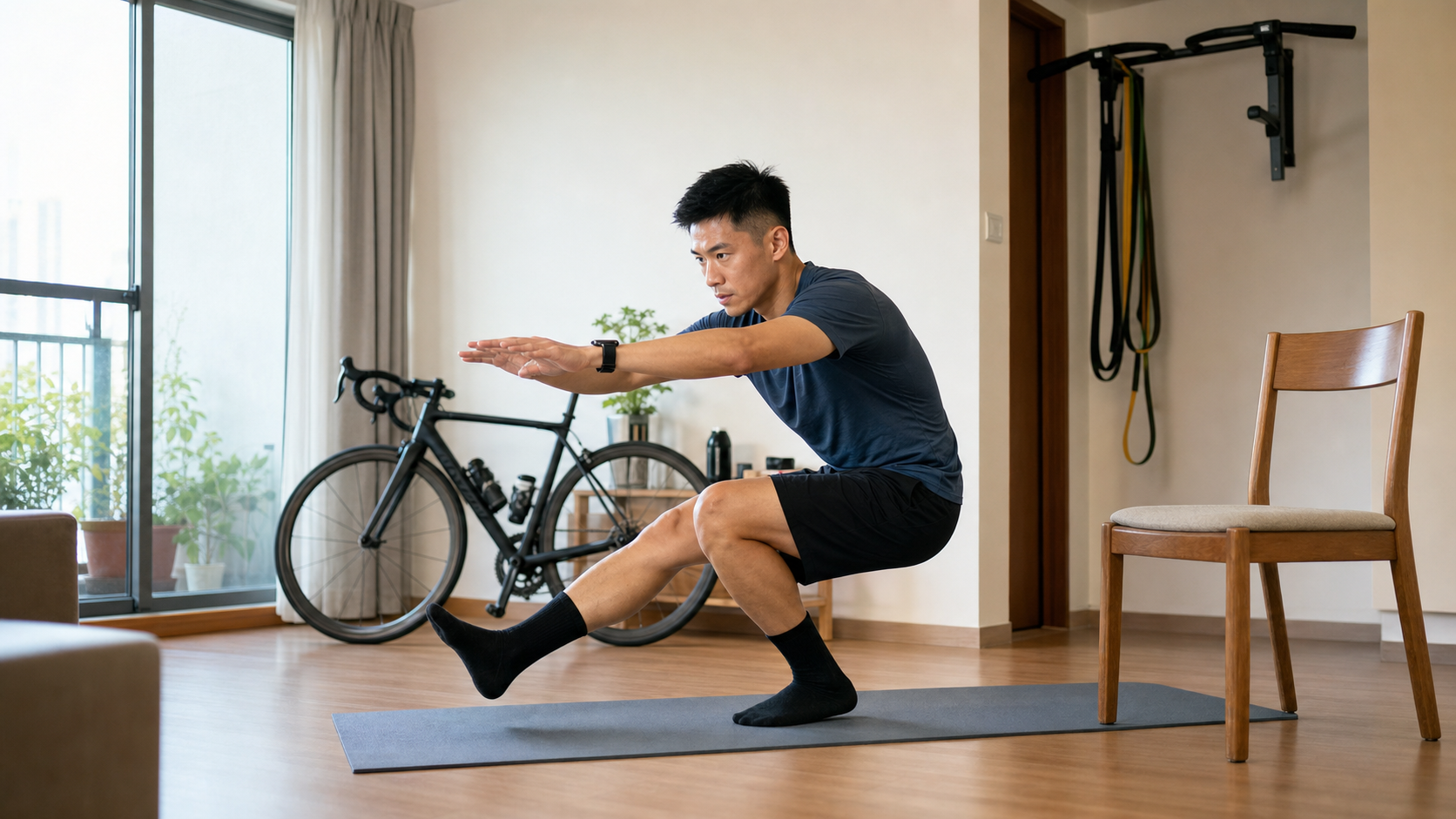
| 5 | Skater Squat (single leg, slight lift) |
| 6 | Pistol Squat (full single-leg squat) |
| 7 | Shrimp Squat (harder single-leg variation) |
Once you progress to Level 6, your single-leg strength is equivalent to a barbell back squat at 1.5–2x body weight.
2. Push-Up Progression Ladder
| Level | Movement |
|---|---|
| 1 | Wall Push-Up |
| 2 | Incline on Table |
| 3 | Kneeling Push-Up |
| 4 | Standard Push-Up |
| 5 | Diamond Push-Up (hands together) |
| 6 | Assisted One-Arm Push-Up |
| 7 | One-Arm Push-Up |
3. Pull Progression Ladder (requires a pull-up bar)
| Level | Movement |
|---|---|
| 1 | Bar Hang |
| 2 | Inverted Row (under a table) |
| 3 | Pull-Up (band-assisted) |
| 4 | Full Pull-Up |
| 5 | L-Sit Pull-Up |
| 6 | One-Arm Pull-Up |
4. Core Progression Ladder
| Level | Movement |
|---|---|
| 1 | Standard Plank |
| 2 | Ab Wheel Rollout |
| 3 | L-Sit |
| 4 | Dragon Flag |
| 5 | Human Flag |
Complete Home Workout Plan (30 minutes)
Workout Day A (Push + Legs + Core)
| Movement | Sets × Reps |
|---|---|
| Warm-up: Jumping Jacks + Hip Mobility 5min | — |
| Bulgarian Split Squat | 4 × 10 / leg |
| Push-Up (per your level) | 4 × 10–15 |
| Jump Squat | 3 × 12 |
| Handstand Push-Up (against wall) | 3 × 8 |
| Plank | 3 × 60 sec |
| Dead Bug | 3 × 12 / side |
Workout Day B (Pull + Legs + Core)
| Movement | Sets × Reps |
|---|---|
| Warm-up 5min | — |
| Pull-Up (or Inverted Row) | 4 × 6–8 |
| Single-Leg Glute Bridge | 4 × 10 / leg |
| Skater Squat | 3 × 8 / leg |
| Inverted Row (under a table) | 3 × 10 |
| Side Plank | 3 × 45 sec / side |
| Saw Plank | 3 × 30 sec |
Five Ways to Break Through Bodyweight Plateaus
Method 1: Increase the Proportion of Unilateral Movements
Switch from bilateral movements (squats) to unilateral ones (Pistol Squat)—intensity doubles instantly.
Method 2: Add Tempo
For example, take 4 seconds to control the descent on a squat, pause 2 seconds at the bottom, then stand up in 1 second. The same movement becomes twice as hard.
Method 3: Plyometric Elements
Standard squat → Jump squat; Push-up → Clap push-up.
Method 4: Reduce Points of Contact
Push-up → One-arm; Squat → Single-leg.
Method 5: Invest in Basic Equipment (< NT$3,000)
- Pull-up bar (doorway type, NT$500–1,000)
- Resistance band set (NT$500)
- Dumbbells 5–15kg pair (NT$1,000–2,000)
- Plyo box (DIY or purchase, NT$1,000)
These four items total less than NT$5,000 and can achieve about 70% of the results of gym training at home.
Conclusion
Although home bodyweight training has its limits, it is sufficient for 80% of endurance athletes. The key is consistency and gradual progression, not chasing the most premium equipment.
Related Reading
- Gym vs Bodyweight Training: How Should Endurance Athletes Choose?
- 30-Minute No-Equipment Home Strength Workout: Perfect for Business Trips, Rainy Days, and Quarantine
- Resistance Bands and Bodyweight Strength Training: Endurance-Specific Strength Without a Gym
- Strength Training Basics for Endurance Athletes: Why Runners and Cyclists Should Hit the Gym
實景訓練台) 彰化經典百K 高強度喵團 90分鐘 跟著一起練功 2019 Indoor workout Changhua Classic 100 Taiwan
7 年前
沉浸室內單車練功房開箱! 100吋大畫面,最便宜的花費? 居然還能K歌!? | 公路車 | CT Yeh
3 年前
白沙屯媽祖進香在家走!UREVO 坡度自調走步機 / 可連接訓練遊戲APP MyWhoosh / 邊看直播邊走起來 / CT Yeh
11 個月前
16/02/16 - 夜訪中社路 緩慢進步中
10 年前
一日北高常見問題大集合 | 攻略 | 路線 | 訓練 | 補給 | 自行車 單車 | 一日雙城 | 雙塔 | TWB北高360 | 屁股痛
6 年前
滑雪新手們慘摔學習全紀錄(請開字幕),滑雪好好玩 | Snowboard + Ski | 岩原 スキー場 | 滑雪APP使用 | GoPro Max
6 年前
一日北高前的高裝檢 | 北高 360 | 挑戰11小時的裝備 | 一日雙塔 | 補給
6 年前
一日北高/長距離團騎 常見問題補充篇 / 組團或跟團的眉角 / 壯車友容易被瘦車友慢性拉爆 / 原來屁股痛可能是這個原因...? / 風場配速法 / 公路車 / CT Yeh
2 年前