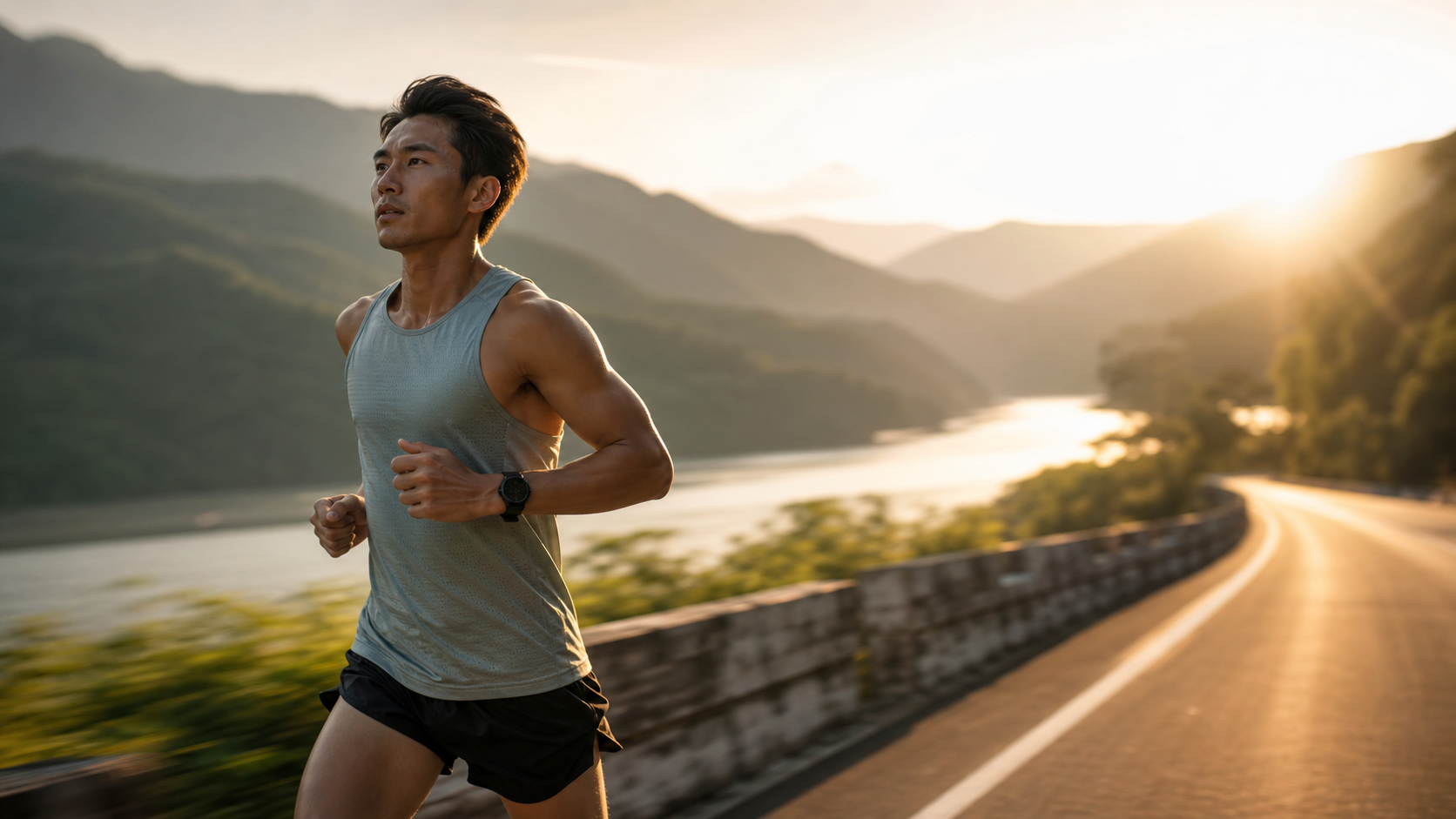
What Is Flow State?
Flow state was proposed by psychologist Mihaly Csikszentmihalyi in the 1970s. It describes a mental state of total absorption, loss of time awareness, and peak performance. In sports, it’s often called “being in the zone” or “runner’s zen.”
The Nine Dimensions of Flow
| # | Dimension | What It Feels Like |
|---|---|---|
| 1 | Challenge-skill balance | Neither too hard nor too easy |
| 2 | Action-awareness merging | Movement happens automatically, without thinking |
| 3 | Clear goals | You know exactly what to do next |
| 4 | Immediate feedback | You instantly know if what you’re doing is right |
| 5 | Intense concentration | Distracting thoughts disappear |
| 6 | Sense of control | Everything feels within your grasp |
| 7 | Loss of self-consciousness | You stop “monitoring” yourself |
| 8 | Time distortion | An hour feels like ten minutes |
| 9 | Autotelic experience | The process itself is the reward |
I. The Neuroscience of Flow
When you enter flow, five major changes happen in the brain:
- Transient hypofrontality: The prefrontal regions responsible for self-criticism temporarily quiet down, so self-doubt fades
- A rise in anandamide (an endogenous cannabinoid): the true chemical behind “runner’s high” (not endorphins, as commonly assumed)
- Simultaneous release of dopamine, norepinephrine, and serotonin: focus, pleasure, and drive together
- Brainwaves shift from beta toward the alpha/theta border: alert yet relaxed
- Changes in the time-perception region (right posterior parietal cortex): your sense of time speed becomes distorted
II. Four Conditions That Trigger Flow
Condition 1: Challenge Matches Skill
According to Csikszentmihalyi’s model:
- High challenge, low skill → anxiety
- Low challenge, high skill → boredom
- High challenge, high skill → flow
In practice: pick a goal that is about 4% harder than usual – not so easy it’s boring, not so hard it forces you to strain. For example, if you normally run 10K at 5:00/km, challenge yourself with 4:48/km for 10K.
Condition 2: Clear Goals + Immediate Feedback
- Goals: per-kilometer pace, heart-rate zone, a specific finish point
- Feedback: sport watch, heart-rate strap, real-time Strava data
Condition 3: Deep Focus, No Distractions
- Turn off social media notifications
- Choose a familiar route (no need to navigate)
- Pick a single point of focus (breathing rhythm OR pace OR heart rate – not all three at once)
Condition 4: Let Go of Self-Evaluation
Stop the inner chatter of “Am I running well?” or “How do I look?”
III. Seven Steps to Enter Flow
Step 1: Choose the Right Task (Intensity + Distance)
Recommended: 60-80% of LTHR heart-rate zone, for 30 minutes or more. Too short and you won’t get there; too intense and you’ll burn out.
Step 2: A Warm-Up Ritual
A consistent routine lowers mental load. For example: “10 minutes of dynamic warm-up → 5 minutes of easy jogging → settle into pace.”
Step 3: Set a Narrow Focus
Choose one thing to pay attention to. Pick one of these four:
- Breathing rhythm (2-2 or 3-3 count)
- Foot strike (midfoot/forefoot, cadence)
- Pace (time per kilometer)
- Environmental sensations (wind, light, sound)
Step 4: Dismiss Self-Criticism
When thoughts like “I’m not fast enough” or “I’m tired” surface, notice them and return to your point of focus. Don’t fight them or analyze them – just let them go.
Step 5: Anchor with Rhythm
Music (synced to 180 BPM cadence) or your breathing rhythm can help you hold a steady rhythm.
Step 6: Sense Your Body – Don’t Monitor It
Sensing is not the same as monitoring. Sensing is “my legs feel light”; monitoring is “is something about to go wrong with my legs?”
Step 7: Allow Yourself to “Forget Time”
When you stop checking your watch every five minutes, flow may already be happening.
IV. Scenarios Where Flow Comes Easily
| Scenario | Why Flow Comes Easily |
|---|---|
| A familiar long-distance route | No decisions to make |
| Mountain riding | Constantly changing terrain provides continuous feedback |
| Trail running | Forces focus on the ground ahead, clearing mental noise |
| Tempo runs | Steady heart rate, balanced intensity |
| Group rides/runs at a matched pace | Social flow |
V. Seven Flow Killers
- Checking your phone: once your attention breaks, it’s hard to get back
- Vague goals: “just running for the sake of it” rarely produces flow
- Too low intensity: your body isn’t being challenged
- Too high intensity: excessive stress
- Over-monitoring data: glancing at your watch every three seconds
- Too much internal dialogue: worrying about times, comparing yourself to others
- Poor physical condition: inadequate sleep, dehydration, low blood sugar
VI. Flow Doesn’t Happen Every Time
Be honest with yourself: even for elite athletes, flow is never guaranteed. Csikszentmihalyi’s research shows that athletes reach a full flow state in only 2-3 out of every 10 sessions, on average.
The key mindset:
- Don’t force it, don’t cling to it
- Keep creating the right conditions
- Enjoy the process – flow is a byproduct, not the goal
VII. Flow vs. “Zen Mind”
Eastern Zen’s concept of “no-self” closely resembles Western flow theory. The Japanese marathon monks’ “Sennichi Kaihogyo” (thousand-day circuit of the mountain) and the “mountain stillness” described by Taiwanese hikers are simply different expressions of flow.
What this means: flow doesn’t require a PB or a podium finish. It is, in itself, the deepest reward that sport can offer – and you already have the ability to reach it.
Related Reading
西進武嶺 免費訓練分析服務 Intervals | 練不夠還是練過頭?你哪一種類型選手?AI模型告訴你! | 備戰神器 | 公路車 訓練 | CT Yeh
4 年前
2018 田中馬拉松 全程健跑 VR 360 環景錄影 體驗現場狂野加油氣氛! Insta 360
7 年前
西進武嶺 自製新版AI配速表產生器 x 賽前攻略 抱佛腳! 沒有功率計也可以產生配速表嗎?有什麼其他眉角賽前要注意的呢? | 西進武嶺 / 東進武嶺 KOM 攻略 | 公路車 | CT Yeh
4 年前
JE22 百里任務體驗,心跳不能過150,三小時內有可能...? 沒有天時地利難度有多高? / 公路車 / CT Yeh
1 年前
水金九不厭五分 10度寒流冷到不願停!feat. 卡卡 / 公路車 / CT Yeh
6 個月前
一起升級!海鷗盃LSD團練...JJSC Zone2招待 騎到手抖 / 公路車 / CT Yeh
1 天前
2026 輪霸西濱200K 挑戰VLOG / 第一集團 / 首次參加..經驗不足、膀胱不足 /死守6H內 / AI戰鬥力顯示系統 / 公路車 / CT Yeh
4 個月前
#公路車 #Vo2Max #最大攝氧量 測驗 體驗 | 心肺測試
6 年前