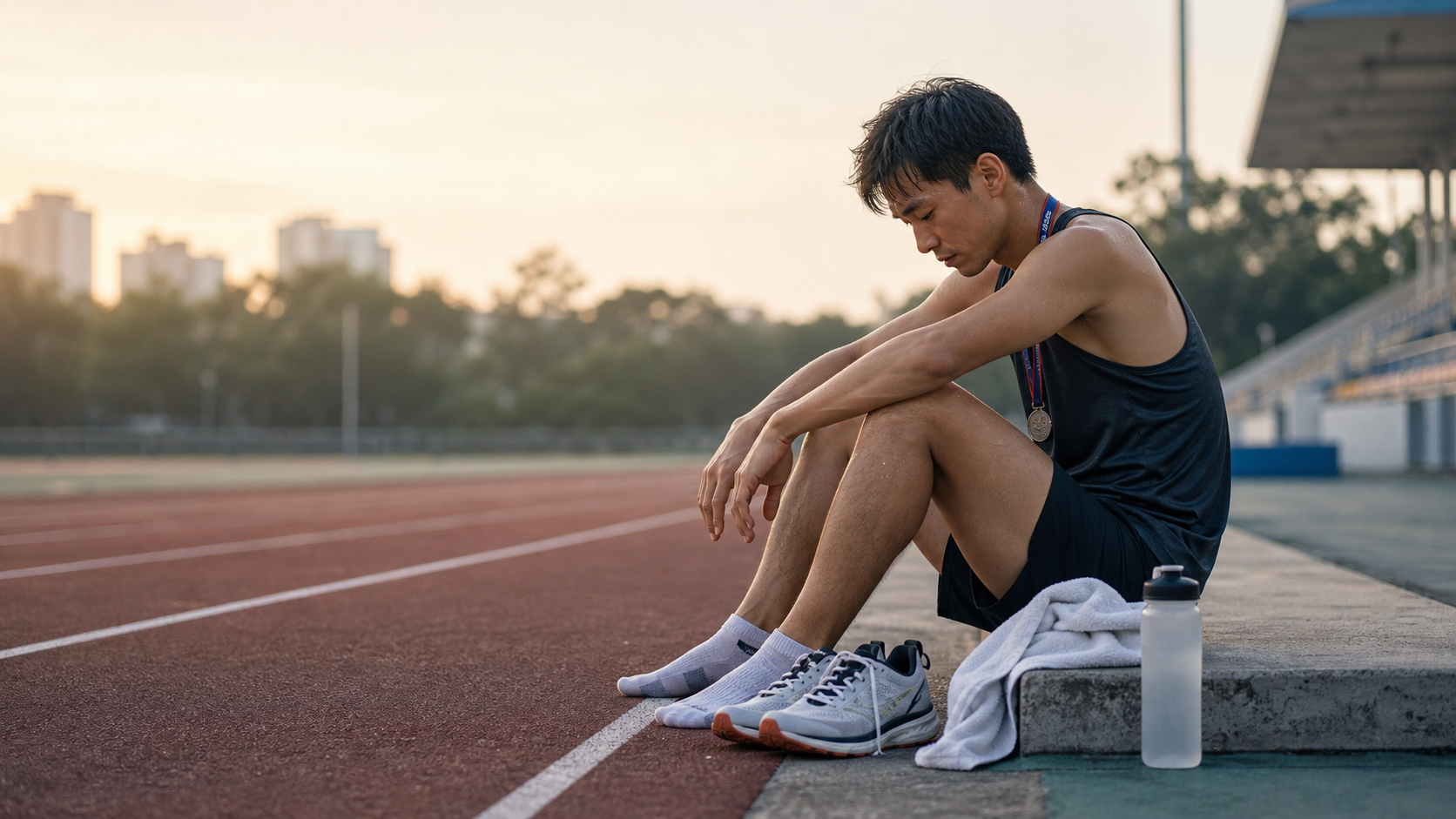
1. What Is Post-achievement Slump?
After achieving a major goal (PB, finishing a race, stepping onto the podium), experiencing low mood, loss of motivation, and a sense of emptiness is called the “post-achievement slump” (or goal-attainment depression).
A 2016 study by Goldstein found that up to 45% of Olympic athletes showed clinical depression symptoms within 3-6 months after a major event.
This is not an isolated case—it’s a common phenomenon.
2. Why Does This Happen?
Cause 1: The Dopamine Cliff
During race preparation, the brain releases dopamine every day because of “approaching the goal.” After achieving it, the goal disappears → dopamine drops sharply → similar to withdrawal symptoms.
Physical manifestations:
- Loss of interest in everything
- Disrupted sleep
- Abnormal appetite
- Scattered attention
Cause 2: Identity Weightlessness
During race prep: “I’m someone training for a marathon” “I’m someone aiming to break 3:30”—this is a strong self-definition.
After achieving it: “What now?” The identity label disappears, creating a void in one’s sense of existence.
Cause 3: Goal Vacuum
The brain needs goals to function. Without a next goal, the prefrontal cortex “can’t find work,” producing a sense of confusion.
Cause 4: Social Disconnect
During race prep: close interaction with training groups, running buddies, and coaches. After the race: during the rest period, social frequency drops and loneliness rises.
Cause 5: Physical Changes
Taking 2-3 weeks of rest after a race leads to a decline in fitness, and you may subjectively feel “I’ve regressed” or “I’ve become useless,” deepening the slump.
3. Timeline of the Slump
| Period | State | Key Point |
|---|---|---|
| 24-48 hours after race | Excitement, pride | Enjoy the achievement |
| 3-7 days after race | Things start to flatten | Be alert for the slump beginning |
| 1-3 weeks after race | Deepest point of the slump | Intervene proactively |
| 1-2 months after race | Gradually recovering | Build new goals |
| 3-6 months after race | Full recovery | Enter a new cycle |
4. Seven Signs to Identify the Slump
If you check 3 or more items, you need to actively address it:
- [ ] Loss of interest in training (not just your body wanting rest)
- [ ] You don’t want to open Strava when you see it
- [ ] No energy for meetups with running buddies
- [ ] Unexplained irritability or agitation
- [ ] Poorer sleep
- [ ] Abnormal appetite (binge eating or loss of appetite)
- [ ] Self-doubt: “Did I overestimate myself?”
5. Eight Strategies to Get Out of the Slump
Strategy 1: Expect It to Exist
Simply “knowing there will be a slump” can reduce the impact by 50%. Tell yourself before the race: “I might feel empty after reaching my goal—this is normal.”
Strategy 2: Deliberately Plan Your Post-Race Schedule
Plan what you’ll do for the 4 weeks after the race one week before the event, so your brain doesn’t enter a vacuum:
- Week 1: Complete rest + celebration gathering
- Week 2: Recovery runs, massage, review training logs
- Week 3: Choose the next goal (no need to start training immediately)
- Week 4: Low-intensity training, socializing
Strategy 3: Write a “Achievement Reflection Letter”
On days 3-7 after the race, write a letter to yourself covering:
- What did finishing this race prove?
- How did I grow during the training process?
- Who am I grateful to?
- What do I want to say to my future self?
This process transforms the “achievement” from a “result” into a “journey,” making it less likely to feel empty.
Strategy 4: Set New Goals in Stages
Don’t rush to set the next PB. First set process goals:
- “Run 4 easy runs per week for the next 4 weeks”
- “Focus on core training for the next 8 weeks”
- “Learn trail running over the next 3 months”
Once both mind and body have recovered, then set outcome goals.
Strategy 5: Switch Sports
After a marathon, you can try swimming, cycling, yoga, or trail running. Novelty stimulates dopamine and helps you break out of the slump.
Strategy 6: Teach and Share
Write articles about your training insights, teach beginners, or host small talks. “Giving” rebuilds a sense of meaning—it’s deeper than simply chasing the next PB.
Strategy 7: Enjoy Your Body’s Recovery
Use a body fat scale or heart rate variability (HRV) to monitor recovery. When you see the data trending upward, it provides positive feedback.
Strategy 8: Seek Professional Help When Needed
If the slump lasts more than 6 weeks or affects your work and daily life, see a doctor. Athlete depression is real—there’s no shame in it.
6. How Top Athletes Handle It
Michael Phelps (23 gold medals)
After the 2016 Rio Olympics, he publicly admitted to severe depression and suicidal thoughts. His approach:
- Received psychological treatment
- Publicly shared his experience
- Found a new mission (promoting athlete mental health)
Eliud Kipchoge (Marathon world record holder)
His method: after every major race, he schedules 3 months of “family time”—going home to be with his wife and children, completely stepping away from a training mindset.
Multiple-time Ironman champion Jan Frodeno
His ritual: for 2 weeks after a race, he doesn’t look at Strava, doesn’t wear sportswear, and deliberately lives an “ordinary person’s life.”
7. A Reminder to Yourself
The slump is not failure—it’s your brain recalibrating. It’s telling you:
- You really accomplished something big
- You need rest
- You need new meaning
Don’t fear the emptiness. Emptiness is the space for something new to enter.
8. A Long-Term Perspective: From Achievement to Growth
Sports psychologist Carol Dweck’s research shows that athletes centered on “growth” have more stable long-term happiness and shallower slumps than those centered on “achievement.”
After your next PB, don’t ask “What now?”—ask “What did I grow through in this process?” The answer will lead you out of the slump.
A PB is a gift, but growth is the real reward.
Related Reading
- The “Goal Loss” After Finishing a Race: What Is Post-race Blues and How to Get Through It
- The Emptiness After Finishing: How to Avoid an Athletic Slump After Achieving a Goal
- Post-Race Low: Where the Sense of Loss Comes From After a Major Goal and When to Seek Professional Help
- Post-Race Psychological Adjustment: The Emptiness After Major Goals and Setting New Ones
一日北高常見問題大集合 | 攻略 | 路線 | 訓練 | 補給 | 自行車 單車 | 一日雙城 | 雙塔 | TWB北高360 | 屁股痛
6 年前
一日北高 11小時 賽後心得分享篇 | TWB北高360 | 一日雙城 | 單車 | 公路車
6 年前
西進武嶺 免費訓練分析服務 Intervals | 練不夠還是練過頭?你哪一種類型選手?AI模型告訴你! | 備戰神器 | 公路車 訓練 | CT Yeh
4 年前
live) 超越北高 之一日北高12小時 策略
7 年前
摔車後補裝備: 好市多新款單車安全帽& Specialized Romin 北高整路屁股都不痛的坐墊 | 一千元居然有MIPS | CT Yeh | 公路車
4 年前
一日北高/長距離團騎 常見問題補充篇 / 組團或跟團的眉角 / 壯車友容易被瘦車友慢性拉爆 / 原來屁股痛可能是這個原因...? / 風場配速法 / 公路車 / CT Yeh
2 年前
滑雪新手們慘摔學習全紀錄(請開字幕),滑雪好好玩 | Snowboard + Ski | 岩原 スキー場 | 滑雪APP使用 | GoPro Max
6 年前
一日北高前的高裝檢 | 北高 360 | 挑戰11小時的裝備 | 一日雙塔 | 補給
6 年前