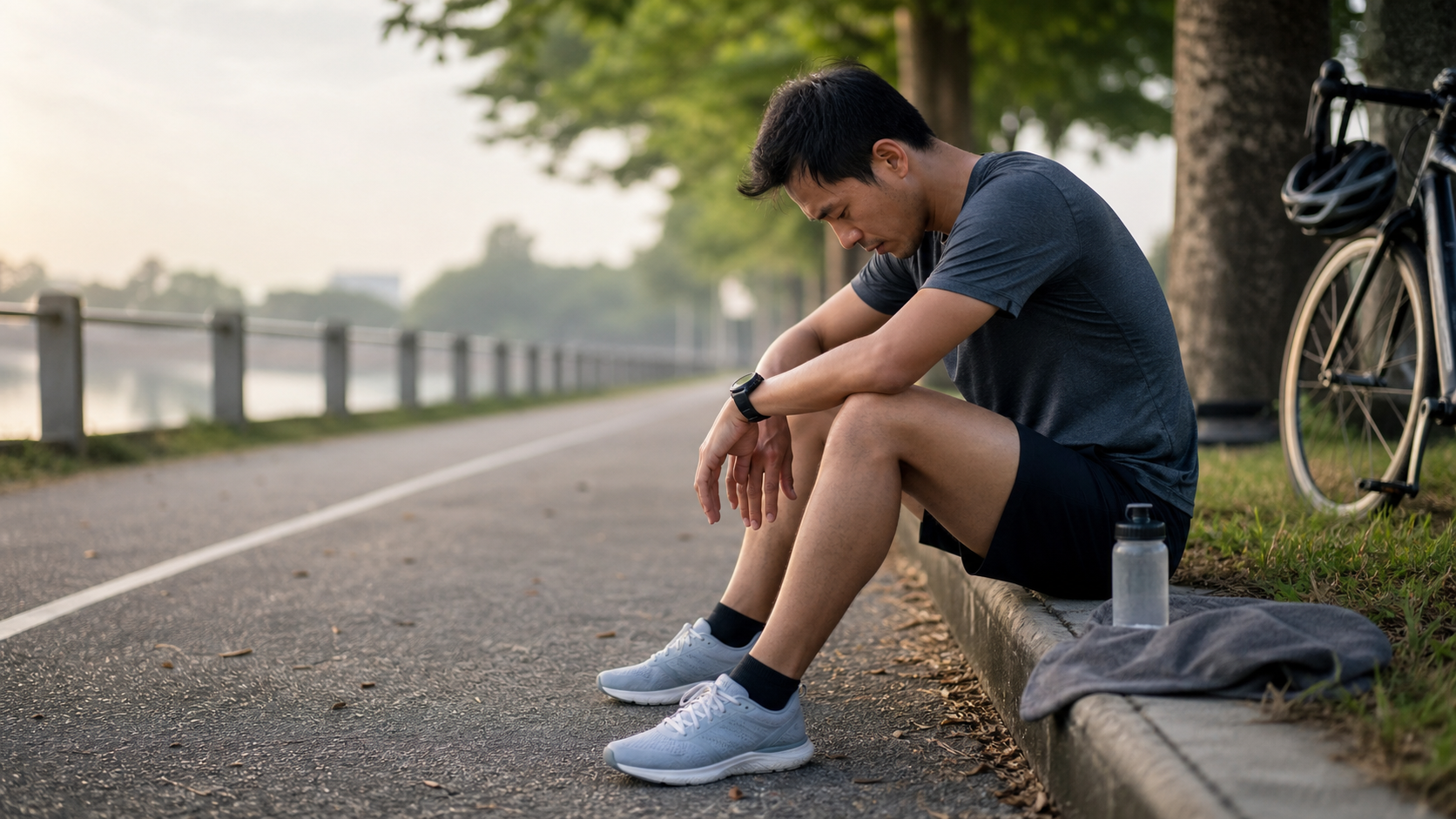
1. What Is Athletic Burnout?
Athletic Burnout, defined by sports psychologist Smith in 1986, encompasses three core dimensions:
1. Emotional / Physical Exhaustion
Persistent fatigue that rest doesn’t relieve.
2. Devaluation
“What’s the point of running?” “Why am I putting myself through this?”
3. Reduced Sense of Accomplishment
Feeling no sense of achievement even when progress is made.
Burnout only qualifies when all three are present simultaneously and persist for more than 4-6 weeks.
2. Burnout vs. Fatigue vs. Overtraining: How to Tell Them Apart?
| Condition | Primary Cause | Duration | Approach |
|---|---|---|---|
| General fatigue | Normal post-training response | 1-3 days | Rest |
| Overtraining | Excessive training volume | 2-8 weeks | Significant reduction |
| Burnout | Psychological + physiological | 4+ weeks | Psychological + physiological intervention |
| Depression | Psychological | Varies | Seek medical help |
Key difference: The core of burnout is loss of motivation, not just physical exhaustion.
3. Ten Warning Signs of Burnout
Be alert if you check 4 or more:
- [ ] Don’t want to put on your running shoes in the morning
- [ ] Cut training sessions short
- [ ] No excitement when looking at Strava
- [ ] Lost desire for a PB
- [ ] Group runs with friends feel like a chore
- [ ] Poorer sleep (even when fatigued)
- [ ] Abnormal appetite
- [ ] Irritable, prone to crying
- [ ] Work and daily life also affected
- [ ] Want to stop exercising entirely
4. Five Major Causes of Burnout
Cause 1: Monotonous Training
Same route, same intensity, same pace every day. The brain loses novel stimulation.
Cause 2: Stalled Progress
No improvement for 6 months, effort yields no visible results, and the motivation system breaks down.
Cause 3: Overcommitment
Preparing for multiple races simultaneously, compounded by work and family pressure, leading to an imbalanced life.
Cause 4: Rigid Identity
“I must be a runner.” “I must go sub-3.” — Identity hijacks your freedom.
Cause 5: Lack of Rest Culture
Social media glorifies “no rest” and “all-out effort,” ignoring that recovery is part of training.
5. Six Strategies to Overcome Burnout
Strategy 1: Take a Mandatory 2-4 Week Break
Not “reduced training,” but complete rest. Don’t even open your training apps.
Many athletes resist: “I’ll lose fitness!” The facts: 4 weeks of complete rest only costs 5-10% of fitness, which can be regained within 6 weeks of resuming — and you may even bounce back stronger (the long-cycle version of Supercompensation).
Strategy 2: Step Away from the Training Mindset
Do things you used to love but set aside:
- Read books, watch movies
- Learn a new instrument or language
- Have quality time with family and friends
- Travel (not a training camp)
Let your “identity” return to being a “person,” not an “athlete.”
Strategy 3: Switch Sports
When you return, don’t go back to the same activity. Marathon burnout → try swimming, climbing, yoga, or trail running.
Novelty is the most powerful antidote.
Strategy 4: Rediscover Your “Why”
Write down:
- Why did I start this sport?
- What’s my happiest training memory?
- Do I want to still be running in 10 years? Why?
If you find your “why” no longer exists, it might be time to switch activities — and that’s OK.
Strategy 5: Change Your Training Structure
Don’t immediately return to your old plan after coming back:
- Cut all the “musts” (must run 200K/month, must train every day)
- Switch to “flexibility” (let your body decide this week)
- Add an element of “play” (low-pressure group runs, exploring new routes)
Strategy 6: Redefine Success
Shift from “outcome-oriented” to “process-oriented”:
- Stop only chasing PBs; also count “happy training sessions”
- Stop only watching pace; also count “how much scenery you saw”
- Stop only tallying monthly mileage; also count “how many meals you had with family”
6. Timeline for Returning
| Week | Content | Intensity |
|---|---|---|
| 1-2 | Complete rest | Zero |
| 3-4 | Walking, stretching | Very low |
| 5-6 | Easy run/ride, no timing | 30% |
| 7-8 | Add tempo runs (short) | 50% |
| 9-10 | Standard easy training | 60% |
| 11-12 | Assess whether to set goals | 70% |
Don’t rush. Burnout took 6 months to build up; recovery may also take 3 months.
7. Seven Principles for Preventing Burnout
1. Periodize Your Training
Include a deload week every 4 weeks, and a “major rest week” (intensity cut in half) every 12-16 weeks.
2. Vary Your Training
Avoid the same intensity and route every day. Mix LSD, tempo, intervals, and trail running.
3. Prioritize Process Goals Over Outcome Goals
Outcome goal: “Break 3:30” (success or failure).
Process goal: “Train 4 times per week” (a sense of accomplishment every day).
4. Limit the Number of Races
No more than 2-3 marathons per year, and no more than 1-2 all-out races.
5. Maintain a Multi-Faceted Identity
You are a parent, an employee, a friend, an athlete — a diverse identity protects you.
6. Keep a Training Log (Including Mood)
Don’t just record distance and pace; also note “Did I enjoy today’s training?” — to catch burnout early.
7. Don’t Train in Isolation
Join groups, clubs, or find partners. Social connection is the strongest fuel for motivation.
8. Olympic Case Study: Simone Biles
At the 2020 Tokyo Olympics, Simone Biles withdrew mid-competition, openly acknowledging burnout and the “twisties” (mind-body disconnect). She said:
We have to protect our minds and our bodies, instead of just go out and do what the world wants us to do.
Her withdrawal was not a failure; it was a milestone for mental health in sports.
9. A Reminder to Yourself
Burnout doesn’t mean you’re not strong enough — it means you haven’t had a breather for too long. Allowing yourself to rest isn’t giving up; it’s long-termism.
Sport is a lifelong pursuit. Slow down in the short term, and you’ll go further in the long run.
Related Reading
- Psychological Recovery and Burnout Management: Finding Mind-Body Balance for Cyclists
- Mental Burnout in Road Running: Identifying the Burnout Phase and Rekindling Your Passion
- Recognizing and Recovering from Athletic Burnout: A Coach’s Guide to Reading Your Body’s Distress Signals
- Maintaining Running Motivation: Psychological Strategies to Avoid Burnout in Long-Term Training
西進武嶺 免費訓練分析服務 Intervals | 練不夠還是練過頭?你哪一種類型選手?AI模型告訴你! | 備戰神器 | 公路車 訓練 | CT Yeh
4 年前
實景訓練台) 彰化經典百K 高強度喵團 90分鐘 跟著一起練功 2019 Indoor workout Changhua Classic 100 Taiwan
7 年前
一個測試有沒有認真練車的方法😂 #公路車
10 個月前
一日北高前的高裝檢 | 北高 360 | 挑戰11小時的裝備 | 一日雙塔 | 補給
6 年前
FTL 與 SYB 車隊專訪 西進武嶺 實用攻略分享! 2小時 如何練?!你不知道的眉角!新手準備武嶺必看 EP1 | 實力派女車友 | 精華版 | 公路車 | CTYeh
4 年前
全台首發神車錶! iGPSPORT iGS630 兩趟一日北高的續航! 超強導航、功率訓練、超人性APP! Garmin & Bryton 有對手了嗎? | 公路車 |CT Yeh
3 年前
一日北高常見問題大集合 | 攻略 | 路線 | 訓練 | 補給 | 自行車 單車 | 一日雙城 | 雙塔 | TWB北高360 | 屁股痛
6 年前
一日北高 11小時 賽後心得分享篇 | TWB北高360 | 一日雙城 | 單車 | 公路車
6 年前