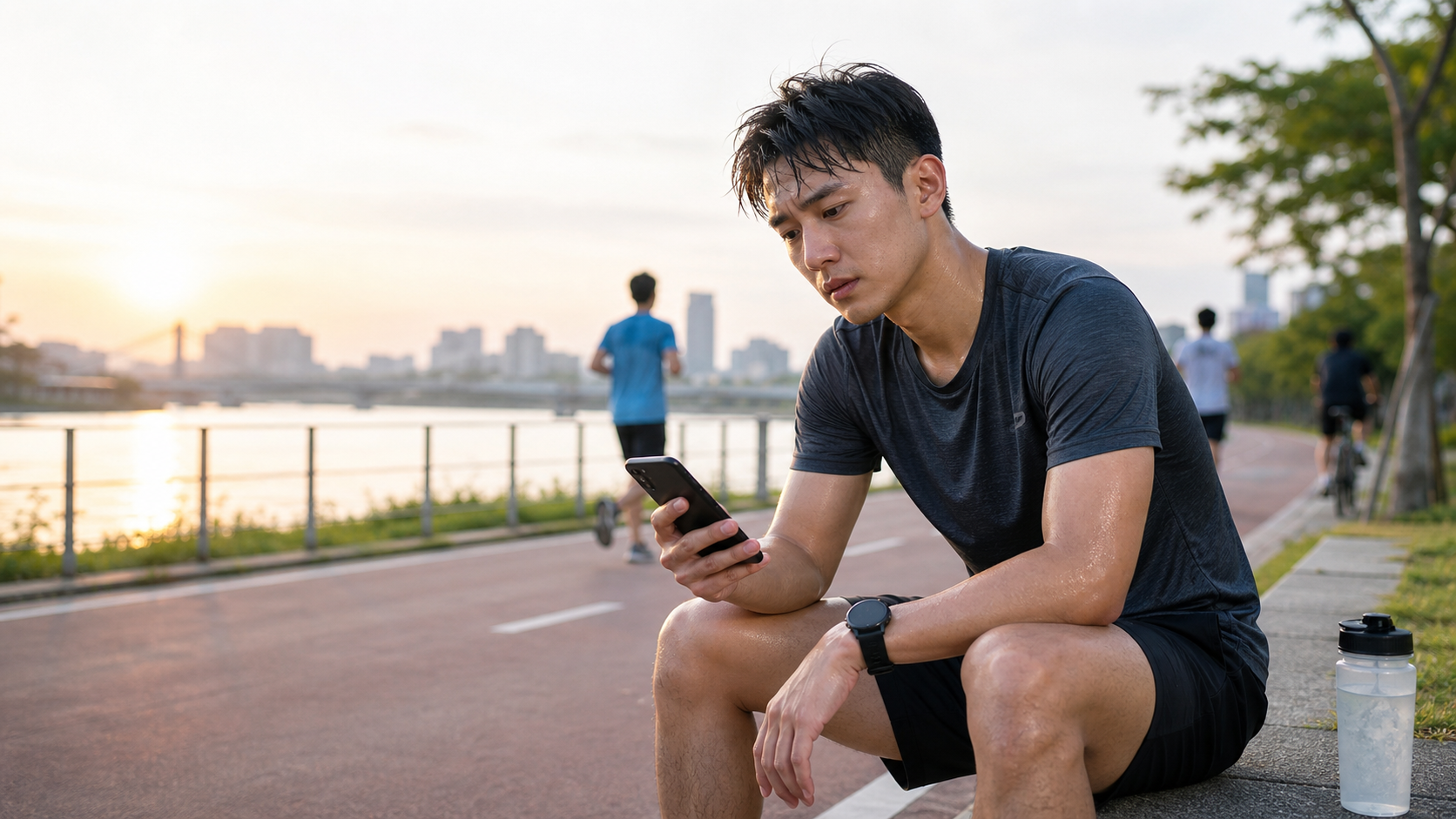
1. How Does Social Media Reshape an Athlete’s Psychology?
Strava, Garmin Connect, Instagram, Komoot—these platforms let us connect with peers, share achievements, and learn from competitors. But at the same time, they are reshaping how we feel about exercise.
2019 Stanford study: athletes who scroll Strava more than 30 minutes a day report 23% lower training satisfaction and 18% higher depressive symptoms than those who don’t.
2. Five Mechanisms of Social Comparison Psychology on Social Media
Mechanism 1: Upward Comparison
You only see others’ best performances, and you compare them against all of your training—inherently unfair.
Mechanism 2: Survivorship Bias
Social media showcases athletes who are improving, healthy, and hitting PBs. Those who are injured, burned out, or regressing quietly disappear—but you don’t see them, so you mistakenly think “everyone is getting better.”
Mechanism 3: Algorithm Reinforcement
Whose training you like determines what the algorithm feeds you next. Gradually, you only see people stronger than you.
Mechanism 4: Numbers Above All
Pace, distance, and elevation gain are reduced to comparable digits, stripping away the joy of the process.
Mechanism 5: Identity Anxiety
“I am a runner” becomes attached to numbers → numbers lose → identity feels threatened → anxiety.
3. Seven Signs You’re Being Affected
- [ ] After a run, you check others’ Strava before your own
- [ ] Your first move after a PB is posting on IG
- [ ] You feel down without likes
- [ ] Seeing others’ elevation gain ruins your mood
- [ ] During training you think, “How would this look as a post?”
- [ ] You change routes just to chase KOMs
- [ ] You don’t upload if the run wasn’t satisfying
4. Seven Principles for Healthy Social Media Use
Principle 1: Define Your Purpose
Before opening Strava, ask yourself: “What do I want to learn/share?”—rather than passively scrolling.
Principle 2: Limit Daily Time
Set phone limits: 15 minutes a day for Strava, 30 minutes for IG. Lock it once exceeded.
Principle 3: Follow the Right People
- Unfollow people who make you anxious (no guilt required)
- Follow people you can learn from (across varying levels)
- Follow “process-oriented” athletes (those who share struggles, not just results)
Principle 4: Upload Without Going Public
Set Strava to “visible to friends only” or “completely private”—you still keep your data logs, but you opt out of the ranking game.
Principle 5: Turn Off “Relative” Information
Disable “Comparisons,” “KOM,” “Suffer Score,” etc. on Strava. Focus on your own progress.
Principle 6: Monthly “Social Media Detox Day”
Pick one week a month to completely avoid exercise social media. Observe how your training feels changes.
Principle 7: Train Without Looking at Any App
At least once a week, train without a GPS watch, without uploading, without posting. Rediscover “running for yourself.”
5. Cognitive Reframing: Four Questions
When seeing others’ training ruins your mood, ask yourself:
Question 1: Am I Seeing the Full Picture?
He may have uploaded, but didn’t share that he was injured last week.
Question 2: Is His Training Right for Me?
He runs 100K a week, is 20 years old, and weighs 55kg. You’re 40, a desk worker, and weigh 75kg. His numbers mean nothing to you.
Question 3: Am I Comparing Against “Past Me”?
The true progress metric: your pace from 6 months ago.
Question 4: Is Training a Means or an End?
Are you training to live a better life, or to beat others? The former brings happiness; the latter brings anxiety.
6. Healthy Interactions on Strava
Healthy Behaviors
- Genuinely encourage others (Kudos + comments)
- Share the process (warm-ups, nutrition, moods)
- Post failed workouts (breaking perfectionism)
- Leave teaching comments for beginners
Unhealthy Behaviors
- Silent comparison and quiet anxiety
- Changing routes/risky riding for KOMs
- Faking slow paces (humble-bragging “I was just jogging”)
- Mocking others’ performances
7. The Benefits of Exercise Communities (Don’t Cut Them All Out)
Communities have real value:
- Motivation: group runs and meetups encourage consistent training
- Learning: seeing others’ training methods
- Tracking: historical data and growth trajectories
- Connection: finding like-minded people and building relationships
The key is active use, not passive scrolling.
8. How Elite Athletes Approach It
Eliud Kipchoge
He barely uses personal social media. He says: “I train for inner peace, not for others’ opinions.”
Killian Jornet (King of Trail Running)
For years, his Strava has only featured landscape photos, rarely pace data. He says: “Share beauty, not comparison.”
Lucy Bartholomew (Ultramarathon Runner)
She openly shares her injury periods, low points, and jealous feelings. She says: “Strava should be real life, not a marketing profile.”
9. A Reminder to Yourself
Sports psychologist Carol Dweck once said:
The only person you should try to be better than is the person you were yesterday.
Next time you open Strava, remember:
- Others’ training is their script
- Your training is your life
- The true meaning of PB is “personal best”—your best, not anyone else’s
10. Action Plan: This Week’s Challenge
Try this 7-day challenge:
- Day 1: Unfollow 5 people who make you anxious
- Day 2: Change Strava to “visible to friends only”
- Day 3: Complete a workout without uploading it
- Day 4: Give 5 friends Kudos + encouraging comments
- Day 5: Post an “imperfect” workout (failure, soreness, slowness)
- Day 6: Avoid all exercise social media entirely
- Day 7: Write down how your feelings changed this week
You’ll discover: the joy of training is back.
Related Reading
- The Impact of Digital Social Platforms (Strava) on Training Motivation: A Study of Social Comparison
- The Social Comparison Trap: Mental Health Boundaries in Instagram Runner Culture
- Comparison Psychology in Road Running: How to Stop Comparing Pace with Others
- Strava Anxiety and Social Media Pressure: Mental Health for Cyclists in the Data Age
西進武嶺 免費訓練分析服務 Intervals | 練不夠還是練過頭?你哪一種類型選手?AI模型告訴你! | 備戰神器 | 公路車 訓練 | CT Yeh
4 年前
安裝) 超酷! RGT Cycling 最新 訓練台 騎乘軟體 模擬一級賽經典路線 選手 Road Grand Tours 安裝教學 Zwift 替代方案
7 年前
公路車 爬坡 破PR 紀錄 小技巧 分享
6 年前
全台首發神車錶! iGPSPORT iGS630 兩趟一日北高的續航! 超強導航、功率訓練、超人性APP! Garmin & Bryton 有對手了嗎? | 公路車 |CT Yeh
3 年前
2026 車錶排行榜!誰是最多車友正在使用?練家子最愛哪款?🏆 (2萬名車友數據) / 公路車 / CT Yeh
5 個月前
CT Talk) 數據面窺看 武嶺大神們 平時的備戰 共通點 (娛樂性質XD)
7 年前
單車元宇宙新霸主?TrainingPeaks Virtual 實測 / Zwift 完美平替? 還是超越?/ 有台灣國旗!前身 indieVelo / 公路車 / CT Yeh
1 年前
福隆鐵人團練隨拍
8 年前