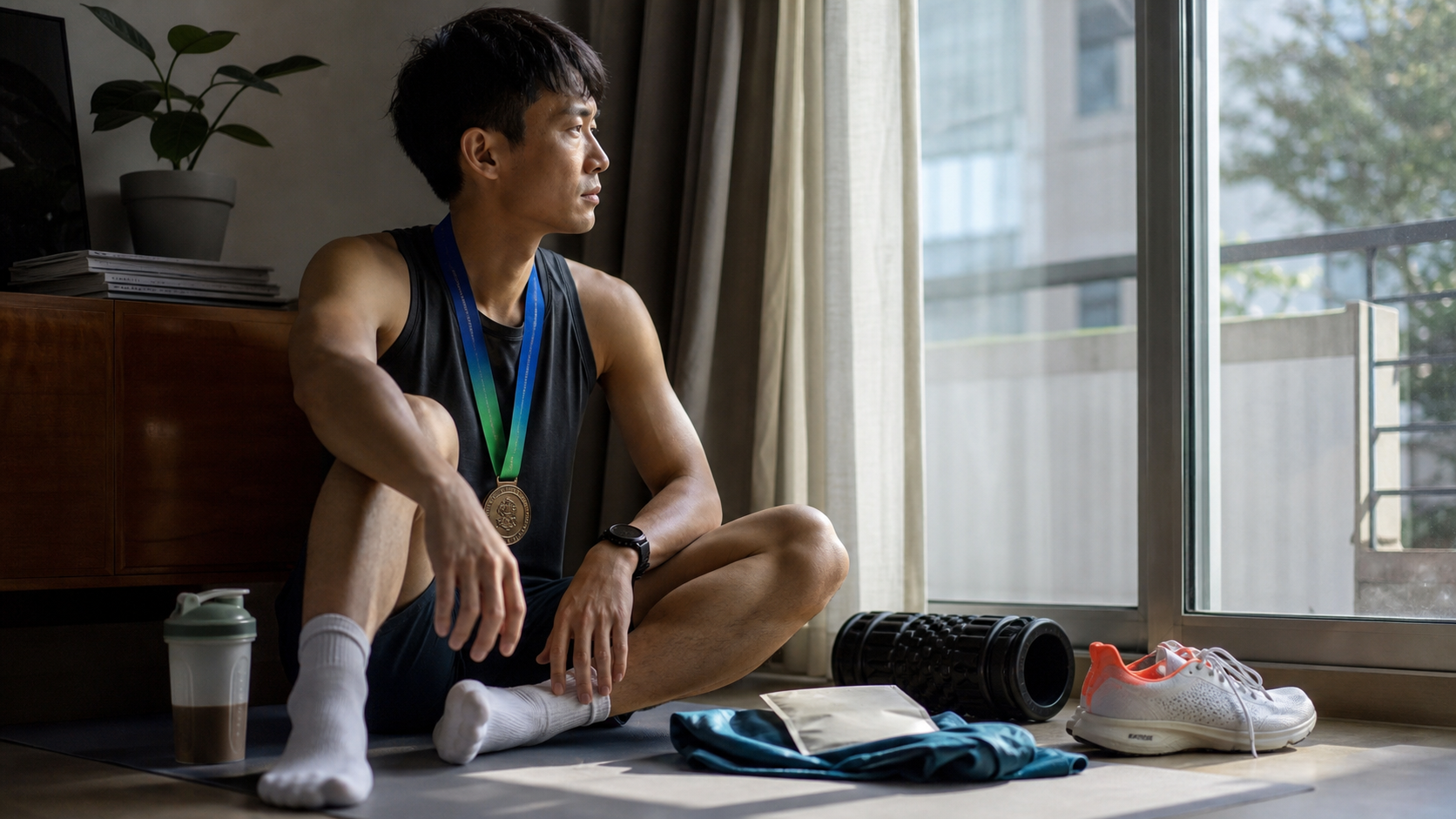
1. What Is Post-Race Blues?
Post-race Blues (also called Post-marathon Depression) refers to a cluster of symptoms that show up within 1-4 weeks after finishing a race:
- Unexplained emptiness or sense of loss
- Loss of interest in training
- Disrupted sleep
- Appetite changes
- Irritability or tearfulness
- Self-doubt
It’s related to, but not identical to, “Post-achievement Slump”:
- Post-achievement Slump: the low that follows a major achievement, like a new personal best (PB)
- Post-race Blues: a post-race letdown that can happen after any race, even without a PB
2. Why Does This Happen?
Reason 1: The neurochemical storm subsides
During a race, your brain releases:
- Adrenaline
- Dopamine
- Endocannabinoids
- Endorphins
These levels crash sharply 24-72 hours after finishing — similar to drug withdrawal, except your body doesn’t know that’s what’s happening.
Reason 2: The goal vacuum
During training: every day involves workouts, pacing, and fueling to think about. After the race: suddenly there’s no goal. Your brain’s “planning center” (the prefrontal cortex) can’t find anything to do.
Reason 3: Identity disconnect
During training: “I’m someone preparing for a marathon.” After the race: “Now what? Am I still an athlete?”
Reason 4: Less social contact
During training: running clubs, training camps, and close community interaction. After the race: a rest period where social contact drops to near zero.
Reason 5: Physical changes
In the 1-2 weeks after a race, fitness dips and muscles ache, which can create a subjective feeling of “I’ve become useless.”
3. Different Types of Finishes Bring Different Kinds of Blues
Type A: Achieving a PB (the post-peak crash)
- The most intense
- Lasts 2-6 weeks
- The “now what?” existential question hits hardest
Type B: Hitting your target exactly
- Moderate intensity
- Lasts 1-3 weeks
- Satisfaction and letdown coexist
Type C: Finishing but missing the target
- A double dose of disappointment and letdown
- Lasts 2-4 weeks
- Self-doubt is pronounced
Type D: DNF or withdrawal
- The most intense of all
- Lasts 4-8 weeks
- Requires more active intervention
4. The Timeline of Post-Race Blues
| Period | State | Focus |
|---|---|---|
| 0-24 hrs after | Excitement, pride | Enjoy the achievement |
| Days 1-3 after | Physical fatigue, mentally still okay | Physical recovery |
| Days 4-7 after | Emptiness begins | Watch for the Blues arriving |
| Weeks 1-3 after | Blues at their deepest | Active intervention |
| Weeks 4-8 after | Gradual recovery | Build a new rhythm |
| Weeks 8-12 after | Full recovery | Enter a new cycle |
5. Nine Strategies to Get Through It
Strategy 1: Expect it
Simply “knowing the Blues are coming” can cut the impact by half. A week before your race, tell yourself: “I might feel low for 1-3 weeks after finishing — that’s normal.”
Strategy 2: Plan your post-race weeks before the race
The week before your race, plan out the next 4 weeks:
| Week | Theme | Examples |
|---|---|---|
| 1 | Celebrate + full rest | Celebration dinner, massage, a trip with family |
| 2 | Physical recovery | Walking, stretching, yoga |
| 3 | Mental processing | Write a race recap, review your training |
| 4 | Explore something new | Try a new sport or hobby |
The key: don’t let the post-race period become a blank space.
Strategy 3: Write a “race reflection journal”
In the 3-7 days after your race, write down:
- What was the most beautiful moment of the race?
- What did I learn?
- Who am I grateful for?
- How did I grow during training?
- What do I want to say to my future self?
This process turns the “result” into a “journey,” which is less likely to leave you feeling empty.
Strategy 4: Be intentional about socializing
Grab a meal or meet up with running friends. You don’t have to talk about the race — talk about anything else, listen to their stories. Social connection is the strongest antidote to the Blues.
Strategy 5: Try a new activity
After a marathon, you could try:
- Swimming: low-impact, relaxing
- Cycling: covers distance, clears your mind
- Rock climbing: a new skill, a new community
- Trail running: new scenery, new challenges
- Yoga: aligns body and mind
Novelty stimulates dopamine.
Strategy 6: Give to others
- Write a race report to help beginners
- Pace for your running club
- Bring a friend into running
- Volunteer
Giving activates oxytocin, eases depression, and rebuilds a sense of meaning.
Strategy 7: Hold off on signing up for the next race
A common mistake: registering for the next race just a week after finishing, to “fill the void.” The result: incomplete recovery + unprocessed mental state → worse performance → deeper Blues.
The right approach: wait at least 4 weeks before considering your next race, and at least 8 weeks before starting to train for it.
Strategy 8: Let yourself be “not an athlete” for a while
Try this for 4 weeks:
- Don’t wear athletic clothes
- Don’t wear your sports watch
- Don’t check Strava
- Don’t talk about running
Let your identity shift from “athlete” back to just “person.” You’ll find the other sides of yourself coming back.
Strategy 9: Seek professional help when needed
If the Blues last more than 6 weeks and are affecting your work or life, please see a doctor. Depression among athletes is real.
6. Cases From the Top
Sarah True (Olympic triathlete)
At the 2019 Ironman Frankfurt, she missed the podium by just 2 minutes. She has openly shared her severe post-race depression: “I couldn’t leave the house for three whole months.” Her path through it: therapy, shifting focus to marathons, and six months of rest. She came back strong the following year.
Meb Keflezighi (Boston Marathon champion)
He wrote in his memoir: “After every major race I have two weeks of the Blues. I’ve come to expect it — it means I truly gave it everything.” His ritual: only walking for a week after finishing, and avoiding all sports news.
Eliud Kipchoge
His approach: three months of “family time” after every major race, going home to be with his wife, children, and farm. A complete switch of identity.
7. Long-Term Strategy: Build a “Post-Race Ritual”
Consider building your own post-race ritual and carrying it out after every race.
Within 24 hours
- Slowly enjoy a favorite meal
- Call family and friends
- Write down one thing you’re grateful for
Within a week
- No training at all
- A massage
- A massage or physical therapy session
- Write your race recap
Within a month
- Complete one small non-athletic goal (finish a book, learn a recipe)
- At least one social activity
- Give yourself an “effort award”
Within three months
- Only then start considering your next race
- Set your next training cycle
8. A Word for Yourself
Haruki Murakami once wrote something close to this idea: every runner carries their own private dreams, and dreams are like clouds — they take shape, then dissolve, then form again.
Post-race Blues is the moment a dream dissolves. It’s uncomfortable, but it’s inevitable — and it’s also the signal that a new dream is about to take shape.
The next time you finish a race, don’t be afraid of the emptiness. Emptiness is the space where the next dream moves in.
9. The Ultimate Question: Why Do You Run?
If you experience severe Blues after every race, it may be worth asking:
- Is running a tool for my life, or is it the meaning of my life?
- If I could no longer run one day, who would I be?
- Can I run purely for the process?
Once you can answer these questions, Post-race Blues will naturally ease — because running is only one part of you, not all of you.
You remain complete even after the finish line. That is the answer.
Related Reading
CT 喇低賽) 單車 比賽總是沒照片? 攝影師的觀點大公開 姿勢就是力量! 請加速1.25倍收看
7 年前
一日北高 11小時 賽後心得分享篇 | TWB北高360 | 一日雙城 | 單車 | 公路車
6 年前
摔車後補裝備: 好市多新款單車安全帽& Specialized Romin 北高整路屁股都不痛的坐墊 | 一千元居然有MIPS | CT Yeh | 公路車
4 年前
西進武嶺 免費訓練分析服務 Intervals | 練不夠還是練過頭?你哪一種類型選手?AI模型告訴你! | 備戰神器 | 公路車 訓練 | CT Yeh
4 年前
CT暗黑廚房) 車友必備 宇宙無敵鮮蚵湯 幫助訓練恢復 天然食補 好市多 超肥鮮蚵 破PR
7 年前
2016 桐花飛舞 單車挑戰 精華片段
10 年前
一日北高/長距離團騎 常見問題補充篇 / 組團或跟團的眉角 / 壯車友容易被瘦車友慢性拉爆 / 原來屁股痛可能是這個原因...? / 風場配速法 / 公路車 / CT Yeh
2 年前
一日北高前的高裝檢 | 北高 360 | 挑戰11小時的裝備 | 一日雙塔 | 補給
6 年前