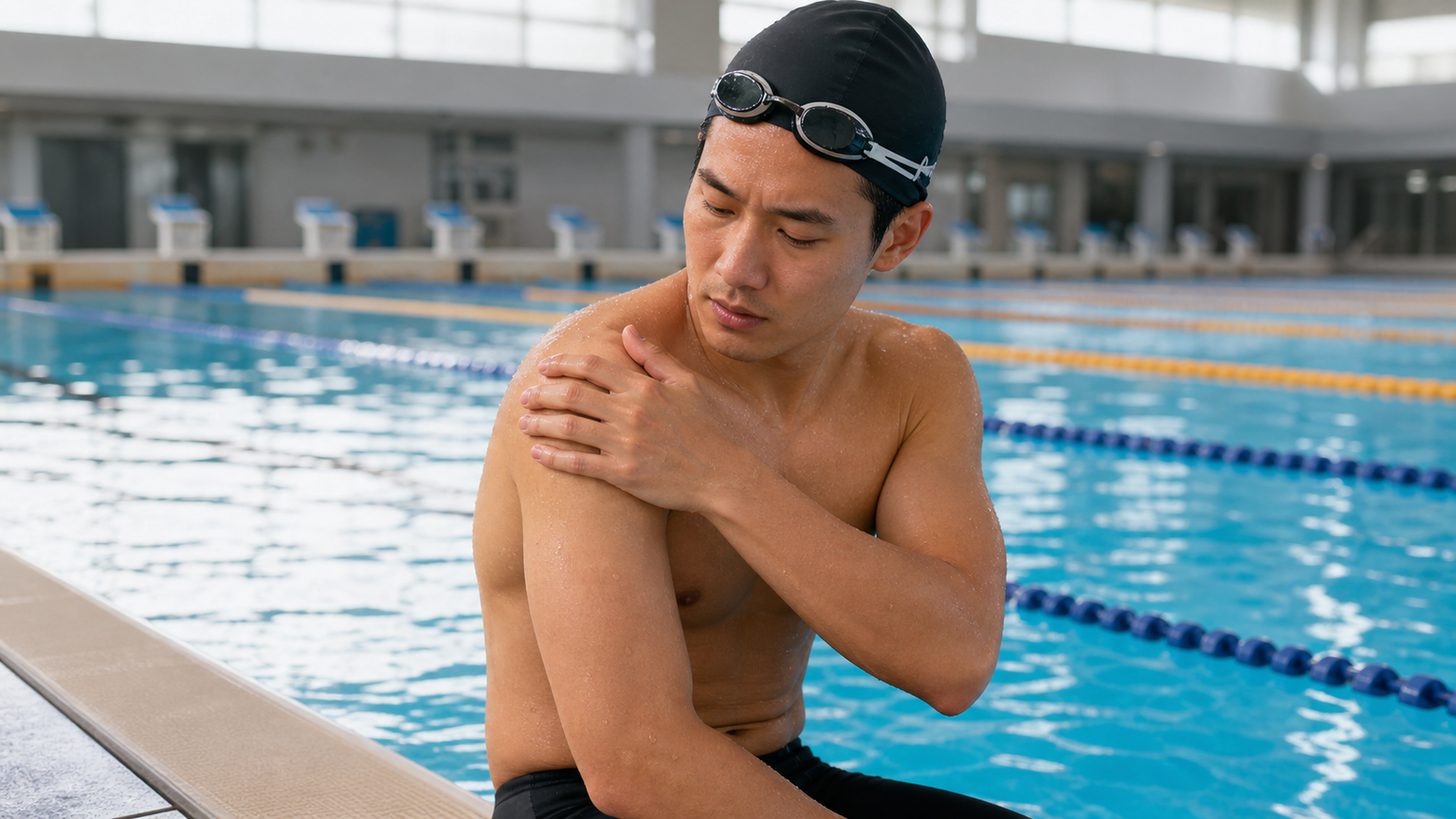
What is Swimmer’s Shoulder
“Swimmer’s Shoulder” is not a single disease, but an umbrella term encompassing rotator cuff tendinitis, subacromial impingement syndrome, long head of the biceps tendinitis, and SLAP lesions. Research indicates that the prevalence of shoulder pain among competitive swimmers within one year ranges from 40% to 91%, making it the most representative injury in swimming.
Anatomical Basis
The shoulder joint is stabilized by four rotator cuff muscles:
| Muscle | Function | Corresponding Swimming Motion |
|---|---|---|
| Supraspinatus | Abduction | Hand entry and catch phase |
| Infraspinatus | External rotation | Recovery phase of the stroke |
| Teres Minor | External rotation | Recovery phase of the stroke |
| Subscapularis | Internal rotation | Pull-through and propulsion phase |
When these muscles become fatigued or imbalanced, the humeral head migrates upward, compressing the subacromial space, leading to inflammation of the supraspinatus tendon and the bursa.
Why Swimming is Particularly Prone to Shoulder Injury
- Staggering Repetition Count: An elite swimmer performs approximately 16,000-20,000 strokes per week, meaning each shoulder cycles 8,000-10,000 times.
- High Catch Torque: At the moment of each hand entry, the rotator cuff endures shear forces equivalent to 1.5-2 times body weight.
- Large Overhead Angles: During the recovery phase of freestyle, the shoulder abducts beyond 90 degrees, which is precisely the angle most susceptible to impingement.
- Lack of Shock Absorption: Running on land benefits from the arch of the foot for cushioning, whereas swimming relies entirely on the upper extremity tendons to absorb forces.
Recognizing Symptoms (From Early to Severe)
- Stage 1: Soreness and fullness in the front of the shoulder after training, subsiding within 24 hours of rest.
- Stage 2: Pain during training, particularly at the moment of hand entry and catch (the first 1/3 of the stroke).
- Stage 3: Pain during daily activities, such as difficulty reaching for objects or getting dressed.
- Stage 4: Night pain, waking from sleep when lying on the affected side.
Three Self-Tests
- Hawkins-Kennedy Test: With the elbow at 90 degrees and the shoulder abducted to 90 degrees, internally rotate the forearm and press down—pain in the front of the shoulder indicates a positive result.
- Empty Can Test: With the arm forwardly abducted to 90 degrees and the thumb pointing downward, resist downward pressure—weakness or pain in the supraspinatus indicates a positive result.
- Painful Arc: Slowly raise the arm from the side to overhead; pain within the 60-120 degree range is typical of impingement.
Common Technical Root Causes
- Excessive Cross-Midline Stroke: The hand crosses the body’s midline after entry, forcing the shoulder into internal rotation and impingement.
- Dropped Elbow During the Catch: A high-elbow catch allows the latissimus dorsi to engage; otherwise, all the load falls on the rotator cuff.
- Insufficient Body Rotation: When body roll is less than 30 degrees, the arm is forced to generate power at a high impingement angle.
- Unilateral Breathing: For those who only breathe to one side, the non-breathing side develops muscle strength asymmetry, becoming noticeably imbalanced after 3 months.
Training Volume Warning Signs
The following situations increase the risk by 2-3 times:
- Weekly swimming volume increasing by more than 20% in a single week
- Using paddles continuously for more than 2000m per week
- 5 consecutive days of high-intensity training without rest
- Simultaneously adding heavy land training such as bench presses and overhead presses
When to Seek Medical Attention
Stop swimming and consult a doctor immediately if any of the following occurs:
- Shoulder pain persists for more than 2 weeks without improvement
- Night pain disrupts sleep
- Arm weakness prevents lifting it to shoulder height
- A sensation of “catching” or “clicking” in the shoulder
Understanding swimmer’s shoulder is the first step in prevention; the next step is rehabilitation for scapular stability and technique correction.
Related Reading
- Shoulder Injuries in Swimming: Causes and Prevention of Swimmer’s Shoulder
- A Complete Guide to Diagnosing and Treating Swimmer’s Shoulder
- Swimmer’s Shoulder Fully Explained: Causes, Diagnosis, and Prevention
- The Complete Guide to Shoulder Pain in Swimming: Causes and Prevention of Shoulder Impingement Syndrome
抖肩舞 台灣x日本交流版 (台灣 vs 前橋) 赤城山登山賽 coincidance
8 年前
一日北高/長距離團騎 常見問題補充篇 / 組團或跟團的眉角 / 壯車友容易被瘦車友慢性拉爆 / 原來屁股痛可能是這個原因...? / 風場配速法 / 公路車 / CT Yeh
2 年前
2026 輪霸西濱200K 挑戰VLOG / 第一集團 / 首次參加..經驗不足、膀胱不足 /死守6H內 / AI戰鬥力顯示系統 / 公路車 / CT Yeh
4 個月前
[教學] Premiere 影片 手震 修正 教學 防抖 單眼 影像 GoPro 穩定 Video Stabilization
8 年前
一日北高常見問題大集合 | 攻略 | 路線 | 訓練 | 補給 | 自行車 單車 | 一日雙城 | 雙塔 | TWB北高360 | 屁股痛
6 年前
Insta 360 One 超級防手震技術實測
7 年前
松運深水池拍攝 作品 防寒衣品牌
8 年前
滑雪新手們慘摔學習全紀錄(請開字幕),滑雪好好玩 | Snowboard + Ski | 岩原 スキー場 | 滑雪APP使用 | GoPro Max
6 年前