Swimmer's Knee (Breaststroker's Knee): Medial Collateral Ligament Stress Caused by the Frog Kick
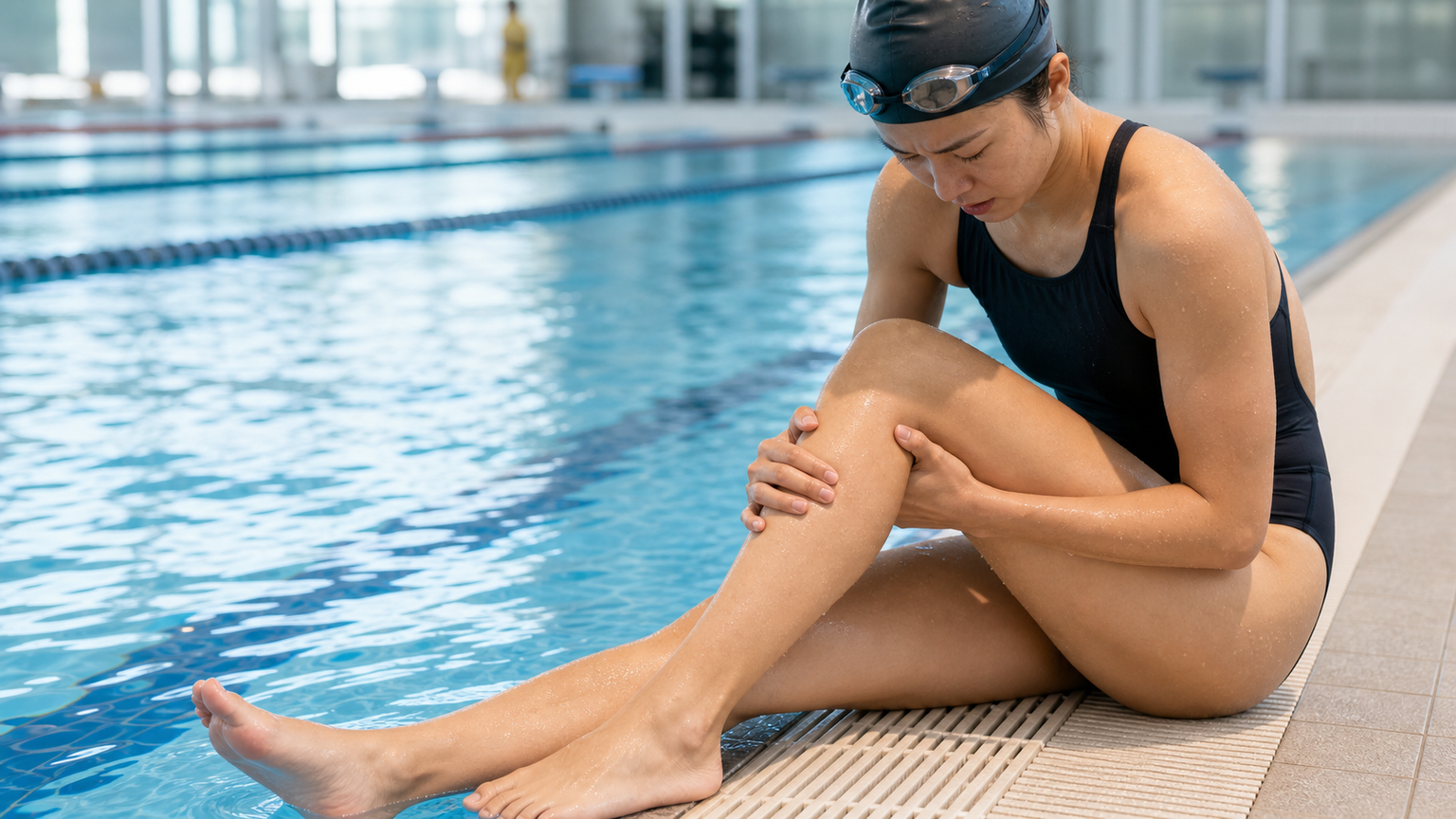
Breaststroker’s Knee Is an Occupational Hazard for Breaststroke Swimmers
Statistics show that 73% of elite breaststroke swimmers have experienced knee pain, with medial collateral ligament (MCL) strains or chronic inflammation accounting for the majority. Swimmers of other strokes have a knee pain rate of only about 10%, highlighting the unique risk of the frog kick motion.
Joint Mechanics of the Frog Kick
Stress on the knee joint during the four phases of the frog kick:
| Phase | Movement | Knee Joint Stress |
|---|---|---|
| Recovery | Knee flexion, drawing legs up | Low |
| Out-sweep | Hip abduction, knee valgus | Extremely high |
| Propulsion | Hip adduction, kicking | High |
| Glide | Legs together | Low |
During the out-sweep phase, the knee joint simultaneously endures:
- Hip external rotation pull
- Tibial external rotation torque
- Opposing water resistance force
Combined, these place the medial collateral ligament (MCL) under shear forces of 4-6 times body weight.
MCL Injury Grading
| Grade | Symptoms | Management |
|---|---|---|
| Grade 1 (sprain) | Medial pain but no instability | Conservative treatment 2-4 weeks |
| Grade 2 (partial tear) | Pain + mild laxity | 4-8 weeks of rehab |
| Grade 3 (complete rupture) | Marked instability | Surgery or long-term rehab |
Most breaststroke swimmers have chronic Grade 1 inflammation, but if left untreated it can progress to Grade 2.
Identifying Breaststroker’s Knee Symptoms
- Pain location: Medial side of the knee, near the joint line
- Aggravating movements: Frog kick out-sweep, climbing stairs
- Swelling: Usually mild; obvious swelling is rare
- Instability: None in Grade 1; Grade 2 presents a feeling that “the knee is coming apart”
Self-test: Valgus Stress Test:
- Lie flat with the knee flexed at 30 degrees
- Place one hand on the outer thigh and the other on the inner shin
- Push the shin outward and observe the medial opening angle and pain
- Pain on the medial side indicates a positive result
Technical Root Causes
Mistake 1: Kicking Too Wide
A valgus angle exceeding 45 degrees significantly increases MCL stress. The ideal angle is about 30-40 degrees.
Mistake 2: Asymmetric Kicking
When the valgus angle difference between the left and right legs exceeds 10 degrees, the MCL on the wider side bears 1.5 times the load.
Mistake 3: Insufficient Hip Mobility
When hip external rotation is inadequate, the knee joint is forced to compensate with additional valgus angle, increasing MCL stress.
Mistake 4: Incorrect Toe Direction
In a proper frog kick, the toes should point outward. If the toes point backward (toward the heels), tibial torque is transmitted directly to the MCL.
5 Preventive Exercises
1. Hip External Rotation Mobility (twice daily)
- Seated, place one ankle on the opposite knee
- Lean forward to feel the stretch in the glutes
- 30 seconds × 3 sets per side
2. Tensor Fasciae Latae Stretch
- Stand with legs crossed, reach both arms upward and to the opposite side
- Hold for 30 seconds, 3 times per side
3. Clamshell
- Lie on your side with knees bent and feet together
- Raise the top knee to 45 degrees, hold for 2 seconds
- 15 reps × 3 sets per side
- Strengthens the gluteus medius to share the MCL load
4. Single-Leg Bridge
- Lie on your back with one knee bent and the other leg lifted
- Raise the pelvis and hold for 2 seconds
- 10 reps × 3 sets per side
5. Isometric MCL Strengthening
- Seated with knees flexed at 30 degrees
- Place a pillow between the knees
- Squeeze firmly and hold for 10 seconds
- 10 reps × 3 sets
Training Load Management
Recommendations for breaststroke-specific training:
- No more than 2000m of breaststroke per day
- No more than 800m per day of isolated frog kick drills (no arms)
- No more than 3 consecutive days of high-intensity breaststroke
- Breaststroke should not exceed 40% of total swim volume
Acute Management: The POLICE Principle
When knee pain occurs:
- Protection: Use a knee brace for support
- Optimal Loading: Moderate loading rather than complete rest
- Ice: Ice for 15 minutes every 2 hours
- Compression: Use an elastic bandage
- Elevation: Elevate above heart level
Return-to-Water Timeline
| Week | Content |
|---|---|
| Weeks 1-2 | Complete rest from swimming + rehab exercises |
| Weeks 3-4 | Freestyle and backstroke, 1500m each |
| Weeks 5-6 | Add frog kick drills (kickboard work without the frog kick motion) |
| Weeks 7-8 | Progressive breaststroke, starting from 200m |
| Week 9 onward | Resume full volume but reduced by 20% |
For breaststroke swimmers to last long-term, hip mobility and gluteal strength must become daily habits.
Related Reading
- Knee Problems in Swimming: Causes, Prevention, and Rehab of Breaststroker’s Knee
- Swimming Knee Problems: Causes and Rehab of Breaststroker’s Knee (MCL)
- Breaststroker’s Knee: The Complete Guide to Frog Kick Knee Injuries
- The Out-Sweep and In-Sweep of the Frog Kick: Balancing Knee Protection and Propulsive Power
滑雪新手們慘摔學習全紀錄(請開字幕),滑雪好好玩 | Snowboard + Ski | 岩原 スキー場 | 滑雪APP使用 | GoPro Max
6 年前
抖肩舞 台灣x日本交流版 (台灣 vs 前橋) 赤城山登山賽 coincidance
8 年前
一日北高常見問題大集合 | 攻略 | 路線 | 訓練 | 補給 | 自行車 單車 | 一日雙城 | 雙塔 | TWB北高360 | 屁股痛
6 年前
[教學] Premiere 影片 手震 修正 教學 防抖 單眼 影像 GoPro 穩定 Video Stabilization
8 年前
[防寒衣體驗] 鐵人魂 三鐵 防寒衣試穿會 於松運 深水游泳池 鯨魚池
8 年前
一日北高/長距離團騎 常見問題補充篇 / 組團或跟團的眉角 / 壯車友容易被瘦車友慢性拉爆 / 原來屁股痛可能是這個原因...? / 風場配速法 / 公路車 / CT Yeh
2 年前
松運深水池拍攝 作品 防寒衣品牌
8 年前
CT 喇低賽) 武嶺牽車 才是王道 西進牽車四小時內秘訣 攝手位置 如何判斷 防抽筋小秘訣
7 年前