Swimming Lower Back Pain: Lower Back Stress and Solutions in the Butterfly Wave Motion
文章導覽
- Butterfly: The Most Unforgiving Stroke for the Lower Back
- Spinal Mechanics of the Butterfly Wave Motion
- Two Main Types of Injuries
- 1. Spondylolysis (Lumbar Pars Fracture)
- 2. Disc Herniation
- Lower Back Risk in Freestyle, Backstroke, and Breaststroke
- Self-Assessment
- Prevention Core: Strengthening the Deep Core Muscles
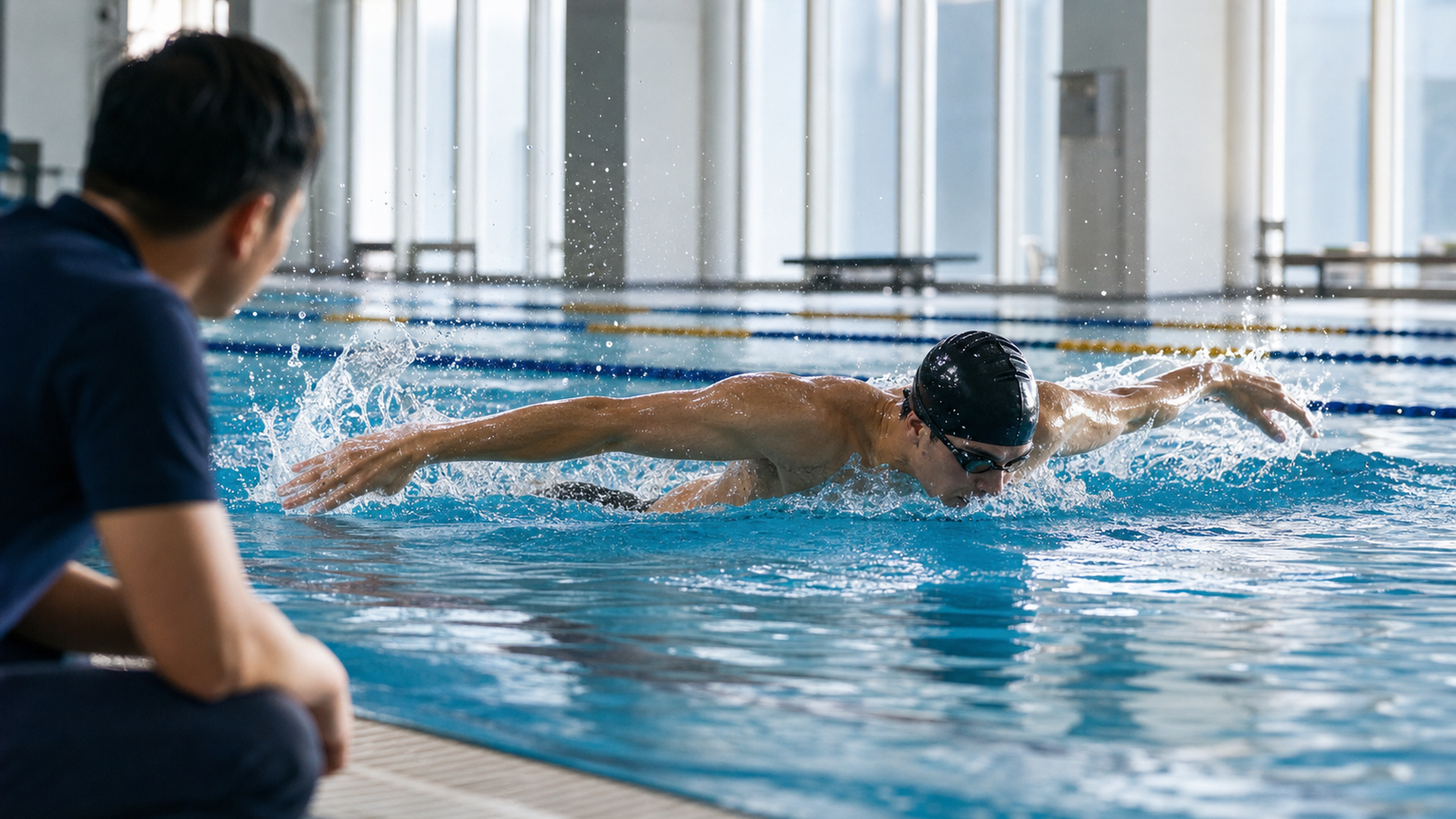
Butterfly: The Most Unforgiving Stroke for the Lower Back
The butterfly is beautiful, but it’s a nightmare for the lower back. Research indicates that 62% of competitive butterfly swimmers suffer from chronic lower back pain, a rate far higher than in other strokes. The core problem: the body is forced into extreme hyperextension, subjecting the lower back to repeated impact.
Spinal Mechanics of the Butterfly Wave Motion
During one full butterfly cycle, the lumbar spine angle changes by more than 40 degrees:
| Phase | Lumbar Spine State | Disc Pressure |
|---|---|---|
| Entry | Flexion 15° | Moderate |
| Catch | Neutral | Low |
| Pull | Hyperextension 5° | Moderate |
| Exit & Breathe | Hyperextension 25° | Extremely High |
At roughly 50-60 cycles per minute, that’s 50-60 extreme hyperextensions per minute. Over a 90-minute training session, the lower back endures 5,000 impacts.
Two Main Types of Injuries
1. Spondylolysis (Lumbar Pars Fracture)
- Most common at the L5 pars interarticularis
- Most frequently seen in athletes aged 14-18
- Repetitive hyperextension causes a stress fracture
- Symptoms: Unilateral lower back pain, worsened by hyperextension
2. Disc Herniation
- Most common at L4-L5 and L5-S1
- The disc is compressed and bulges posteriorly
- Symptoms: Lower back pain + radiating pain or numbness into the buttocks or legs
Lower Back Risk in Freestyle, Backstroke, and Breaststroke
Although butterfly is the most severe, other strokes also carry risk:
| Stroke | Risk | Mechanism |
|---|---|---|
| Freestyle | Moderate | Insufficient body rotation during breathing, compensated by lumbar twisting |
| Backstroke | Low | Lumbar hyperextension when the hips drop |
| Breaststroke | Moderate | Lumbar hyperextension during the breathing phase |
| Butterfly | High | Continuous wave motion throughout |
Self-Assessment
Single-Leg Standing Hyperextension Test:
- Stand on one leg and lift the other leg
- Bend the upper body backward
- Unilateral lower back pain is a positive result, suggesting a pars issue
Toe Touch Test:
- Sit with knees extended
- Slowly bend forward to touch the toes
- Radiating pain or numbness down the leg indicates nerve root compression
Prevention Core: Strengthening the Deep Core Muscles
1. Dead Bug
- Lie on your back with hips and knees flexed at 90 degrees
- Simultaneously extend the opposite arm and leg just above the floor
- Keep the lower back pressed to the floor throughout
- 10 reps × 3 sets
2. Bird Dog
- Start on all fours
- Simultaneously extend the opposite arm and leg
- Hold for 5 seconds
- 10 reps × 3 sets
3. Plank Variations
- Standard plank for 30-60 seconds
- Side plank for 30-60 seconds per side
- Plank with leg lift, 10 reps
- 3 sets total
4. Glute Bridge
- Lie on your back with knees bent
- Lift the pelvis and hold for 5 seconds
- 15 reps × 3 sets
- Strengthens the gluteus maximus to share the load on the lower back
5. Hip Flexor Stretch
- Lunge position with the back knee on the ground
- Push the pelvis forward to feel a stretch in the front
- 30 seconds × 3 times per side
- Tight hip flexors pull the pelvis into an anterior tilt, increasing lower back stress
Technique Corrections
Reducing Hyperextension During Butterfly Breathing
- Don’t lift the chin: Look forward, not upward
- Keep the head as low as possible: Only the mouth needs to clear the water; no need to lift the head
- Quick head return: The shorter the breathing time, the better
- Use a 2-stroke, 1-breath pattern: Reduces breathing frequency
Freestyle Breathing Without Twisting the Lower Back
- Drive with body rotation: Use body roll to initiate the breath, not just turning the head
- Sufficient rotation angle: At least 30 degrees
- Stable lower body: Avoid erratic kicking
Training Volume Management
- Do not exceed 800m of butterfly per day
- Butterfly should not exceed 20% of total swimming volume
- Do not do consecutive high-intensity butterfly sessions for more than 2 days
- Young athletes should not swim more than 1500m of butterfly per week
Acute Phase Management
If lower back pain occurs, immediately:
- Stop swimming for 7-14 days
- Ice for the first 48 hours of the acute phase: 15 minutes every 2 hours
- Switch to heat: After 48 hours, apply heat to promote circulation
- Avoid prolonged sitting: Get up and move every 30 minutes
- Seek medical evaluation: Especially if radiating pain or numbness extends into the leg, imaging is required
Red Flag Warnings
Seek immediate medical attention if you experience:
- Numbness or weakness in both legs
- Loss of bowel or bladder control (cauda equina syndrome)
- Pain severe enough to prevent standing
- No improvement after 4 weeks
Return-to-Water Phase
| Week | Content |
|---|---|
| Weeks 1-2 | No swimming + core training |
| Weeks 3-4 | Backstroke 1000m (lowest back strain) |
| Weeks 5-6 | Low-intensity freestyle + backstroke |
| Weeks 7-8 | Add breaststroke |
| Week 9 onwards | Gradually reintroduce butterfly, starting with 100m |
Butterfly swimmers often continue to have lower back issues after retirement; prevention is better than cure.
Related Reading
- Protecting the Lower Back in Breaststroke and Butterfly: How to Perform Wave-Style Strokes Without Injuring Your Back
- Lumbar Spine Stress in Swimming: Lower Back Protection Strategies for Butterfly and Backstroke
- Swimming and Lumbar Spine Health: A Complete Analysis of Butterfly Back Pain Causes and Core Strengthening Solutions
- Excessive Lumbar Curvature in Butterfly: Corrective Movements for Insufficient Hip Drive