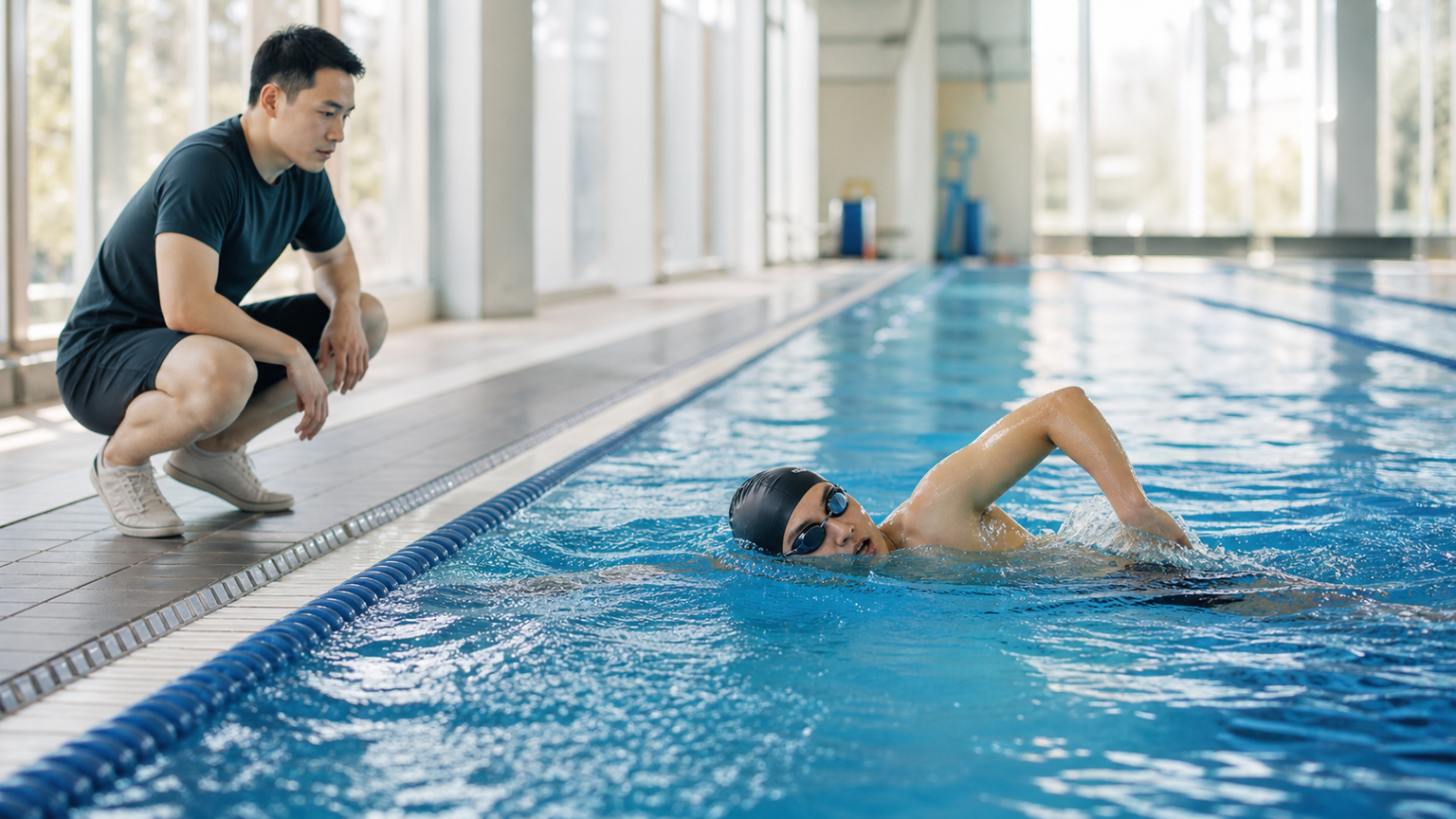
Why Swimming Causes Neck Stiffness
Swimming may seem like a full-body exercise, but if your breathing technique is incorrect, your neck becomes the sacrificial victim of overuse. Three common causes:
- Unilateral breathing: Breathing to the right or left only causes muscle asymmetry
- Looking forward when lifting the head: Lifting the head instead of rotating it during freestyle breathing
- Butterfly and breaststroke breathing: Excessive neck extension when lifting the head
Statistics show that 45% of recreational swimmers experience varying degrees of neck discomfort, while elite athletes have a lower rate (due to proper technique).
Analysis of Neck Muscle Imbalance
Long-term unilateral breathing (using the right side as an example):
| Muscle | Right Side | Left Side |
|---|---|---|
| Sternocleidomastoid | Strengthened and lengthened | Shortened and tight |
| Scalene | Overused | Relatively weakened |
| Upper trapezius | Tight | Tight |
| Levator scapulae | Tight | Relatively relaxed |
Symptoms of imbalance:
- Head habitually tilts to one side
- Asymmetrical range of motion when turning the head left and right (a difference exceeding 10 degrees is abnormal)
- Tightness at the base of the skull
- Stiff neck after sleeping
Self-Assessment
Head Rotation Range Test
- Stand with chest lifted
- Slowly turn your head to the left as far as possible, note the position
- Slowly turn your head to the right as far as possible, compare the range
- A difference exceeding 10 degrees indicates clear asymmetry
Lateral Flexion Range Test
- Stand and bring your ear toward your shoulder
- Compare both sides
- A difference exceeding 5 degrees indicates asymmetry
The Correct Mechanism of Freestyle Breathing
Incorrect movement vs. correct movement:
| Item | Incorrect | Correct |
|---|---|---|
| Movement | Lift head | Rotate head |
| Driving part | Neck | Body rotation |
| Gaze | Forward | To the side |
| One ear | Out of the water | Stays in the water |
| Mouth position | Above the water surface | Near the water surface |
Key principle: Keep the neck in a straight line with the spine, relying only on 60 degrees of body rotation to bring the mouth above the water.
The Necessity of Bilateral Breathing
Breathing every 3 strokes (one breath per 3 arm strokes) automatically achieves bilateral breathing and is the golden rule for preventing neck imbalance.
Beginners typically breathe every 2 strokes on one side; switching to breathing every 3 strokes requires adaptation. Recommendations:
- Use 3-stroke breathing during warm-up
- Use 3-stroke breathing during low-intensity main sets
- For high intensity, you may switch to 2-stroke breathing but alternate sides each set
- On race day, follow personal preference
5 Neck Rehabilitation Exercises
1. Neck Mobility (2 times daily)
In order:
- Nod 10 times
- Tilt head back 10 times
- Turn left 10 times
- Turn right 10 times
- Lateral flexion left 10 times
- Lateral flexion right 10 times
Perform each movement slowly; do not circle the head (this can compress the vertebral artery).
2. Isometric Contractions
- Place both hands overlapping on your forehead, push your head forward against your hands’ resistance, 10 seconds × 5 reps
- Place both hands on the back of your head, push your head backward against your hands’ resistance, 10 seconds × 5 reps
- Place one hand on your temple, push your head sideways against your hand’s resistance, 10 seconds × 5 reps per side
3. Chin Tuck
- Imagine pulling your chin inward to create a double chin
- Hold for 5 seconds
- 15 reps × 3 sets
- Improves forward head posture
4. Upper Trapezius Stretch
- Hold the chair with your right hand to stabilize your shoulder
- Reach your left hand over your head and gently pull your head to the left
- Hold for 30 seconds
- 3 times per side
5. Levator Scapulae Stretch
- Hold the chair with your right hand to stabilize
- Turn your head 45 degrees toward the lower left
- Gently press the top of your head with your left hand
- Hold for 30 seconds
- 3 times per side
Pre-Swim Neck Warm-Up
5-minute on-land neck warm-up:
- Neck mobility (as above)
- Shoulder circles: 10 forward, 10 backward
- Thoracic spine rotation: seated, hands behind head, rotate left and right 10 times
- Simulated body rotation: hands crossed on chest, perform side-lying rotation movement 10 times
Monitoring During Training
Check between each set:
- Any tightness in the back of the neck
- Any pain in the neck after breathing
- Whether breathing comfort is consistent on both sides
When tightness occurs:
- Do 30 seconds of neck stretching at the poolside
- Reduce intensity for that set
- Switch to backstroke or kickboard work
When to Seek Medical Attention
Professional evaluation is needed in the following situations:
- Neck pain radiating into the arm
- Numbness in the fingers
- Dizziness or visual disturbances (possible vertebral artery issues)
- No improvement after 2 weeks
- Morning stiffness lasting more than 30 minutes
The Impact of Sleep Posture
Swimmers’ neck stiffness is often related to sleep posture:
- Recommended: Sleeping on your back + a medium-height pillow
- Avoid: Sleeping on your stomach (the neck is twisted to one side all night)
- Side sleeping: Pillow height should fill the distance from shoulder to ear
Proper breathing technique + bilateral practice + daily neck care are what allow swimmers to break free from chronic neck stiffness.
Related Reading
- Over-Lifting the Head to Breathe in Swimming: Relaxation Exercises for Neck Stiffness
- Neck Pain in Swimming: Injuries and Corrections from Improper Breathing Posture
- Breathing Side Selection and Cervical Spine Protection: The Health Logic of Bilateral Breathing
- Cervical Spine Issues and Swimming Breathing: Does Your Breathing Posture Harm Your Cervical Spine?
一日北高/長距離團騎 常見問題補充篇 / 組團或跟團的眉角 / 壯車友容易被瘦車友慢性拉爆 / 原來屁股痛可能是這個原因...? / 風場配速法 / 公路車 / CT Yeh
2 年前
CT暗黑廚房) 車友必備 宇宙無敵鮮蚵湯 幫助訓練恢復 天然食補 好市多 超肥鮮蚵 破PR
7 年前
[教學] Premiere 影片 手震 修正 教學 防抖 單眼 影像 GoPro 穩定 Video Stabilization
8 年前
CT 喇低賽) 武嶺牽車 才是王道 西進牽車四小時內秘訣 攝手位置 如何判斷 防抽筋小秘訣
7 年前
一日北高常見問題大集合 | 攻略 | 路線 | 訓練 | 補給 | 自行車 單車 | 一日雙城 | 雙塔 | TWB北高360 | 屁股痛
6 年前
詳測) 小米 電動打氣筒 公路車胎要充多久? 值得買嗎? 米家充氣寶 小心燙手!
7 年前
戰略) Zwift Race 如何咬在第一集團 如何評估自己要開多少推力 (請開1.5倍速看)
7 年前
Garmin Edge 1040 重大韌體更新!! / 1050功能全下放!? / 坡度反應變快了嗎?/ 快速對比實測 / 公路車 / CT Yeh
1 年前