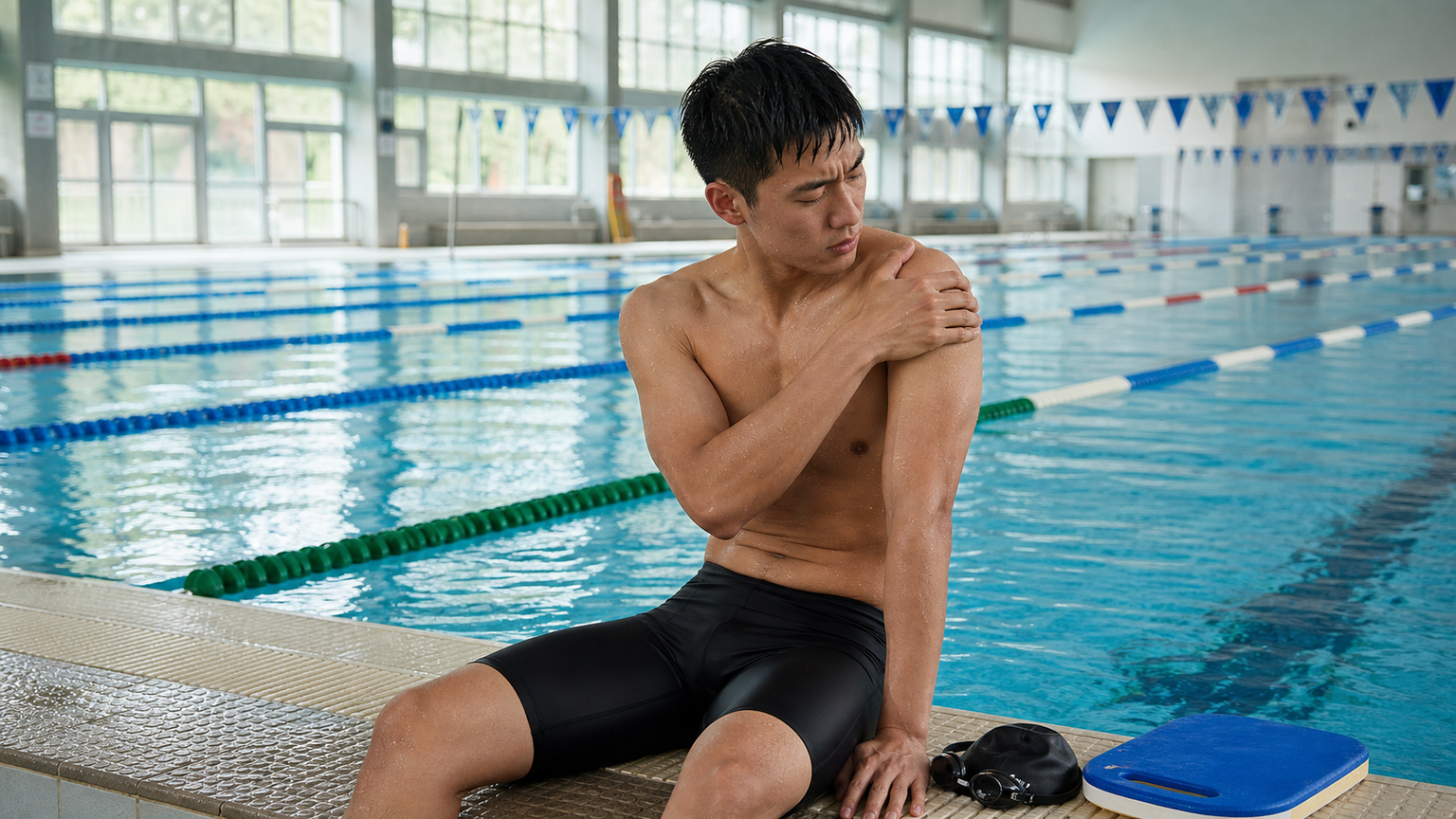
Training Volume Is the Biggest Risk Factor for Injury
Sports injury research consistently points out: Improper training volume management is the root cause of 60-80% of sports injuries. As a high-repetition sport, swimming carries an even greater risk.
Key metric: Acute:Chronic Workload Ratio (ACWR)
- ACWR 1.0-1.3: Safe zone
- ACWR 1.3-1.5: Caution zone
- ACWR > 1.5: High-risk zone
This means: this week’s training volume should not exceed 1.3 times the 4-week rolling average.
Why “Sudden Increases” Are the Most Dangerous
Muscles, tendons, and bones adapt at different rates:
| Tissue | Adaptation Time |
|---|---|
| Cardiorespiratory system | 2-4 weeks |
| Muscle strength | 4-6 weeks |
| Tendons | 6-12 weeks |
| Ligaments | 12-26 weeks |
| Bones | 26-52 weeks |
When your cardiorespiratory system feels like “you can swim more,” your tendons may not be ready yet. Tendons and ligaments are the most injury-prone, which is why progressive overload is the golden rule.
Calculating Swimming Training Volume
Basic metrics:
- Weekly swim volume (meters)
- Per-session volume
- High-intensity percentage
- Specific stroke volume
Example:
Swimmer A’s average weekly volume over the past 4 weeks = 12,000m
This week’s recommended ceiling = 12,000 × 1.3 = 15,600m
Exceeding this value significantly raises the risk.
5 Common “Dangerous Increase” Patterns
1. Summer Break Volume Spike
Most common among student swimmers:
- 6,000m per week during the school term
- Suddenly 18,000m per week during summer break
- 3x increase → ACWR = 3.0
- Result: rotator cuff, knee, and plantar issues strike in succession
Recommendation: Increase by no more than 10-15% per week; it takes 4-6 weeks to reasonably ramp up to 12,000-15,000m during summer break.
2. Pre-Competition Volume Push
- 10,000m per week during regular training
- Switches to 16,000m per week 4 weeks before competition
- Injury only becomes apparent 2 weeks before race day
Recommendation: Pre-competition volume should be built up gradually 8-10 weeks before the event, with a taper in the final 2 weeks.
3. Returning to Training
- After a 3-month layoff
- Returns to the original 12,000m in the first week
- Severe shoulder pain the next day
Recommendation: After more than 4 weeks off, restart at 50% of the original training volume, increasing by 10% each week.
4. Adding Paddles (Sudden Increase in Resistance)
Paddles increase water resistance by 30-50%, effectively raising swim volume even if distance stays the same.
Recommendation: Use paddles only once in the first week, for 500m; increase by 500m per week up to a 2,000m cap.
5. Adding a New Stroke to Training
- Swims only freestyle, then suddenly does a lot of butterfly
- Butterfly places far greater strain on the shoulders and lower back than freestyle
- Even if total distance doesn’t increase, injury risk rises
Recommendation: Start the new stroke at 200m per session, increasing by 100m each week.
The Progressive Principle: The 10% Rule
The widely adopted sports medicine principle of increasing by no more than 10% per week:
| Week | Target Swim Volume |
|---|---|
| Week 1 | 8,000m |
| Week 2 | 8,800m (+10%) |
| Week 3 | 9,680m (+10%) |
| Week 4 | 7,500m (recovery week, -22%) |
| Week 5 | 10,650m (+10% from Week 3) |
| Week 6 | 11,715m (+10%) |
| Week 7 | 12,887m (+10%) |
| Week 8 | 10,000m (recovery week) |
Key point: Schedule a reduced-volume week every 3-4 weeks to allow tissues to adapt and repair.
Special Considerations for High-Intensity Training
High-intensity training should not exceed 20% of total swim volume:
| Training Type | Pace | Heart Rate | Percentage |
|---|---|---|---|
| Low-intensity aerobic | T-pace +20-30s | 60-70% | 60-70% |
| Threshold training | T-pace ±5s | 80-85% | 15-20% |
| High-intensity intervals | T-pace -10s | 85-95% | 5-10% |
| Sprints | All-out | 90-100% | <5% |
The 80/20 Principle: 80% of training at low intensity, 20% at high intensity.
Training Load Monitoring Metrics
1. Rating of Perceived Exertion (RPE)
Record a score of 1-10 after each session:
- 1-3: Very easy
- 4-6: Moderate
- 7-9: Hard
- 10: Maximal effort
Cumulative fatigue = Training volume × RPE
2. Morning Heart Rate
Measure heart rate immediately upon waking:
- More than 10 bpm above normal
- Elevated for 3 consecutive days
- Indicates overtraining; reduce volume
3. Sleep Quality
Sleep duration, ease of falling asleep, and nighttime awakenings:
- Poor sleep after training → training volume too high
- Poor sleep quality for 1 consecutive week → mandatory volume reduction
4. Appetite and Mood
- Decreased appetite
- Irritability, low mood
- Loss of enthusiasm for training
All are warning signs of overtraining.
Training Log Recommendations
Record after each session:
Date: 2026/05/27
Total swim volume: 4,500m
Main sets: Freestyle 3000m + Backstroke 1000m + Breaststroke 500m
Intensity: Moderate (RPE 6)
Physical feeling: Slight shoulder soreness
Sleep: 7 hours
Morning heart rate: 58 bpm (normal)
Notes: Occasional pain in left shoulder during catch phase
Accumulating 1-2 months of data reveals trends and helps identify problems early.
Training Volume Recommendations by Age
| Age Group | Recommended Weekly Volume | Notes |
|---|---|---|
| Children (8-12) | 4,000-8,000m | Prioritize technique over volume |
| Adolescents (13-18) | 15,000-30,000m | Can be higher during competition season |
| Adult recreational | 8,000-15,000m | Depends on personal schedule |
| Adult competitive | 20,000-50,000m | Coach supervision required |
| Masters (50+) | 6,000-12,000m | Watch joint health |
Rebuilding After Injury
Phases for resuming training after injury:
| Week | Training Volume Percentage | Intensity |
|---|---|---|
| Week 1 | 30% | Low |
| Week 2 | 50% | Low |
| Week 3 | 65% | Low-moderate |
| Week 4 | 75% | Moderate |
| Week 5 | 85% | Moderate |
| Week 6 | 95% | Moderate-high |
| Week 7 | 100% | Normal |
Differences Between Coached and Self-Trained Swimmers
Under professional coach supervision:
- Objective monitoring of training volume
- Timely adjustments
- Avoids subjective bias
Most common problems among self-trained swimmers:
- Over-optimism
- Ignoring warning signs
- Comparing with others
- Consecutive high-intensity days
Recommendation: Review your training plan with a professional coach every 4 weeks.
Conclusion
The pain of a week of injury far outweighs the discomfort of a 10% reduction in training volume. The key to long-term performance is not “how much you train,” but “how long you can keep training consistently.” Progression, monitoring, rest, and listening to your body are the lifelong lessons for every swimmer.
Related Reading
- The Principle of Progressive Overload in Swim Training: The Safe Limit for Weekly Increases
- Swim Training Volume Management: The Principle of Progressive Weekly Kilometers and Fatigue Monitoring
- The Principle of Progressive Overload in Long-Distance Swim Training: Applying a 10% Weekly Increase to Swimming
- The Overload Principle in Swim Training: How to Safely Increase Training Volume
西進武嶺 免費訓練分析服務 Intervals | 練不夠還是練過頭?你哪一種類型選手?AI模型告訴你! | 備戰神器 | 公路車 訓練 | CT Yeh
4 年前
一日北高/長距離團騎 常見問題補充篇 / 組團或跟團的眉角 / 壯車友容易被瘦車友慢性拉爆 / 原來屁股痛可能是這個原因...? / 風場配速法 / 公路車 / CT Yeh
2 年前
一日北高常見問題大集合 | 攻略 | 路線 | 訓練 | 補給 | 自行車 單車 | 一日雙城 | 雙塔 | TWB北高360 | 屁股痛
6 年前
戰略) Zwift Race 如何咬在第一集團 如何評估自己要開多少推力 (請開1.5倍速看)
7 年前
2026 輪霸西濱200K 挑戰VLOG / 第一集團 / 首次參加..經驗不足、膀胱不足 /死守6H內 / AI戰鬥力顯示系統 / 公路車 / CT Yeh
4 個月前
滑雪新手們慘摔學習全紀錄(請開字幕),滑雪好好玩 | Snowboard + Ski | 岩原 スキー場 | 滑雪APP使用 | GoPro Max
6 年前
CT暗黑廚房) 車友必備 宇宙無敵鮮蚵湯 幫助訓練恢復 天然食補 好市多 超肥鮮蚵 破PR
7 年前
FTL 與 SYB 車隊專訪 西進武嶺 實用攻略分享! 2小時 如何練?!你不知道的眉角!新手準備武嶺必看 EP1 | 實力派女車友 | 精華版 | 公路車 | CTYeh
4 年前