Early Recognition of Heatstroke During Summer Training: 3 Stages of Warning Signs and Emergency Response
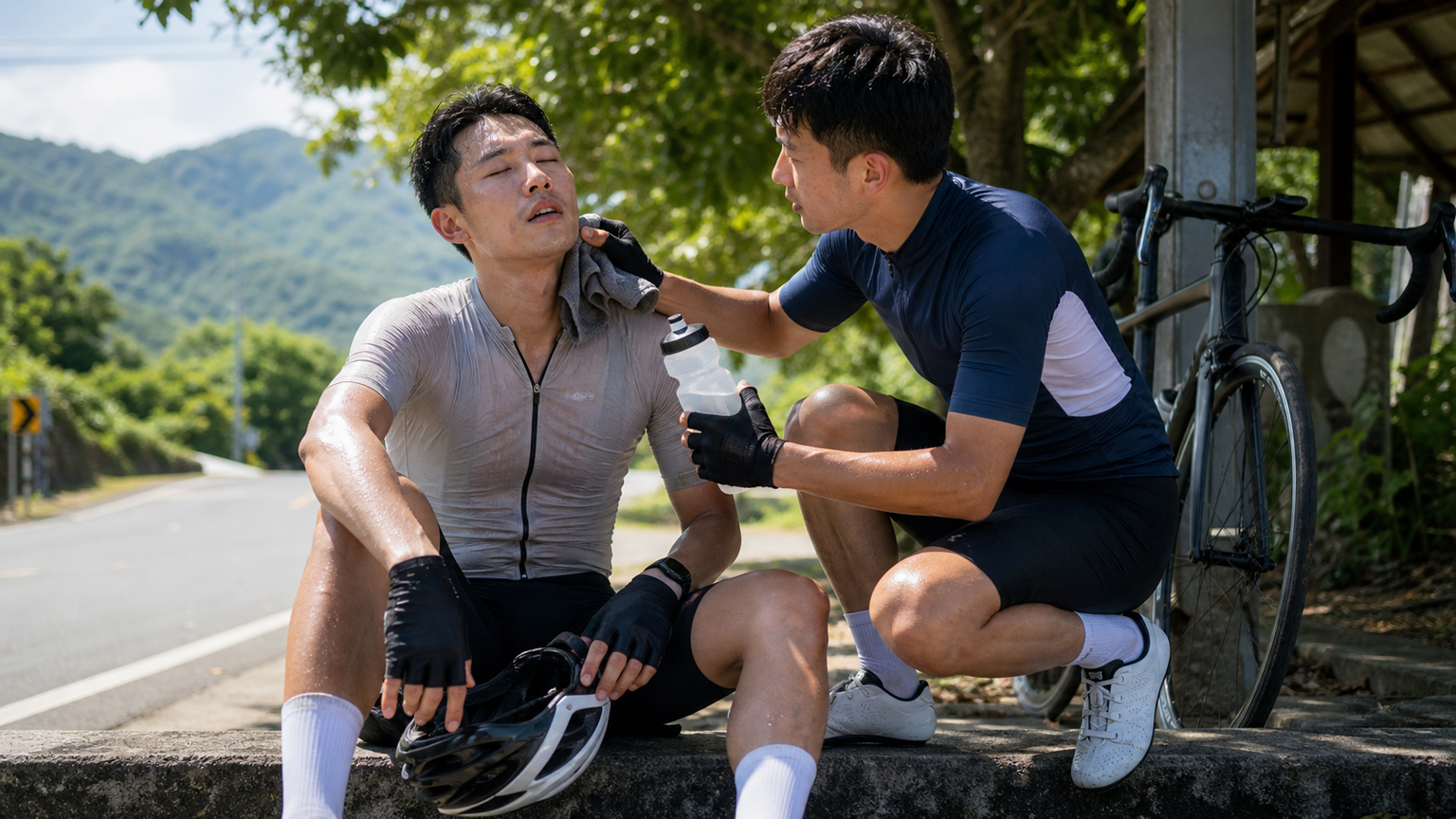
Medical Classification of Heat Illness
Exertional hyperthermia is divided into three stages, with core temperature as the gold standard:
| Stage | Medical Term | Core Temperature | Mortality Rate |
|---|---|---|---|
| Stage 1 | Heat Cramps | 38-39°C | <0.1% |
| Stage 2 | Heat Exhaustion | 39-40°C | 1-5% |
| Stage 3 | Heat Stroke | >40°C | 30-80% |
Stage 1: Heat Cramps
Early Warning Signs
- Cramping in the calves, thighs, or abdomen (most common sites)
- Heavy sweating with noticeably salty sweat
- Increased thirst
- Heart rate 10-15 bpm higher than usual
- Unable to maintain pace, but fully conscious
Treatment Protocol
- Stop training immediately and move to a shaded area
- Passively stretch the cramped muscle (for calves, pull toes upward)
- Consume 500ml of electrolyte drink containing sodium (do not drink plain water only)
- Rest for 15-20 minutes; only consider resuming if symptoms subside
- Reduce intensity or mileage by 50% for the remainder of the day’s training
Stage 2: Heat Exhaustion
Warning Signs (much more severe than heat cramps)
- Dizziness, headache, blurred vision or seeing flashes
- Nausea, feeling of vomiting
- Cool, clammy skin (not hot, not dry)
- Heart rate exceeding 90% of max HR, pace collapses
- Brief confusion but still able to converse
- General weakness, unable to run in a straight line
Emergency Treatment Protocol
- Stop training immediately, lie flat, and elevate legs 30 cm
- Move to a shaded area or air-conditioned room
- Remove excess clothing and wipe the forehead, neck, armpits, and groin with cool water
- Sip sports drinks slowly (avoid gulping large amounts of water at once)
- If symptoms do not improve within 30 minutes → seek medical attention immediately
- Complete rest from training that day; reassess after 48 hours
Stage 3: Heat Stroke (Life-Threatening)
Life-Threatening Warning Signs
- Loss of consciousness or incoherent speech
- Skin becomes dry and sweating stops (central thermoregulation fails)
- Rapid breathing, irregular heart rate
- Seizures, coma
- Skin feels like “red-hot iron” to the touch
First Aid Principle: “Cooling First”
- Call 119 immediately (every minute of delay reduces survival rate by 5%)
- Immerse in cold water or pour copious cold water over the entire body (most effective cooling method)
- If no cold water bath is available: wrap the body in wet towels + use a fan at full blast
- Cooling takes priority over transport to hospital; the goal is to lower core temperature below 38.5°C within 30 minutes
- Continue cooling while waiting for the ambulance
Fatal Myth: “Don’t cool too fast” is wrong. Research shows that the faster the cooling, the higher the survival rate; cold water immersion is the gold standard.
High-Risk Groups
The following runners have a 3-5 times higher risk of developing heat illness:
- BMI > 27
- Alcohol consumption within 24 hours before training
- Less than 6 hours of sleep within 24 hours before training
- Taking diuretics, antihistamines, or antidepressants
- Recovering from a cold (even a mild one)
- First-time exposure to that intensity of heat environment
Prevention Principles: 5 Must-Dos
-
Check WBGT (Wet Bulb Globe Temperature) on a weather app
- <28°C: normal training allowed
- 28-30°C: reduce volume by 25%
- 30-32°C: reduce volume by 50%
- >32°C: suspend outdoor training
-
Buddy system: never run long distances alone above 30°C
-
Phone as a lifeline: enable location sharing and inform family of your route
-
Identify shaded points on the route: rest stops with shelter and water access every 3-5 km
-
Pre-training self-check: sleep, alcohol, cold symptoms, weight changes (a sudden 2kg drop may indicate dehydration)
Recovery After Heat Illness
Stage 1: return to normal training within 48 hours
Stage 2: 1 week of reduced training, full recovery in 2 weeks
Stage 3: at least 4 weeks off running + physician evaluation; liver, kidney, and heart muscle may be damaged
Emergency Kit
Recommended to carry during summer long runs:
- 5 salt candies
- 2 packets of electrolyte powder
- Cooling towel
- Phone (emergency contact + GPS)
- 100ml plain water (not sports drink; for pouring over the body to cool down)
Heat illness is not a matter of luck—it’s a matter of your ability to read your body’s signals. Memorize these 3 stages, and your summer training will have its first line of safety.
Related Reading
- Heat Stroke Warning Signs and Rescue: The Red Line Guide for Runners’ Summer Training
- Heat Exhaustion vs Heat Stroke: The Life-or-Death Distinction for Basketball Players’ Summer Training
- Complete Guide to Distinguishing Heat Exhaustion and Heat Stroke: Classification, On-Site Management, and Hospital Warning Signs You Must Not Delay
- Exertional Heat Exhaustion and Heat Stroke: Advanced Warning Signs from Core Temperature 38.5°C to 41°C
西進武嶺 免費訓練分析服務 Intervals | 練不夠還是練過頭?你哪一種類型選手?AI模型告訴你! | 備戰神器 | 公路車 訓練 | CT Yeh
4 年前
FTL 與 SYB 車隊專訪 西進武嶺 實用攻略分享! 2小時 如何練?!你不知道的眉角!新手準備武嶺必看 EP1 | 實力派女車友 | 精華版 | 公路車 | CTYeh
4 年前
CT 喇低賽) 武嶺牽車 才是王道 西進牽車四小時內秘訣 攝手位置 如何判斷 防抽筋小秘訣
7 年前
一日北高/長距離團騎 常見問題補充篇 / 組團或跟團的眉角 / 壯車友容易被瘦車友慢性拉爆 / 原來屁股痛可能是這個原因...? / 風場配速法 / 公路車 / CT Yeh
2 年前
西進武嶺 自製新版AI配速表產生器 x 賽前攻略 抱佛腳! 沒有功率計也可以產生配速表嗎?有什麼其他眉角賽前要注意的呢? | 西進武嶺 / 東進武嶺 KOM 攻略 | 公路車 | CT Yeh
4 年前
水金九不厭五分 10度寒流冷到不願停!feat. 卡卡 / 公路車 / CT Yeh
6 個月前
單車 一日北高 ( 雙城 ) 肥宅雙人瘋狂行 紀錄片 REACTO
10 年前
Never Stop 西進武嶺 前後雙機 完整全程錄影 訓練台 實境
8 年前