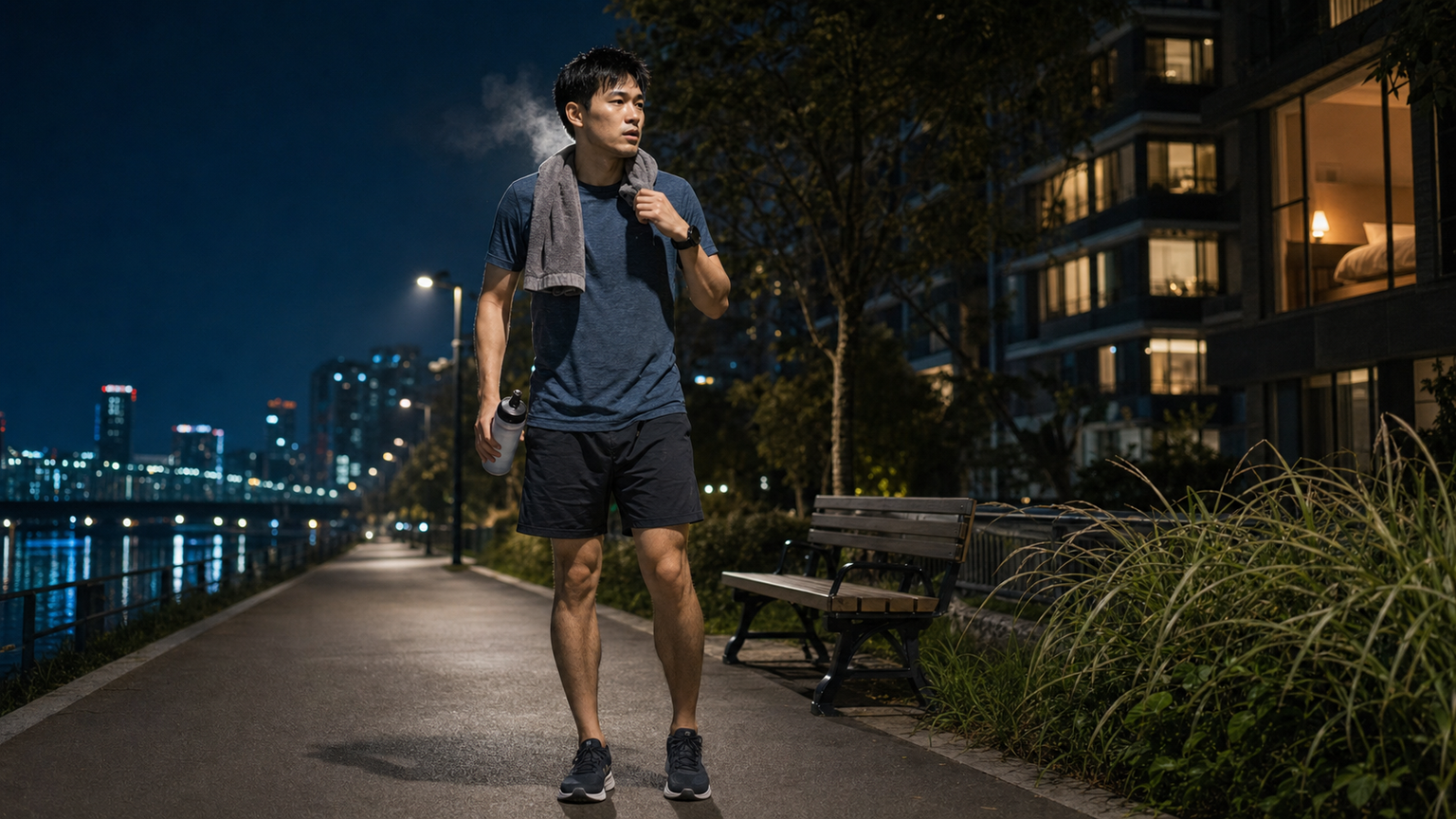
The Physiological Interaction Between Sleep and Exercise
Night running affects three systems related to sleep:
- Core body temperature: Rises 1-1.5°C after running, needs to cool down to fall asleep
- Cortisol: The stress hormone, rises after exercise and stays elevated for 90-180 minutes
- Adrenaline: Surges during high-intensity exercise, takes 1-2 hours to subside
- Adenosine: Fatigue substance accumulates, helps you fall asleep
- Growth hormone: Secreted after exercise, deepens deep sleep
Whether night running leads to good or poor sleep depends on which system dominates.
Intensity Determines the Direction of the Impact
Low Intensity (E pace, < 60 minutes)
- Core body temperature rise is limited
- Cortisol rise is small
- Adenosine accumulation is moderate
- Result: Improved sleep quality (deep sleep +10-15%)
Moderate Intensity (M pace, 60-90 minutes)
- Core body temperature rises significantly
- Cortisol rises noticeably
- Moderate adrenaline release
- Result: Impact depends on the finish time
High Intensity (T/I/R pace, intervals)
- Core body temperature rises substantially
- Cortisol surges
- Adrenaline spikes
- Result: Sleep onset delayed 30-90 minutes, deep sleep reduced
The Golden Rule for Finish Times
Using a 11:00 PM bedtime as an example:
| Training Intensity | Recommended Finish Time | Time Before Bed |
|---|---|---|
| Walking, easy stroll | Before 10:30 PM | 30 minutes |
| E pace recovery run | Before 9:30 PM | 90 minutes |
| M pace long run | Before 8:30 PM | 150 minutes |
| T pace, intervals | Before 7:30 PM | 210 minutes |
| Race intensity | Before 6:30 PM | 270 minutes |
Key point: After high-intensity exercise, it takes 2-3 hours for core body temperature to return to the level needed for sleep (0.5°C below your normal baseline).
Measured Data: Impact of Finishing at 11:00 PM
Monitoring from an exercise laboratory (n=42 runners):
| Finish Time | Sleep Onset Delay | Deep Sleep Ratio | REM Sleep | Overall Quality |
|---|---|---|---|---|
| 7:00 PM | +5 minutes | 23% | 22% | 8.5/10 |
| 8:00 PM | +10 minutes | 21% | 21% | 8.0/10 |
| 9:00 PM | +20 minutes | 18% | 19% | 7.0/10 |
| 10:00 PM | +35 minutes | 15% | 17% | 5.5/10 |
| 11:00 PM | +55 minutes | 12% | 14% | 4.0/10 |
Body Temperature Management: Cooling Down to Fall Asleep Faster
In the 90 minutes between finishing your night run and going to bed, deliberately cooling down can improve sleep:
Effective Methods
- 40°C warm shower for 10 minutes: Warms you up first, then blood vessels dilate afterward, accelerating heat loss (most effective)
- Cold water on feet for 5 minutes: Stimulates the parasympathetic nervous system
- Keep the room at 18-21°C: Ideal sleeping temperature
- Breathable cotton bedding: Avoid overheating
Counterproductive
- Cold bath: Suppresses heat loss, actually makes falling asleep slower
- Tight clothing: Hinders heat dissipation from the skin
- Heavy duvet: Core temperature cannot drop
- Air conditioning at 16°C: Too cold, constricts blood vessels instead
Meal Timing
What you eat after a night run, and when, directly affects your sleep:
Within 30 minutes after the run
- Protein 20-30g + carbs 30-50g
- Example: High-protein yogurt + banana + honey
- Avoid: High-sugar drinks, caffeine
1 hour before bed
- Sleep-promoting foods: Warm milk (tryptophan), kiwi, cherries
- Avoid: Fried foods, spicy food, red meat
3 hours before bed
- Avoid caffeine, alcohol, nicotine
- Drinking coffee after a run delays sleep onset by 90+ minutes
Best Arrangements for Different Chronotypes
Depending on your chronotype, some people are naturally suited for night running, others are not:
Morning Type (Lark)
- Wake up: 5:00-6:00 AM
- Peak performance window: 8:00 AM-12:00 PM
- Night running not recommended: Running after 9:00 PM severely affects sleep
- Recommendation: Morning run at 6:00 AM
Intermediate Type
- Wake up: 7:00-8:00 AM
- Peak performance window: 10:00 AM-4:00 PM
- Night running is possible but needs control: Finish before 9:30 PM
- Recommendation: Dusk run at 6:00-7:00 PM
Evening Type (Owl)
- Wake up: 9:00-10:00 AM
- Peak performance window: 2:00-10:00 PM
- Best suited for night running: Finishing at 10:00 PM does not affect sleep
- Recommendation: Night run at 8:00-9:30 PM
To determine your type: use the MEQ-SA (Morningness-Eveningness Questionnaire), free versions are available online.
Cumulative Effects of Consecutive Night Runs
A single night run has limited impact, but high-intensity running after 9:00 PM for 5 or more consecutive days will:
- Raise baseline cortisol levels by 15-20%
- Decrease heart rate variability (HRV) by 10%
- Accumulate subjective fatigue
- Lower immunity, increasing the risk of catching a cold
Recommendation: Do not run at night more than 3 times per week, and keep most sessions at E pace.
Sample Weekly Night Running Schedule
Suitable for office workers and evening-type runners:
- Monday: Rest or yoga
- Tuesday: 8:00 PM E pace 45 minutes
- Wednesday: Rest
- Thursday: 7:30 PM T pace 30 minutes (finish early)
- Friday: Rest
- Saturday: Morning long run 90 minutes
- Sunday: Morning easy run 60 minutes
Conclusion: Night Running Is Not Taboo, It’s a Skill
Does night running affect sleep?
- Low intensity, early finish → Improves sleep
- High intensity, late finish → Disrupts sleep
The biggest enemy for office workers is not night running itself, but the mental tug-of-war of “wanting to run after work, yet fearing it will affect sleep.” With a well-designed schedule, night running can be a win-win for both exercise and rest.
Related Reading
- Sleep and Road Running Recovery: The Scientific Impact of Sleep Quality on Repair
- The Science of Sleep in Road Running: How Deep Sleep Accelerates Muscle Synthesis and Motor Memory Consolidation
- The Impact of Sleep on Road Running Performance: The Specific Athletic Consequences of Sleep Deprivation
- The Night Running Pace Illusion: Why It Feels Faster but Is Actually Slower
2016/4/20 - 中社路 夜騎 半年甩肉14KG 後測
10 年前
一日北高 11小時 賽後心得分享篇 | TWB北高360 | 一日雙城 | 單車 | 公路車
6 年前
iPhone 12 Pro 夜間騎車動態錄影 效果屌打 GoPro Hero 9 | 公路車 團練
5 年前
大家都在開箱的...單車用藍芽對講耳機真的有幫助嗎? SENA BiKom 20 長距離旅遊 & 海鷗繞圈賽 實際體驗心得 / 公路車 / CT Yeh
9 個月前
iPhone 13 Pro 電影級 VLOG 實拍測試!優缺點 原理分析! 夜間效果對決 GoPro10!蘋果沒有說的超強錄影體驗!? | CT Yeh
4 年前
#公路車 #Fitting 靠人工智慧APP 幫你調整單車
6 年前
西進武嶺 免費訓練分析服務 Intervals | 練不夠還是練過頭?你哪一種類型選手?AI模型告訴你! | 備戰神器 | 公路車 訓練 | CT Yeh
4 年前
Live) 備戰2019彰化經典百K 賽前攻略 (已完賽請看新影片
7 年前