The Dividing Line Between Two Types of Long-Distance Cycling
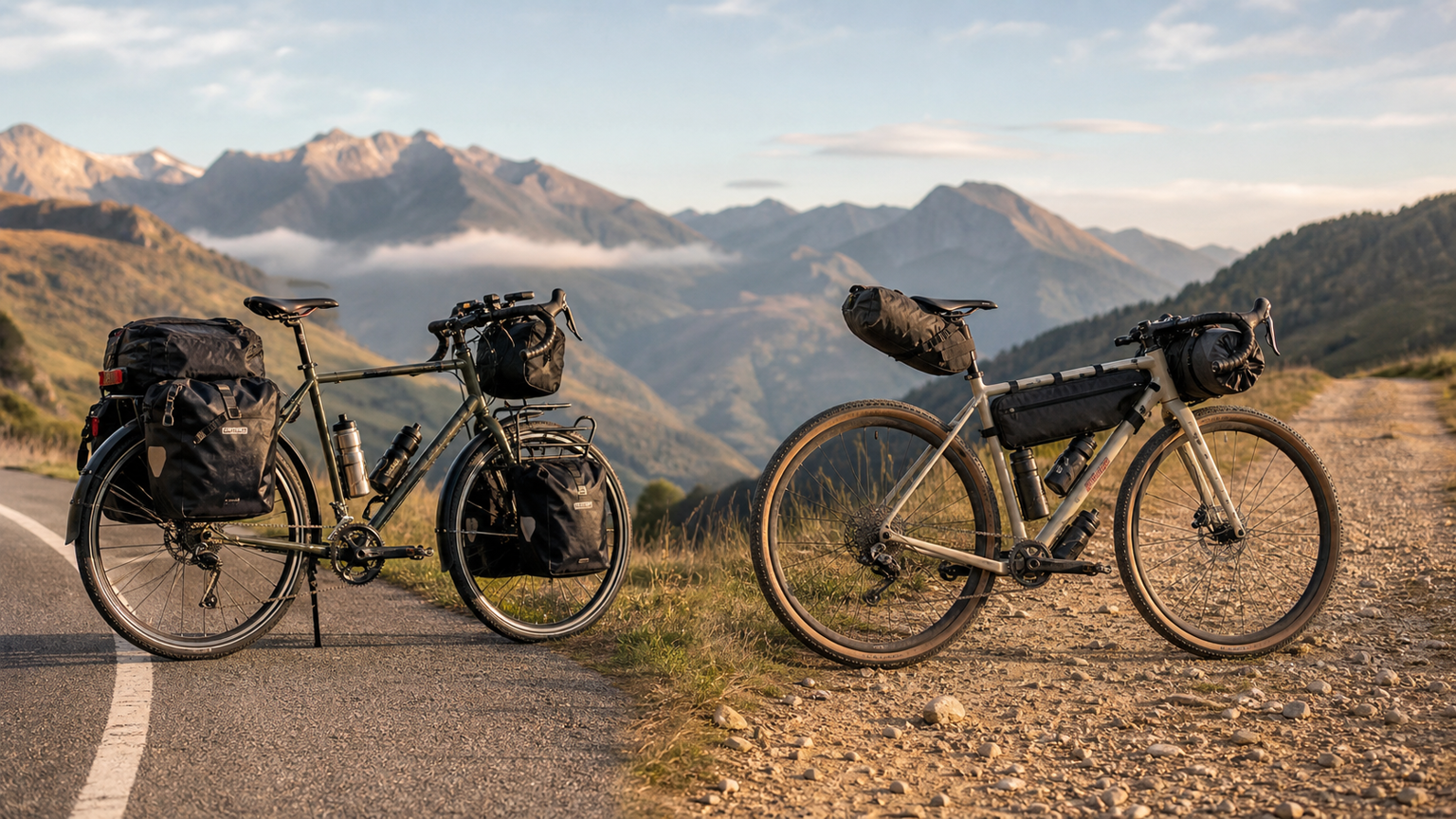
Many beginners confuse Bikepacking with Touring, but in reality these represent two completely different philosophies of long-distance cycling. Touring originated in the 1970s, using front and rear pannier racks paired with panniers, primarily on paved roads. Bikepacking rose to prominence after 2010, using rackless soft bag systems (Bikepacking Bags), primarily on gravel and off-road trails.
Gear System Comparison
| Item | Touring | Bikepacking |
|---|---|---|
| Capacity | 60-80 liters | 20-35 liters |
| Gear weight | 15-25 kg | 6-12 kg |
| Racks | Essential (front and rear) | Not used |
| Bag types | Panniers | Frame bag/Seat pack/Handlebar roll |
| Suitable terrain | Primarily paved | Gravel, Singletrack |
| Daily distance | 80-150 km | 60-120 km |
| Bike type | Touring Bike | Gravel / Hardtail MTB |
The Fundamental Difference in Weight Philosophy
The core of Touring is “comfort.” Riders bring folding chairs, stoves, coffee makers, and even guitars. A total weight of 25 kg is common, because you’re mainly on flat paved roads where weight has limited impact.
The core of Bikepacking is “minimalism,” with the goal of keeping total weight under 10 kg. This is because off-road terrain involves lots of climbing and technical sections, where every extra kilogram noticeably affects handling and energy expenditure.
Differences in Bag Setup
Touring panniers hang on both sides of the front and rear racks, one on each side—large capacity but high wind resistance and a low center of gravity. Bikepacking’s three-bag system is as follows:
- Frame Bag: 4-8 liters, for heavy items (tools, food)
- Seat Pack: 8-16 liters, for light but bulky items (sleeping bag, clothing)
- Handlebar Roll: 8-15 liters, for tent and sleeping pad
Total capacity is about 20-35 liters, with the center of gravity concentrated in the middle of the frame, meeting the handling needs of off-road riding.
Route Selection Comparison
Classic Touring routes include Europe’s EuroVelo and the US Pacific Coast Highway, mostly paved roads. Classic Bikepacking routes include the US Great Divide Mountain Bike Route (4400 km of gravel) and New Zealand’s Tour Aotearoa.
Taiwan’s Round-the-Island Route 1 (paved) suits Touring, while Central Mountain Range forest roads (such as Nenggao Cross-Ridge Trail and Batongguan) fall under the Bikepacking category.
How to Choose
If you enjoy staying in guesthouses every day, savoring local cuisine, and riding gentle paved roads, choose Touring. If you want to challenge remote forest roads, carry your own tent and camp in the wild, and pursue minimalism and a sense of adventure, choose Bikepacking.
Neither is superior; they are simply different travel philosophies. Many experienced riders own both setups and switch based on the route’s characteristics.
Related Reading
- Touring Bike vs Bikepacking: Choosing Between Two Long-Distance Riding Gear Philosophies
- Bicycle Camping for Beginners: Bikepacking Gear Checklist and Recommended Routes in Taiwan
- Bicycle Camping (Bikepacking) for Beginners: Lightweight Gear and Taiwan Route Recommendations
- Bicycle Travel Gear Checklist: The Packing Philosophy of a One-Week Bikepacking Load
單車 一日北高 ( 雙城 ) 肥宅雙人瘋狂行 紀錄片 REACTO
10 年前
多到選擇障礙... 換個單車把帶想一個小時 / BTP / 編織&軟木特有材質超吸睛! / 公路車 / CT Yeh
1 年前
靠單車減肥35公斤 心得分享與整理
7 年前
單車 梅山36灣 坡度介紹 路段介紹 空拍 (相關遊記影片,請參考說明或我的頻道喔,歡迎訂閱)
6 年前
大家都在開箱的...單車用藍芽對講耳機真的有幫助嗎? SENA BiKom 20 長距離旅遊 & 海鷗繞圈賽 實際體驗心得 / 公路車 / CT Yeh
9 個月前
2025 自行車錶排行榜 兩萬車友大數據 / Garmin Bryton 排名會大洗牌嗎? / 全新的碼表前身分析 /公路車 / CT Yeh
1 年前
風櫃嘴! 現實與虛擬騎乘 會有誤差嗎? 背著iPad邊騎一趟風櫃嘴實際測試一次 | 公路車 | CT Yeh
3 年前
#公路車 #Fitting 靠人工智慧APP 幫你調整單車
6 年前