Bikepacking Weight Distribution: The Scientific Principles of Where to Put Heavy and Light Items
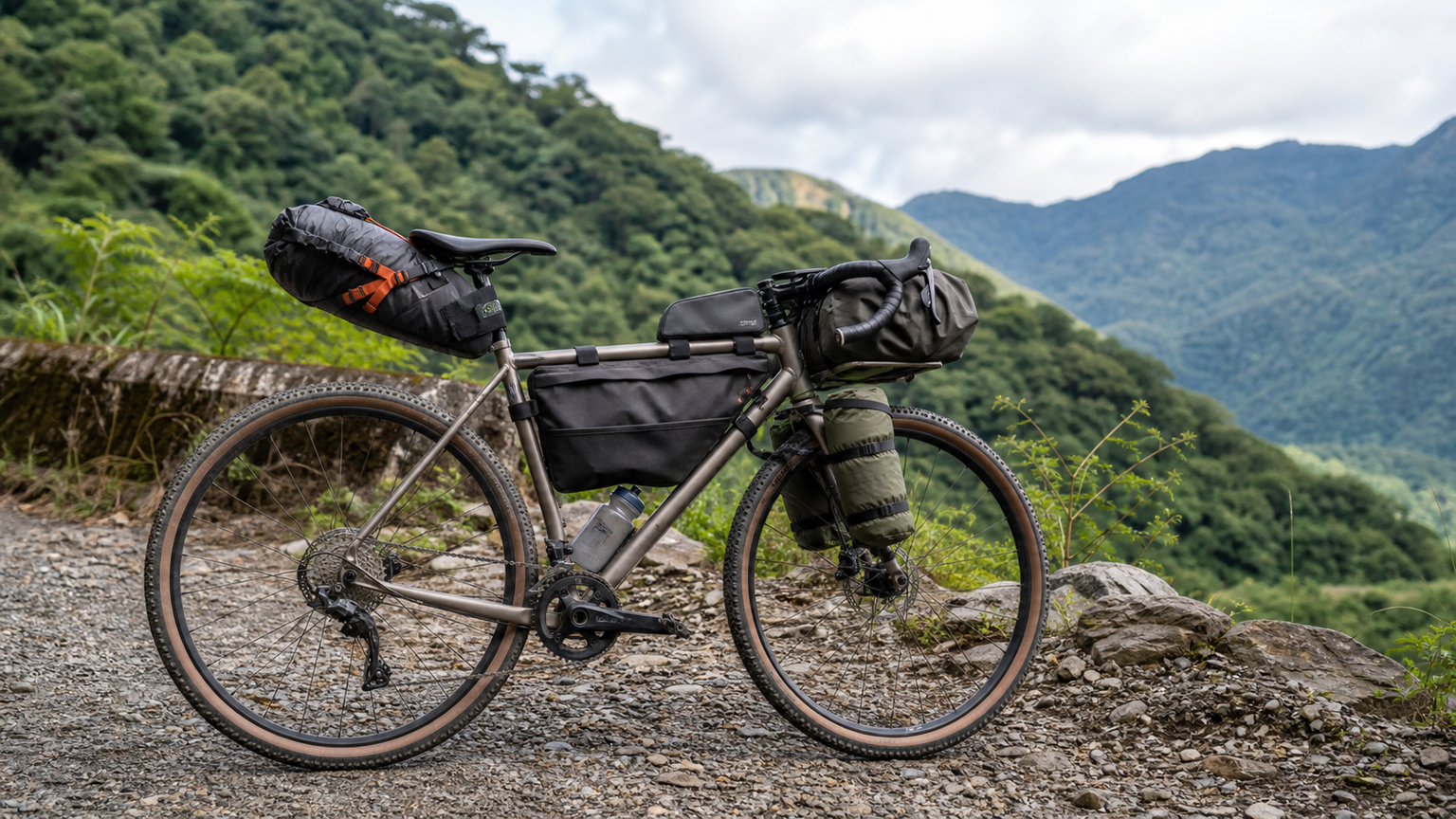
Why Weight Distribution Is So Critical
With the same 10 kg of gear, the difference in handling between a well-distributed bike and a poorly distributed one is like carrying 5 kg versus 15 kg. The reason is that a bicycle’s “pitch inertia” and “roll inertia” directly affect steering response and stability.
The Golden Rules of Center of Gravity Distribution
Bikepacking gear distribution follows three key principles:
- Heavy items centered, close to the BB (bottom bracket): Reduces pitch inertia
- Heavy items low, close to the frame: Lowers the center of gravity
- Left-right symmetry: Avoids uneven rolling
“Weight Limits” for Each Bag Type
| Position | Recommended Weight | Weight Type |
|---|---|---|
| Frame Bag | 3-5 kg | Heaviest (tools, food) |
| Top Tube Bag | 0.5-1 kg | Medium (nutrition) |
| Fork Bag | 1-2 kg per side | Medium (water, clothing) |
| Seat Bag | 1.5-3 kg | Light (sleeping bag, clothing) |
| Handlebar Bag | 1.5-3 kg | Light (tent, sleeping pad) |
Why Heavy Items Go in the Frame Bag
The frame bag sits between the front and rear wheels, close to the BB, making it the ideal location for the bike’s center of gravity. The benefits of placing heavy items here:
- Does not affect front wheel steering response
- Does not increase rear wheel Tail Wag
- Low center of gravity, stable on descents
- Does not affect frame pitch on climbs
What should go in the frame bag: Multi-tool, spare tube and pump, canned food, power bank (a 10000mAh unit weighs about 200g), hydration bladder, first aid kit.
Why Light Items Go in the Seat Bag and Handlebar Bag
The seat bag sits far from the steering axis; placing heavy items there creates two problems:
- Tail Wag: At high speeds on descents or when out of the saddle, the bag swaying side to side affects handling
- Front wheel lift: On climbs, the front end becomes too light and the front wheel tends to lift
The handlebar bag connects directly to the steering axis, so heavy items greatly increase steering inertia, making cornering sluggish.
What should go in the seat bag: Sleeping bag (500-800g), down jacket (300g), spare clothing (500g)
What should go in the handlebar bag: Tent fly (800-1200g), sleeping pad (400-600g), headlamp, camera
The Details of Left-Right Symmetry
If you use fork bags, be sure to mount them on both sides with similar weights. Loading only one side causes steering pull, which is especially dangerous on descents.
Example of a symmetrical setup:
- Left fork bag: 2L water bladder (2 kg)
- Right fork bag: Spare clothing + rain jacket (1.8 kg)
The Special Position for Tool Kits and Spare Tubes
Spare tubes are not kept inside bags; instead, they are strapped to the top tube or seat stays with Voile straps. Reasons:
- Saves bag space
- Quick access in an emergency
- Adds a stiffer feel to the frame (superstitious, but many veterans insist on it)
Real-World Weight Distribution Test
Take a 10 kg road/gravel bike with 10 kg of gear as an example:
Poor setup (heavy front, light rear):
- Handlebar bag 4 kg + seat bag 1 kg + frame bag 5 kg
- Result: Sluggish steering, front wheel wobbles when out of the saddle
Proper setup:
- Handlebar bag 2 kg + seat bag 2 kg + frame bag 5 kg + top tube bag 0.5 kg + fork bags totaling 0.5 kg
- Result: Handling close to an unloaded bike, stable on both climbs and descents
Test Before You Depart
After packing, be sure to ride 20-30 km to test:
- Steep descent (40+ km/h): Observe whether the seat bag sways
- Climbing out of the saddle: Feel whether the front end is too light
- Sharp corners: Test steering response
If you spot a problem, redistribute immediately—it’s far better than discovering it out in the wilderness.
Related Reading
- The Physics of Bikepacking Loads: Weight Distribution, CdA Penalties, and the Trade-offs of Self-Sufficiency
- Bicycle Touring Gear Checklist: The Packing Philosophy for a Week of Bikepacking Luggage
- Round-the-Island Luggage Setup: Weight Distribution Strategies for Front/Rear Rack Bags and Bike Trailers
- Gravel Long-Distance Touring: Bikepacking Strategies for Bag System Selection and Weight Distribution
靠單車減肥35公斤 心得分享與整理
7 年前
#公路車 #Fitting 靠人工智慧APP 幫你調整單車
6 年前
單車 一日北高 ( 雙城 ) 肥宅雙人瘋狂行 紀錄片 REACTO
10 年前
多到選擇障礙... 換個單車把帶想一個小時 / BTP / 編織&軟木特有材質超吸睛! / 公路車 / CT Yeh
1 年前
再一組! 全碳幅條 碟煞/無內胎輪組 開箱! 到底好騎嗎? UNAAS X40 | 公路車 | CT Yeh
4 年前
Nepest NOVA 碳條輪組:輕量、空力、舒適一次滿足!/ 公路車 / CT Yeh
7 個月前
武嶺配速表最佳使用方式 #bike
1 年前
Vision Metron RS 37碳幅條輪組 (非SL)官網沒有的 低調開箱 / 這重量太銷魂了 / 公路車 / CT Yeh
6 個月前