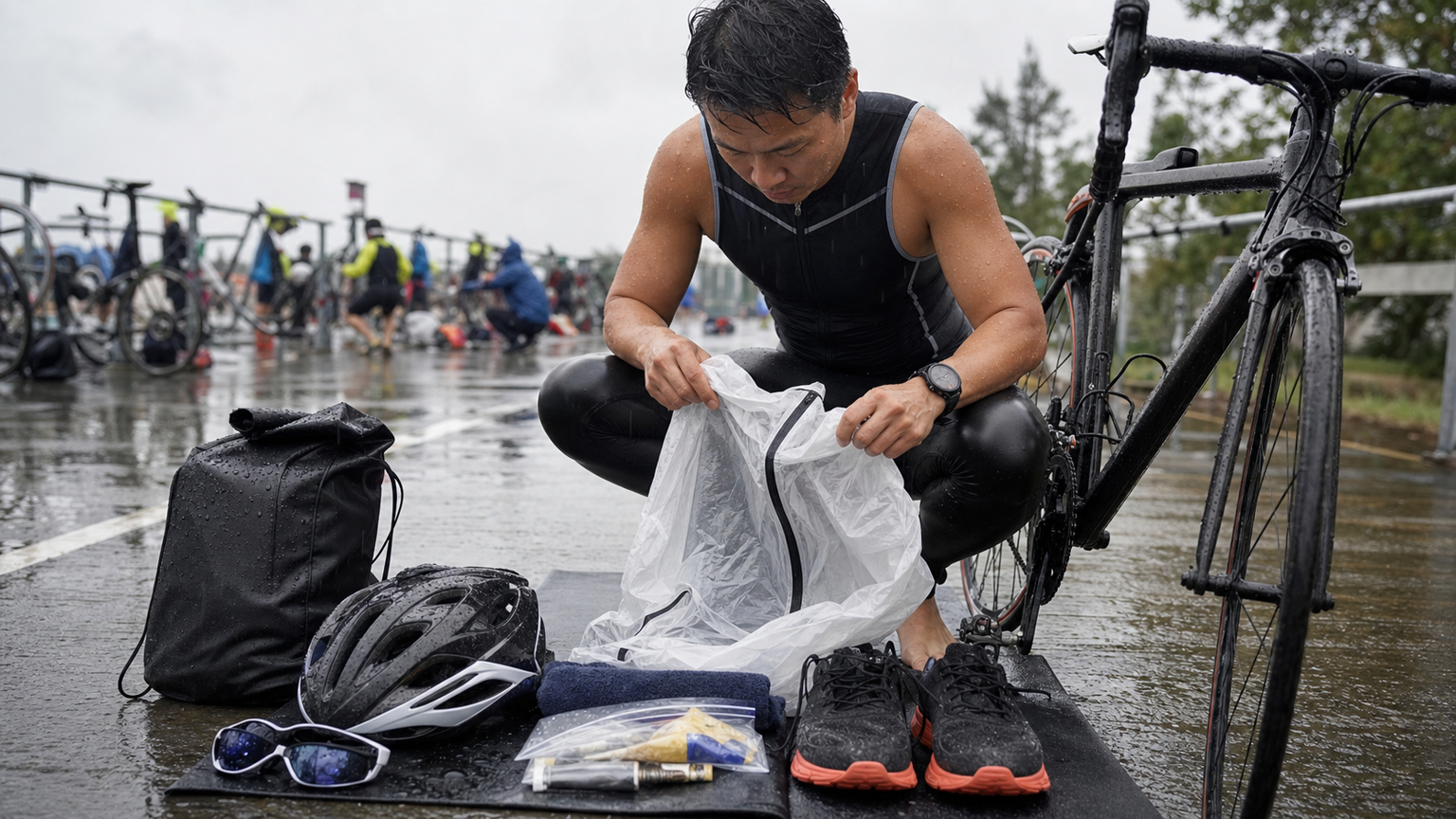
How Rain Affects a Triathlon
Rain affects two of the three disciplines (swimming aside):
- Bike leg: Slippery roads, braking distance increases by 30-50%, impaired visibility, rapid body heat loss
- Run leg: Dramatically higher risk of blisters, body heat loss, running shoes get heavier
- Transition area: All gear gets soaked, timing chip gets drenched, visual identification becomes difficult
The Taiwan race season runs from March to November, with a rain probability exceeding 30%. Rain gear is not “nice to have”—it’s essential.
Rain Gear Categories
1. Rain Jacket
Key specs:
| Spec | Recommended Value |
|---|---|
| Waterproof rating | 10,000mm water column or higher |
| Breathability | 10,000 g/m²/24hr or higher |
| Weight | < 100g (stowable in rear pocket) |
| Packed size | < fist-sized |
Things to look for:
- Extended tail: Lower back stays covered when bent over on the bike
- Cuff elasticity: Prevents rain from entering through the sleeves
- Rear pocket access: Allows grabbing nutrition from outside the jacket
- Stowable hood brim: Premium models have a hood that tucks into the collar
2. When to Wear the Rain Jacket?
Decision tree:
- Temperature < 18°C with rain → Must wear
- Temperature 18-22°C with heavy rain → Recommended
- Temperature > 22°C with light rain → Optional
- Mountain descents (speed > 50 km/h) with rain → Must wear (wind chill effect)
The key factor is the “wind chill effect”: at 40 km/h with 5°C rain, the perceived temperature can drop to just 8-10°C. Hypothermia can end your race outright.
Bike Leg Rain Setup
Tire Selection
Tire strategy for rainy days:
| Option | Pros | Cons |
|---|---|---|
| Racing slick | Low rolling resistance | Poor grip, longer braking distance |
| Semi-slick (fine tread) | Balanced | Slightly more rolling resistance |
| Puncture-resistant | Flat protection | Heavy + high rolling resistance |
For rainy races, go with semi-slicks + reduce tire pressure by 10%: drop from 110 psi to 95-100 psi to increase contact patch and grip.
Braking Adjustments
- Brake earlier: multiply braking distance by 1.5
- Avoid sudden hard braking (risk of losing control and sliding)
- Wipe brake pads clean beforehand (for carbon rim wheelsets) to remove carbon dust
- Slow down in a straight line before corners; do not brake while cornering
Gearing and Cadence
- Spin a higher cadence in the rain (90-100 RPM)—lower torque reduces the chance of wheel slip
- Avoid standing climbs (weight shifts can cause the rear wheel to slide)
- Stay seated on climbs to prevent rear-wheel spin
Run Leg Rain Setup
Running Shoe Selection
Priority order for rainy-day running shoes:
- Drainage: Prioritize shoes with more drainage holes in the outsole
- Traction: Deep tread pattern on the outsole
- Weight: Won’t absorb water and become too heavy when soaked
Avoid:
- Fully mesh uppers (absorb too much water)
- Pure racing carbon-plated shoes (poor grip in wet conditions)
Sock Selection
In heavy rain, always wear socks, even if you normally train sockless. Recommendations:
- Quick-drying drainage socks (Merino wool or synthetic fibers)
- Compromise on thickness (too thin causes blisters, too thick makes feet feel stuffy)
- Apply Vaseline to your feet before the race so rain doesn’t cause chafing
Hat Brim and Eyewear
- Running cap: Lowering the brim keeps rain out of your eyes
- Sunglasses: Vision can actually get blurrier in the rain—optional
- Rain-resistant sunglasses: Premium models feature water-repellent hydrophobic lenses
Transition Area Rain Setup
Waterproofing Your Gear Bag
- Pack all gear in large ziplock bags
- Seal running shoes and socks in separate bags
- Keep nutrition and electronics in independent waterproof cases
Towel Selection
- Absorbent towel: Can soak up 7-10 times its own volume in water
- Lay it under the transition area to keep gear off the wet ground
- Use it after the race to dry off and stay warm
Race Number
In rainy races, traditional paper race numbers fall apart completely. Recommendations:
- Bring your own clear race number pouch (usually provided at race HQ)
- Or DIY: wrap it in a document protector sheet
- Secure it with a Race Belt (safety pins will tear through wet paper)
Body Temperature Management
Hypothermia Warning Signs
Shivering, blue lips, numb fingers, slowed thinking → stop racing immediately and go to the medical tent.
Prevention Measures
- 30 minutes before the start, drink something hot (coffee or hot cocoa)
- Apply a layer of Vaseline over your body before the start (waterproof and insulating)
- Wear thin gloves (especially important for the bike leg)
- Choose a thicker wetsuit (4mm vs 3mm)
In-Race Decision Making
When to Call It Quits?
Stop immediately in these situations:
- Lightning appears near the course
- Body temperature has dropped to the point of uncontrollable shivering
- Visibility is so poor you can’t see athletes 5m ahead
- Standing water is deeper than the pedals (bike leg)
A champion isn’t disqualified for dropping out, but being hospitalized for hypothermia will cost you the entire season.
Pacing Adjustments in the Rain
- Bike leg: Keep the same heart rate zone, but expect pace to slow by 3-5%
- Run leg: Slowing 5-10 sec/km is reasonable
- Don’t take risky cornering lines just to “make up time”
Rain Gear Shopping List
| Gear | Budget |
|---|---|
| Lightweight rain jacket | NT$ 2,500-5,500 |
| Semi-slick anti-slip tires | NT$ 1,800-3,500 |
| Drainage socks ×2 | NT$ 600-1,200 |
| Waterproof gear bag | NT$ 800-1,500 |
| Clear race number pouch | NT$ 200-400 |
| Rain-resistant sunglasses | NT$ 2,500-5,500 |
| Waterproof watch (most sports watches have this) | Usually built-in |
| Large ziplock bags ×5 | NT$ 200 |
Total budget: NT$ 8,500-17,000. A very worthwhile investment for a rainy race season.
When to Check the Weather Before Race Day
- 7 days out: Initial forecast, prepare gear
- 3 days out: Detailed planning, decide whether a thicker wetsuit is needed
- 1 day out: Final decision, inspect all gear
- 2 hours out: Confirm actual conditions, make last-minute adjustments
Rain Training
Most athletes only train in dry conditions and panic when race day brings rain. Recommendations:
- Do at least 2 training sessions in the rain
- Practice cornering and braking in wet conditions
- Run a 10K in the rain to confirm your sock and shoe choices
- Practice changing clothes in the rain (with cold fingers, everything takes twice as long)
Conclusion
Rain gear is an “insurance-type investment”: useless on sunny days, life-saving on rainy ones. Taiwan’s race season averages over 30% rain probability, making this roughly NT$ 10,000 investment an extremely high ROI. More importantly, rainy races tend to eliminate a large portion of the field, so those who are prepared can actually climb the rankings. Next time the forecast calls for rain, don’t sigh—it’s your opportunity.
Related Reading
- Rain Jacket and Rain Pants Packing Guide: A Life-Saving Combo for Cold, Wet Weather
- Rainy Triathlon: Complete Guide to Riding, Running, and Hypothermia Management on Slippery Roads
- The Complete Guide to Riding in the Rain: Gear, Technique, and Safety Tips
- Survival Guide for Riding in the Rain: Gear, Technique, and Mindset
3D 列印車褲墊 / 舒適改善? / 無痕 x 分區壓縮 / ATK & Decider系列 / JE22黑科技 / #公路車 #CTYEH
11 個月前
雨戰! 西進武嶺員工旅遊 加料 各路段大數據分析 | 同事端出5公斤的公路車來挑戰!? EP1
4 年前
單車賞雪 裝備準備及注意事項分享 | 公路車
5 年前
下雨天就是要改車 #ceramicspeed #bike
1 年前
摔車後補裝備: 好市多新款單車安全帽& Specialized Romin 北高整路屁股都不痛的坐墊 | 一千元居然有MIPS | CT Yeh | 公路車
4 年前
洗單車神器 吹水機! 實際洗車用用看 暴力洗鍊條大法 | 公路車 | CT Yeh
4 年前
[防寒衣體驗] 鐵人魂 三鐵 防寒衣試穿會 於松運 深水游泳池 鯨魚池
8 年前
三鉄共購百人風中劍/ feat. 單車小D、Doris 、城希、Ruby、Ada/ 公路車 / CT Yeh
2 年前