Swimmers' Land-Based Explosive Power: A Complete Guide to Resistance Band Stroke Simulation and Shoulder Explosive Power Training
Why Do Swimmers Need Land-Based Explosive Power Training?
Swimming may look like a typical endurance sport, but a deeper look at the biomechanics of the stroke reveals that every pull requires extremely high explosive power output during the “catch → pull” phase. In freestyle, for example, the first 0.1 seconds after the hand enters the water are critical for stroke efficiency—the greater the force and the faster the speed, the higher the propulsion peak.
However, water resistance makes it difficult to train high-intensity explosive power in the pool alone. This is where land-based supplementary training comes in: through band simulations and targeted strength work, swimmers can directly strengthen the neuromuscular system without the interference of water resistance.
Core Muscles for Shoulder Explosive Power
The swimming pull involves the coordinated explosive action of the following muscle groups:
- Latissimus Dorsi: Provides the primary pulling force, contributing roughly 70% of propulsion
- Teres Major: Assists with adduction and internal rotation
- Rotator Cuff: Provides shoulder joint stability, preventing dislocation risk during explosive movements
- Triceps: Explosive elbow extension during the final phase of the pull
- Serratus Anterior: Stabilizes scapular protraction, controlling the angle of hand entry
Important Note: Swimmers’ shoulders are chronically at the end range of motion. Overemphasizing anterior deltoid training while neglecting the posterior muscle groups is a common imbalance issue.
Band Pull Simulation Training
Basic Setup
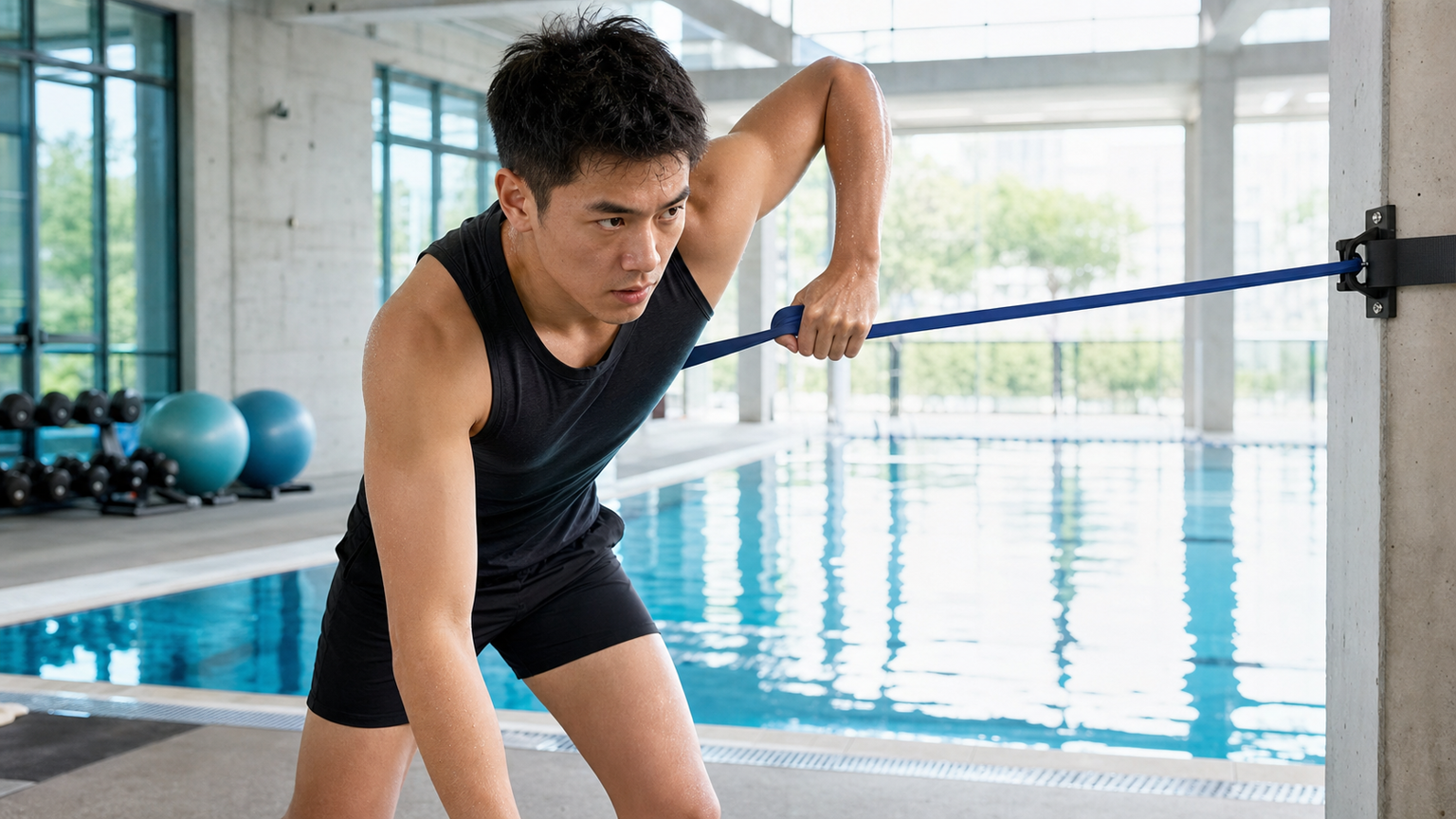
Anchor a resistance band to a wall attachment point at shoulder height or slightly higher. The athlete stands facing the anchor point, simulating the freestyle pull motion.
Exercise 1: Straight-Arm Pulldown
Simulates the full arc from the high-elbow catch to the finish of the freestyle pull:
- Hold the band with both hands, arms extended, pressing down from shoulder height to the hips
- Emphasize “accelerating through the finish”: start with slow, controlled movement, then explode through the final 30% of the range
- 3 sets × 10 reps, with the last 3 reps performed at full explosive speed
Exercise 2: Single-Arm Swim Pull
| Phase | Movement Description | Explosive Focus |
|---|---|---|
| After entry | Thumb pointing down, high elbow catch position | Elbow bent at 90 degrees, quickly establish the catch surface |
| Pull | Elbow fixed, hand accelerates backward | Maximum speed directly beneath the abdomen |
| Finish phase | Hand rotates outward, triceps extend | Explosive finish, generating peak propulsion |
12 reps per side, 3 sets, 60 seconds rest between sets.
Exercise 3: Band Explosive Press
Targets start block explosive power:
- Face away from the anchor point, band secured behind the lower back
- Drive both arms forward explosively, simulating the streamlined entry after the start
- 10 reps × 3 sets, emphasizing speed over resistance
Advanced Land-Based Strength Training
Beyond resistance bands, the following weight training movements translate directly into swimming propulsion:
- Pull-Up: The most transferable training movement for swimming. Use an explosive pull-up with a slow lowering phase (1 second up, 3 seconds down)
- Medicine Ball Chest Pass: Strengthens anterior shoulder explosiveness, simulating arm extension before water entry after the start
- Farmer’s Carry: Builds grip strength and upper back muscular endurance, maintaining force output during long-distance swimming pulls
Common Mistakes and Corrections
Mistake 1: Excessive Band Resistance
The core of explosive power training is speed. Excessive resistance slows the movement, training muscular endurance rather than explosive power. Choose a resistance that allows maximum speed, typically 30–50% of your maximum resistance.
Mistake 2: Neglecting Eccentric Control
The “recovery” phase of the pull simulation is an ideal opportunity to build tendon elasticity. Do not relax quickly; return to the starting position slowly over 2–3 seconds.
Mistake 3: Insufficient Shoulder Warm-Up
The shoulder is a high-risk joint for swimmers. Before every explosive training session, complete: 20 shoulder circles, 15 band external rotations per side, and 10 T-spine rotations per side.
Program Recommendation: 2 Land-Based Explosive Sessions Per Week
Workout A (Pull-Focused):
- Band straight-arm pulldown: 3×10
- Explosive pull-up: 4×5
- Medicine ball chest pass: 3×8
Workout B (Stability and Coordination):
- Single-arm band pull: 3×12/side
- Band external rotation (rotator cuff): 3×15/side
- TRX row: 3×10, with the last 3 reps explosive
Conclusion
The goal of explosive power training for swimmers is not to create “swimming weightlifters,” but to make the initial acceleration of every stroke faster and the propulsion peak higher. The advantage of band simulation lies in its movement pattern precisely matching in-water demands, making it the most transferable land-based training tool. After 8 consistent weeks, you will notice a significant increase in distance per stroke—proof that explosive power and efficiency are improving together.
Related Reading
- Land-Based Supplementary Training for Swimmers: The Complete Guide to Bands, Pull Racks, and Explosive Power
- Land-Based Strength Training for Swimmers: Balancing Shoulder Health and Pulling Propulsion
- Land-Based Strength Training for Swimmers: Which Movements Offer the Most Transfer
- Land-Based Strength Training for Swimmers: An Evidence-Based Program for the Latissimus Dorsi, Core Anti-Rotation, and Shoulder Health
一起升級!海鷗盃LSD團練...JJSC Zone2招待 騎到手抖 / 公路車 / CT Yeh
2 天前
戰略) Zwift Race 如何咬在第一集團 如何評估自己要開多少推力 (請開1.5倍速看)
7 年前
西進武嶺 免費訓練分析服務 Intervals | 練不夠還是練過頭?你哪一種類型選手?AI模型告訴你! | 備戰神器 | 公路車 訓練 | CT Yeh
4 年前
[教學] Premiere 影片 手震 修正 教學 防抖 單眼 影像 GoPro 穩定 Video Stabilization
8 年前
抖肩舞 台灣x日本交流版 (台灣 vs 前橋) 赤城山登山賽 coincidance
8 年前
CT 喇低賽) 武嶺牽車 才是王道 西進牽車四小時內秘訣 攝手位置 如何判斷 防抽筋小秘訣
7 年前
西進武嶺 8000名單車友數據分析 PART1 | 從新手到高手數量/瓦數/推力比/FTP推力比/功率計使用率 大解析 | 公路車 | CTYeh
5 年前
西進武嶺 自製新版AI配速表產生器 x 賽前攻略 抱佛腳! 沒有功率計也可以產生配速表嗎?有什麼其他眉角賽前要注意的呢? | 西進武嶺 / 東進武嶺 KOM 攻略 | 公路車 | CT Yeh
4 年前