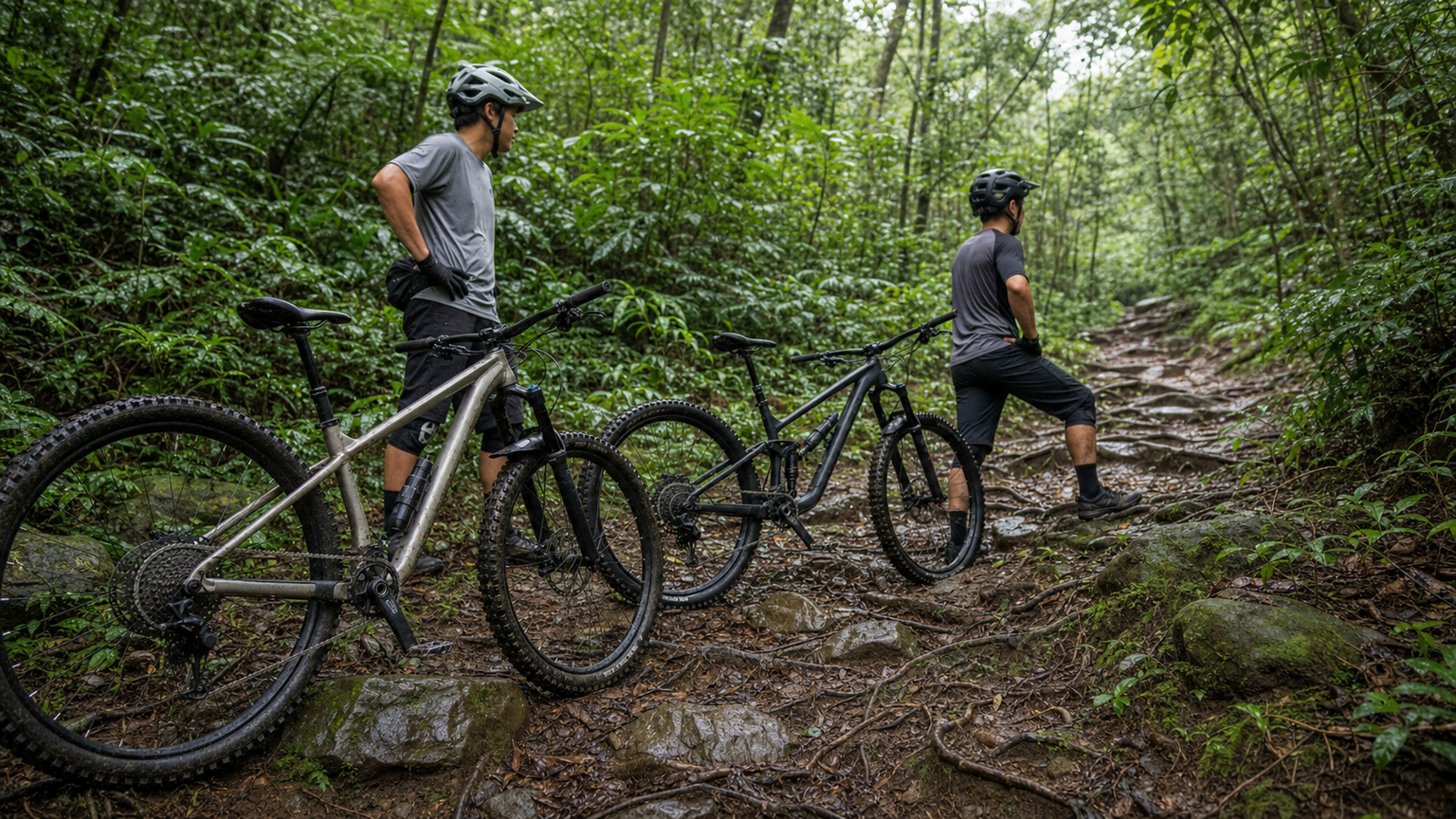
MTB Hardtail vs Full Suspension: The Logic of Choosing a Bike for Taiwan’s Mountain Trails
Taiwan’s mountain trails feature a unique combination of terrain: muddy trails after summer downpours, primitive forest paths strewn with rocks and tree roots, sudden steep descents with sharp turns, and mossy surfaces that stay slippery year-round. Facing these terrain challenges, choosing an MTB that “fits Taiwan” is far more important than choosing an “expensive” MTB.
The debate between hardtail and full suspension (FS) has never ceased in the MTB community, but the answer isn’t really an either-or proposition—it depends on where you ride, how you ride, and what your riding goals are.
Core Differences Between the Two Bike Types
| Comparison Item | Hardtail MTB | Full Suspension MTB |
|---|---|---|
| Rear suspension travel | None | 100–170mm (depending on use) |
| Complete bike weight | 9–12kg | 11–15kg |
| Climbing efficiency | Higher (direct power transfer) | Moderate (suspension absorbs some pedaling energy) |
| Technical terrain capability | Limited | Excellent |
| Maintenance complexity | Low | High |
| Entry-level price | Lower | Higher |
Advantages of the Hardtail: Where It Shines on Taiwan’s Trails
The hardtail’s biggest advantage is pedaling efficiency. Since the rear wheel is directly fixed to the frame, every watt of pedaling force is fully transferred to the ground. This is especially useful on the following Taiwan trails:
- Long forest-road climbs: Such as Chatienshan and the Hehuan Mountain East Peak industrial road, where continuous climbs exceed 500 meters—the hardtail’s efficiency advantage accumulates significantly over these long ascents
- Slab-stone sections: Some ancient trail surfaces in Yilan feature stone paving; although uneven, the pattern is regular, and the hardtail’s direct feedback allows for more precise line reading
- Technical training settings: Many top MTB coaches recommend beginners start on a hardtail because it doesn’t mask technical errors, forcing you to learn proper body technique
Another advantage of the hardtail is simple maintenance. Taiwan’s mountain trails are often hours away from towns; if the rear shock on a full suspension bike fails, the entire trip can be affected. A hardtail rarely has such concerns.
Advantages of Full Suspension: Where Taiwan’s Trails Demand It
There are several types of trails in Taiwan where the full suspension’s advantage is overwhelming:
- The Bunun ancient trail series: Multiple ancient trails around Xinyi, Nantou feature surfaces covered with large rocks and tree roots; full suspension lets you ride these sections 15–25% faster than on a hardtail
- Around Taipingshan Cuifeng Lake: Some sections have consecutive drop-offs over 30cm with root-strewn surfaces; the full suspension’s ability to keep the rear wheel glued to the ground is clearly superior to a hardtail
- Summer muddy sections: When tires slip slightly, a full suspension’s rear wheel can continuously track the ground, unlike a hardtail which may suddenly bounce and lose control in mud
- Downhill zones (such as Shiding D-Trail type sections): Man-made technical trails designed for full suspension; riding these on a hardtail requires much more effort and offers a lower safety margin
Taiwan’s Special Consideration: The Slippery Rock-and-Moss Combination
Taiwan’s mountain trails have one special factor rarely mentioned in foreign tutorials: year-round high-humidity rock moss. This is especially severe in northeastern Taiwan (Yilan and Taipei mountain areas), where moss on rock surfaces reduces the coefficient of friction by 30–40% compared to normal rock.
Under these conditions, the full suspension’s rear-wheel traction advantage becomes even more pronounced. The risk of losing control on mossy rock surfaces is significantly higher on a hardtail than on a full suspension. When riding a hardtail on such trails, it’s recommended to lower tire pressure by 5–8 psi below normal to increase contact area.
Choosing a Bike Based on Riding Purpose
Choose a hardtail if you are:
- New to MTB, with a budget of NT$30,000–60,000
- Primarily focused on climbing-oriented routes, with descents accounting for no more than 20% of the ride
- Looking to build fundamental technical skills through training
- Planning to participate in XC (cross-country) or Marathon long-distance races
Choose full suspension if you are:
- Finding your main riding enjoyment in technical sections and descents
- Have a budget above NT$80,000 and are willing to invest in maintenance costs
- Weigh over 90kg (a hardtail’s comfort noticeably decreases for heavier riders on technical terrain)
- The humid trails of Yilan or Taipei’s mountain areas are your primary riding grounds
The Middle Option: The Rise of the 29er Hardtail
In recent years, an increasingly popular choice in Taiwan’s MTB community is the 29-inch wheel hardtail. The large wheel’s ability to roll over obstacles (the so-called “29er effect”) is highly practical on Taiwan’s root-strewn trails, compensating for some of the hardtail’s lack of rear-wheel ground tracking while retaining the hardtail’s weight and efficiency advantages.
Conclusion
No single bike suits every mountain trail in Taiwan, but most Taiwanese riders will own both bike types at some point in their MTB career. If you can only choose one, it’s recommended to start with a hardtail: it forces you to learn real technique rather than relying on mechanical systems to mask mistakes. Once your skills mature, a full suspension’s performance can truly shine, rather than being wasted on compensating for the rider’s technical gaps.
Related Reading
- Mountain Bike (MTB) Beginner’s Guide: Hardtail vs Full Suspension—Which Suits You
- MTB Off-Road Beginner’s Guide: Choosing a Bike, Safety Gear, and Your First Trail
- Taiwan Mountain Bike (MTB) Beginner’s Guide: A Complete Transition Guide from Road to Off-Road
- Mountain Bike Climbing Technique: Traction and Weight Distribution for MTB Climbs
多到選擇障礙... 換個單車把帶想一個小時 / BTP / 編織&軟木特有材質超吸睛! / 公路車 / CT Yeh
1 年前
公路車 BB培林大升級! / 備戰海鷗繞圈賽 Canyon Aerod & TIME 一起改 / MIT大廠 CEMA對鎖式陶瓷培林BB & 導輪 / 公路車 / CT Yeh
2 年前
再一組! 全碳幅條 碟煞/無內胎輪組 開箱! 到底好騎嗎? UNAAS X40 | 公路車 | CT Yeh
4 年前
單車 梅山36灣 坡度介紹 路段介紹 空拍 (相關遊記影片,請參考說明或我的頻道喔,歡迎訂閱)
6 年前
大武山後門26%歡樂陡坡!JJSC南台灣單車行Day2 / 被颱風追著跑 / 公路車 / CT Yeh
2 年前
台北闊瀨陡坡 騎旅 / 日本單車雜誌編輯車友臨時加入!/ 髮香才是最強的 / feat. 北迴歸線小隊 / 公路車 CT Yeh
6 個月前
車友來我家測FTP...好硬啊🤣 #cycling #公路車
2 年前
碟煞公路車 優缺點?換車一年半實際經驗分享 / 公路車 / CT Yeh
2 年前