Gravel Climbing Strategy: Gear Ratio Selection and Cadence Stability Techniques on Gravel Surfaces
文章導覽
- Gravel Climbing Strategy: Gear Selection and Cadence Stability on Gravel Surfaces
- The Physical Impact of Gravel Surfaces on Climbing
- Gear Selection: The Core Strategy for Gravel Climbing
- Cadence Stability Techniques: Four Key Points
- When and How to Climb Out of the Saddle
- Breathing Rhythm and Pacing Strategy
- Conclusion
- Related Reading
Gravel Climbing Strategy: Gear Selection and Cadence Stability on Gravel Surfaces
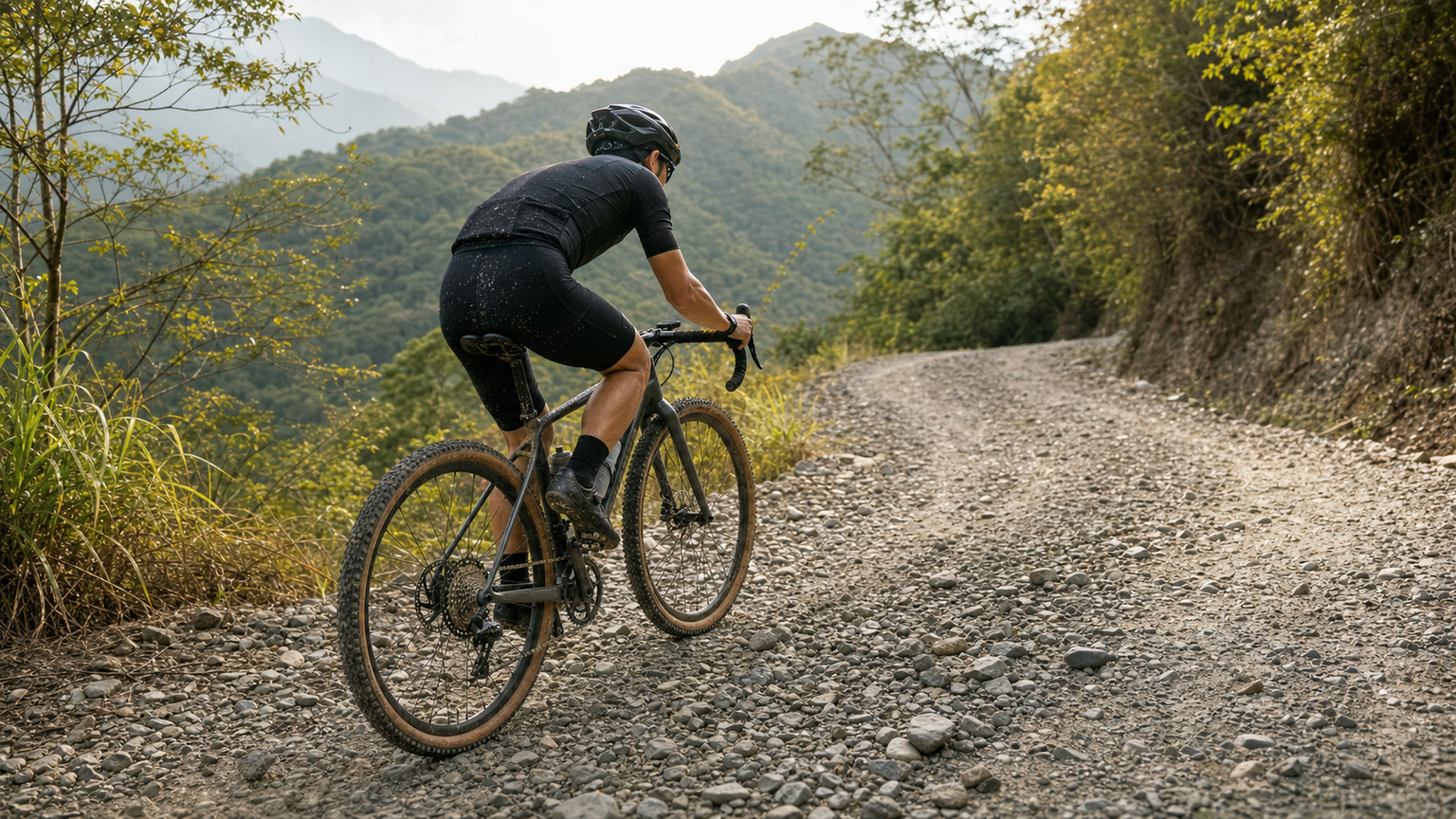
Most gravel routes in Taiwan include significant climbing sections, especially forest roads and mountain industrial roads, which often require sustained climbing over loose surfaces for several hundred meters. The difficulty of gravel climbing lies not only in physical exertion but also in technical complexity: rolling resistance is 20–35% higher than on asphalt, tire traction is unstable, and the rear wheel tends to slip during pedaling. These factors combined make gravel climbing the aspect of gravel riding that requires the most systematic preparation.
The Physical Impact of Gravel Surfaces on Climbing
Only by understanding the nature of the problem can you find the right solution.
Increased Rolling Resistance: Rolling resistance (RR) on gravel surfaces is approximately 1.5–2.5 times that of asphalt, depending on the size and looseness of the gravel. This means that at the same speed, you need to output significantly more power.
Unstable Traction: The rear wheel needs to convert torque into forward propulsion during pedaling, but gravel shifts under the pressure of the rear wheel, causing traction to disappear momentarily and resulting in rear-wheel slip. This is the biggest technical challenge in gravel climbing.
Vibration Affects Pedaling: Continuous surface vibration makes it difficult to maintain a steady pedaling rhythm, as every time the tire hits a loose stone, it slightly interrupts the cadence.
Gear Selection: The Core Strategy for Gravel Climbing
Choosing the right gear ratio is the first step in gravel climbing and the most underestimated technique.
Basic Principle: Use a Lighter Gear Than You Think You Need
The first mistake most riders with a road background make on gravel is using the same climbing gear ratios as on the road. The increased resistance on gravel means you need a lighter gear than you would use for road climbing to maintain the same cadence.
| Gradient | Recommended Gear on Asphalt | Recommended Gear on Gravel |
|---|---|---|
| 5% | 50/28 or equivalent | 50/32 or equivalent |
| 8% | 50/32 | 46/36 or the lightest gear on a 1× system |
| 12% | 46/34 | 40/36 or the lightest gear on a 1× system |
| 15%+ | Lightest gear | Lightest gear + possibly pushing the bike |
Modern 1× Drivetrains on Gravel Bikes
In recent years, more and more gravel bikes use 1× drivetrains (a single front chainring paired with a wide-range rear cassette, such as 40T × 10–44T or 10–51T). The climbing gears on these systems are usually more than adequate, but note that the gear steps are larger, and sudden changes in pedaling force can trigger rear-wheel slip on gravel.
Gravel climbing technique for 1× systems: when shifting to a lighter gear, simultaneously reduce pedaling force slightly to avoid a sudden torque spike at the moment of shifting, which could cause the rear wheel to slip.
Cadence Stability Techniques: Four Key Points
The cadence target for gravel climbing is 75–85 rpm (slightly lower than the 80–90 rpm used for road climbing), because a lower cadence allows you to apply more stable force with each pedal stroke, reducing the likelihood of rear-wheel slip.
Point One: Shift Down Preemptively
Shift to a lighter gear before entering a steep or loose section, rather than shifting while pedaling hard. Shifting under heavy load has two problems: shifting while the chain is under tension damages the derailleur, and the torque change at the moment of shifting can easily cause slipping on gravel. The principle for judging when to shift: shift down before your cadence drops to 70 rpm.
Point Two: Smooth Pedaling
Road climbing allows you to apply explosive force at the top of the pedal stroke (the 12 o’clock position); gravel climbing requires a smoother, more even pedaling motion. Imagine the pedal circle as a complete circular motion: push forward and down (toward the 3 o’clock position), kick back (toward the 6–8 o’clock position), and pull up (toward the 9–12 o’clock position), distributing force more evenly throughout the entire pedal cycle rather than concentrating it at the moment of the downstroke.
Point Three: Shift Your Center of Gravity Forward
On gravel climbs, you need to keep your center of gravity more toward the middle-front of the saddle than on road climbs, so that the rear wheel receives sufficient downward pressure. If you feel the rear wheel starting to slip, try leaning your body forward, even bringing your chest toward the front wheel—rear-wheel traction will usually improve immediately.
Point Four: Handling Asymmetric Surfaces
Gravel surfaces are often uneven, and one side may be firmer ground. When climbing, actively seek out the firmest, highest-traction part of the surface rather than staying in the center of the lane. Even if it means taking a slightly longer line, climbing efficiency on firmer ground is often higher.
When and How to Climb Out of the Saddle
Standing climbs on gravel are more challenging than on the road because the shift in center of gravity when standing up can more easily trigger rear-wheel slip.
Recommended times to stand:
- When the gradient suddenly steepens (briefly exceeding 15%)
- When you need to get over large obstacles on the surface
- When fatigue sets in and you need to change your pedaling pattern
Standing technique on gravel:
Before standing up, shift to a gear one step heavier than what you were using seated, because standing allows you to output more torque. At the same moment you stand, lean your body slightly forward (not backward) to maintain downward pressure on the rear wheel. When standing, pedal at a slower, smoother rhythm than when seated, avoiding repeated hard pedal strokes that could cause the rear wheel to slip.
Breathing Rhythm and Pacing Strategy
A common mistake in gravel climbing is relying too heavily on road climbing pace as a reference. Because gravel has higher resistance, judging the difficulty of a gravel climb by road speeds will seriously underestimate the actual effort required.
Recommended pacing strategy for gravel climbs:
- Start at 75–80% of your maximum aerobic power rather than pushing to your lactate threshold
- Judge intensity by breathing rhythm rather than speed: an intensity at which you can speak short sentences clearly but cannot hold a full conversation is the ideal range
- Every 20–30 minutes, reassess your remaining energy and adjust your pace accordingly
Conclusion
Gravel climbing is the moment in gravel riding that best reveals technical maturity. Skilled riders often look more relaxed on gravel climbs because their gear selection, cadence control, and center-of-gravity management reduce unnecessary energy expenditure. The time invested in gravel climbing technique will pay off clearly in the second half of every long gravel ride.
Related Reading
- Gravel Riding Technique: Center of Gravity Control and Tire Pressure Settings on Loose Surfaces
- Gravel Riding Technique Guide: Practical Tips for Climbing and Descending on Crushed Stone Roads
- Gravel Bike Basics: Riding Differences and Technical Adjustments Between Gravel and Road Bikes
- Gravel Bike Complete Analysis: Bike Positioning, Geometry, and Tire Width Logic, and Trade-offs with Road Bikes/Mountain Bikes