Solid Food Choices for Ultramarathons: Gastrointestinal Tolerance Training with Bananas, Salty Crackers, and Rice
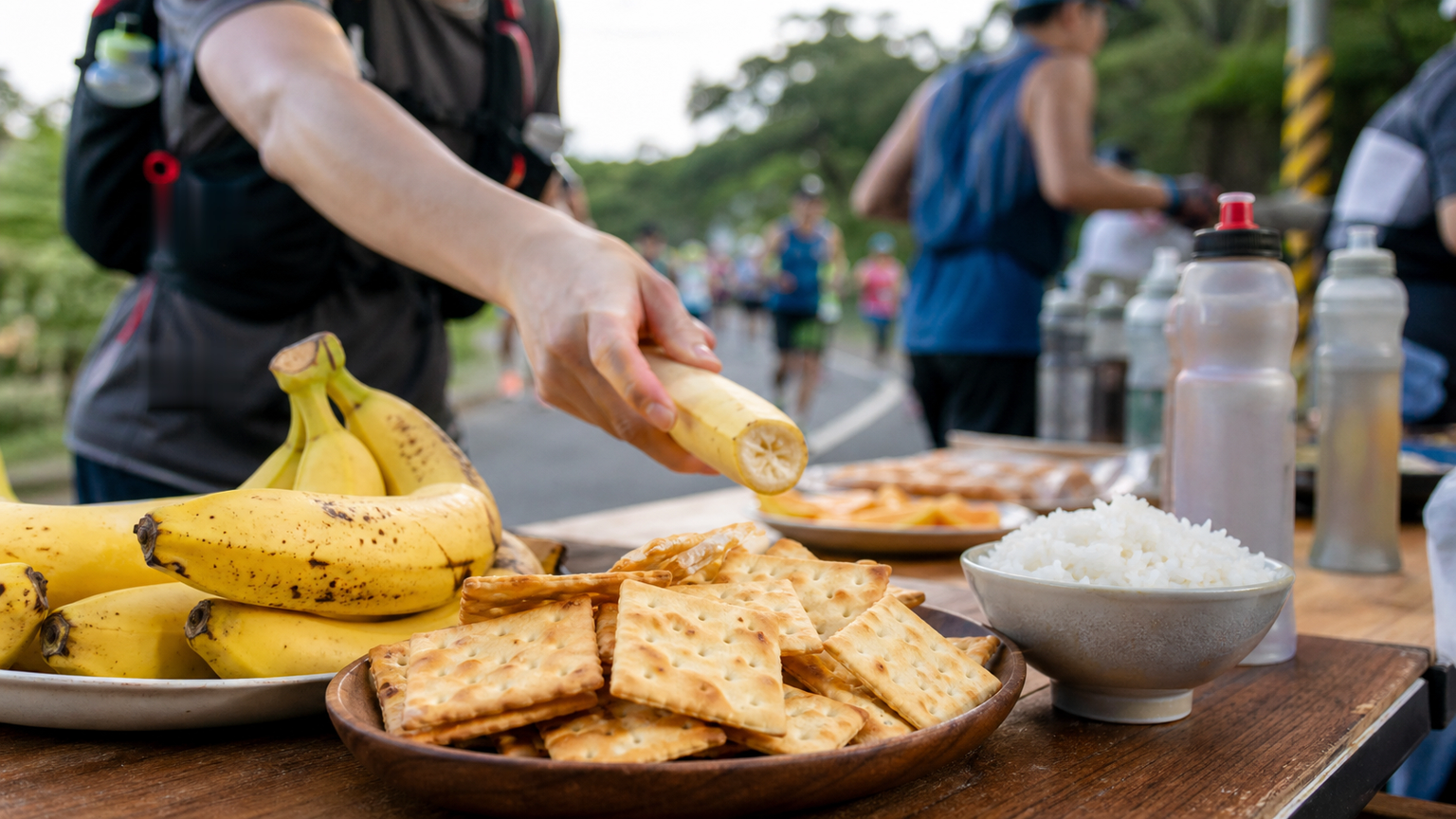
Solid Food Choices for Ultramarathons: Gut Tolerance Training with Bananas, Salty Crackers, and Rice
Introduction
At aid stations in Taiwanese ultramarathon events, you will almost certainly see these three staples: bananas, salty crackers, and plain white rice. Their presence is no accident—over years of practical experience, these three foods have proven to be solid fueling options with high gut tolerance, stable energy supply, and ease of consumption. However, many runners only know “they can eat these,” without understanding how to integrate them into a systematic training plan or how to choose the most suitable food during different stages of a race.
1. Comparing the Characteristics of the Three Solid Foods
| Food | Carbs (per serving) | Primary Energy Source | Tolerance Difficulty | Recommended Timing |
|---|---|---|---|---|
| Banana (half) | ~13g | Fructose + Glucose | Low | Suitable throughout, especially early stages |
| Salted Soda Crackers (5 pieces) | ~20g | Starch (refined) | Low–Medium | Mid-to-late stages for sodium and carb replenishment |
| Plain White Rice (half bowl) | ~28g | Starch | Medium | During aid station breaks, after 70km |
2. Bananas: The All-Rounder of Ultramarathon Fueling
Why Are Bananas the Best Starting Point?
The advantages of bananas are:
- Low Osmolality: Does not cause excessive fluid shifts in the intestines
- Natural Packaging: Easy to carry, won’t make a mess
- Mixed Sugar Types: Contains both glucose and fructose, supporting dual-channel absorption
- Rich in Potassium: One banana contains about 350–400mg of potassium, aiding electrolyte balance
Gut Tolerance Training Steps
- Stage 1: During a 45-minute easy run, eat half a banana and observe for 30 minutes
- Stage 2: During a tempo run, eat half a banana every 40 minutes
- Stage 3: During a long run at marathon pace, eat one banana per hour for the first 3 hours
Important Notes
- Ripeness matters: Fully ripe bananas (with dark spots) are easier to digest; unripe bananas are high in resistant starch
- When the gut becomes sensitive in the later stages of a race, switch to peeled, mashed banana (available at some aid stations)
3. Salty Crackers: The Dual Function of Sodium and Carb Replenishment
The Role of Salted Soda Crackers in Ultramarathons
The core advantage of salty crackers (especially the soda crackers common in Taiwan) is their sodium content. Every 5 soda crackers contain about 200–300mg of sodium, which is crucial for replenishing sodium ions after prolonged sweating, while also providing refined starch for quick energy.
Gut Tolerance Challenges and Solutions
- Dry Texture: Crackers absorb water and must be consumed with fluids; it is recommended to drink 150mL of water with every 5 crackers
- Chewing Time: Chewing dry food while running requires slowing down, making it suitable for eating during steep uphill walking sections
- Amplified Thirst: High-sodium foods increase thirst, which is a good mechanism for triggering hydration
Training Suggestions
Practice eating salty crackers (with water) during uphill walking sections, which is also the most natural time to eat them during a race. Practice this fueling action at least 2–3 times per training session to let your body become familiar with it.
4. Plain White Rice: The Heavyweight Fuel for the Latter Stages of an Ultramarathon
Why Is Rice So Popular in Ultramarathons?
Plain white rice is the most distinctive food at Taiwanese ultramarathon aid stations and a source of comfort for many runners after the 70km mark. The advantages of rice:
- Low Fiber: Refined white rice contains almost no fiber, placing minimal burden on the gut
- High Starch Density: Half a bowl of white rice provides about 28g of carbs, a reasonable energy density
- Warm Version is Better: Warm white rice empties from the stomach slightly slower than cold rice, providing sustained energy
- Psychological Satisfaction: Taiwanese runners’ familiarity with rice helps stabilize their mood
Gut Tolerance Training Steps
- First, eat rice and then run in a static state to confirm there is no discomfort
- Try eating rice during the last hour of a long run lasting over 3 hours (in a fatigued running state)
- Gradually test at higher intensities
Practical Tips
- At race aid stations, it is recommended to shape the white rice into small rice balls for quick and easy consumption
- Adding a small amount of salt (or pickled plum, pickled vegetables) can simultaneously replenish sodium ions
- Avoid mixing in too much fat (like minced pork rice), as fat significantly slows gastric emptying
5. Combination Strategy for the Three Foods
- Early Race Stage (0–40km): Primarily bananas + sports drinks, with solid food making up 30% of fueling
- Mid-Race Stage (40–70km): Alternate between bananas + salty crackers, paired with electrolyte drinks
- Late Race Stage (70km+): White rice + a small amount of banana, increasing the proportion of fluids
Conclusion
Bananas, salty crackers, and rice are not just food at aid stations; they are “fueling tools” that require repeated practice in training. From today onward, incorporate them into your long runs and systematically test the tolerance of each food at different intensities. You will then have the most reliable solid-fuel weapons on race day.
Related Topic Reading
- Ultramarathon Fueling Strategy: Energy and Electrolyte Rhythm from 50K to 100K
- Ultramarathon Fueling Strategy: The Ratio of Solid Food to Liquid Fueling in a 100km Race
- Ultramarathon Gut Training: How to Train Your Gut to Accept Solid Food During Training
- Food Selection Strategies at Road Race Aid Stations: Making Energy Gels Not the Only Option
CT暗黑廚房) 車友必備 宇宙無敵鮮蚵湯 幫助訓練恢復 天然食補 好市多 超肥鮮蚵 破PR
7 年前
一日北高/長距離團騎 常見問題補充篇 / 組團或跟團的眉角 / 壯車友容易被瘦車友慢性拉爆 / 原來屁股痛可能是這個原因...? / 風場配速法 / 公路車 / CT Yeh
2 年前
CT 喇低賽) 武嶺牽車 才是王道 西進牽車四小時內秘訣 攝手位置 如何判斷 防抽筋小秘訣
7 年前
一日北高前的高裝檢 | 北高 360 | 挑戰11小時的裝備 | 一日雙塔 | 補給
6 年前
Never Stop 西進武嶺 前後雙機 完整全程錄影 訓練台 實境
8 年前
馬祖北竿單車體驗遊 | 被歐兜賣集體80差點摧不動 | 兩台公路車上飛機超重費...? 4K高畫質
5 年前
2021 96聯賽 桃園市長盃 4K多視角實況 當天選手瓦數/推力比/均速/時間 即時數據分析 | 公路車 | CT Yeh
5 年前
單車 一日北高 ( 雙城 ) 肥宅雙人瘋狂行 紀錄片 REACTO
10 年前